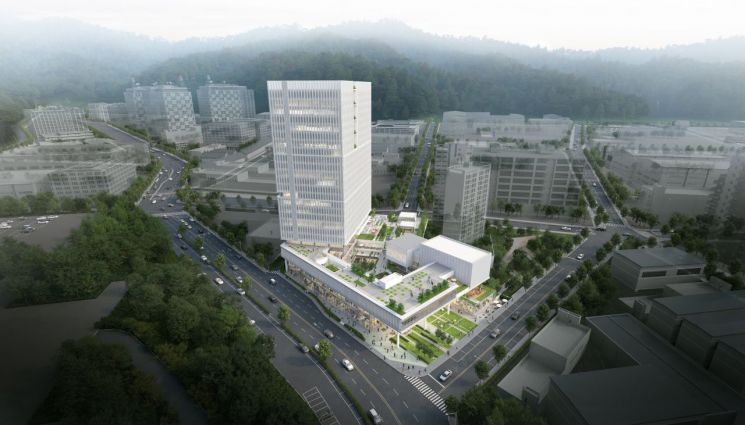
The 'Comprehensive Workers' Welfare Center' in Sangdaewon-dong, Seongnam-si, Gyeonggi-do, a underdeveloped area, will be completed in June.
On the 21st, Gyeonggi-do announced that the Comprehensive Workers' Welfare Center in Sangdaewon-dong, Seongnam, which was promoted for urban revitalization by introducing new functions to declining cities due to population decline, industrial structure changes, and aging residential environments, and by strengthening residents' capabilities through the utilization of local resources, will be completed in June.
The urban regeneration project in Sangdaewon-dong, Seongnam was selected in 2019 as a project by the Ministry of Land, Infrastructure and Transport. The project is being carried out according to the urban regeneration recognition project plan by relocating the existing aging Seongnam Workers' Comprehensive Welfare Center to the knowledge industry center being promoted within the Seongnam General Industrial Complex.
The newly completed Comprehensive Workers' Welfare Center will be located on two floors within the knowledge industry center at 252-1 Sangdaewon-dong, Seongnam-si, with a total floor area of 4,600㎡. Occupancy will begin in July.
Gyeonggi-do expects that once the Comprehensive Workers' Welfare Center is established, it will provide industrial support facilities such as spaces for start-up and employment courses and a grievance handling center for workers, as well as convenience facilities for daily life such as spaces for sports and cultural classes, thereby improving working conditions and contributing to the enhancement of the quality of life for local residents.
Kim Tae-su, Director of the Urban Regeneration Division of Gyeonggi-do, said, "We are promoting the regeneration project considering the local situation of the Seongnam General Industrial Complex, which was established in the 1970s," and added, "We ask for the active participation of tenant companies, workers, and local residents."
Meanwhile, Gyeonggi-do has achieved the result of having the highest number nationwide with 66 sites selected in government urban regeneration contest projects by cooperating with cities, counties, and urban regeneration support centers to revitalize declining old downtown areas within the province, and is promoting urban regeneration projects at 79 sites including 13 Gyeonggi-do type urban regeneration projects.
© The Asia Business Daily(www.asiae.co.kr). All rights reserved.

















