The proportion of wafers in the front-end process is about 40%
Samsung Electronics, SK Hynix, and US-based Micron, the three major memory semiconductor companies, are expected to use 35% of the wafers投入 in advanced processes this year for high-bandwidth memory (HBM) production.
On the 20th, Taiwanese market research firm TrendForce stated, "The three major DRAM companies are increasing wafer投入 for advanced processes."
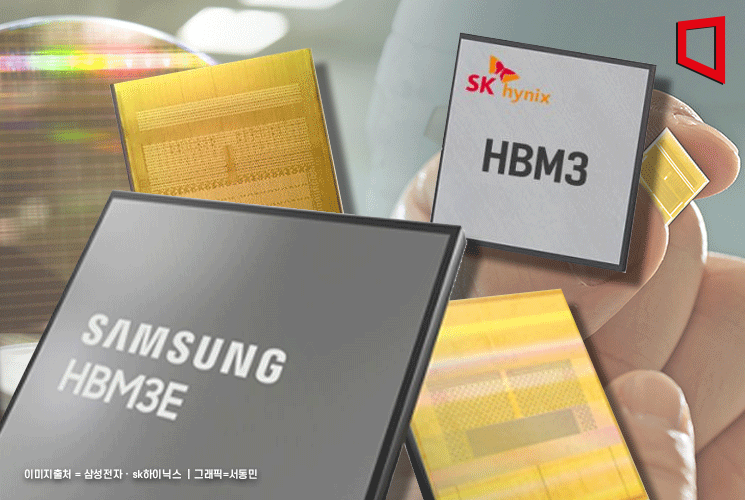
TrendForce explained that memory companies are increasing capital expenditures to expand capacity (CAPA) in the second half of the year. They also forecast that wafers used in 10-nanometer class 4th generation (1a) nanometer (nm; 1 nm is one billionth of a meter) or more advanced processes will account for 40% of the total DRAM wafer投入 by the end of the year.
It is expected that 35% of the wafers used in advanced processes will be for HBM production. TrendForce explained that since HBM has a yield (the proportion of good products among finished products) of 50-60% and requires 60% more wafer area compared to general DRAM, the memory industry’s wafer投入 is inevitably increasing.
The company also predicted, "The remaining wafer capacity will be allocated to low-power double data rate (LPDDR) 5X and double data rate (DDR) 5 products."
This year, the mainstream HBM product is expected to be the 5th generation HBM (HBM3E), with shipments concentrated in the second half. TrendForce said, "SK Hynix, along with Micron, is supplying NVIDIA with HBM3E using the 1b process," and "Samsung Electronics, using the 1a process, completed certification in the second quarter and is expected to start deliveries from mid-year."
TrendForce explained that the demand for advanced process capacity is increasing every quarter due to the growing content capacity of PCs, servers, and smartphones. In particular, servers, especially AI servers, "show the highest capacity increase."
With the arrival of the memory peak season, demand for DRAM such as DDR5 and LPDDR5·5X is also expected to increase. For DDR5 DRAM, used alongside Intel Sapphire Rapids and AMD Genoa, market penetration could exceed 50% by the end of the year.
However, TrendForce explained that as the proportion of wafers投入 for HBM increases, production of general products based on advanced processes may be limited. The company pointed out, "With HBM4 development imminent, if significant investment is not made to expand capacity, prioritizing HBM could lead to capacity constraints causing DRAM supply shortages."
© The Asia Business Daily(www.asiae.co.kr). All rights reserved.

















