777 Violent Crimes in the Past 5 Years
Legal Amendments Not Applied Retroactively, Creating a 'Loophole'
"Government Needs Active Promotion"
"You just need to go down one floor. Take some tissue with you."
Around 2 p.m. on the 20th, near Exit 10 of Gangnam Station in Seocho-gu, Seoul, inside a building. When asking a store clerk about the restroom, this was the reply. Following the stairs down, an old restroom marked with "Namja" (Men) and "Yeoja" (Women) written in black pen caught the eye.
The stalls were separated, but since the entrance to the restroom was shared, male and female users could encounter each other coming and going. The partition blocking the restroom entrance was just a shabby curtain. From the opposite side, the interior was clearly visible at a glance.
Upon entering and inspecting the restroom interior, the condition was equally inadequate. There was no emergency bell installed for urgent situations, nor was there a safety screen to prevent illegal camera filming.
This place is only about 10 minutes away from the site of the so-called "Gangnam Station Murder Case" in May 2016, where a man killed a 20-something woman he did not know in a unisex restroom.
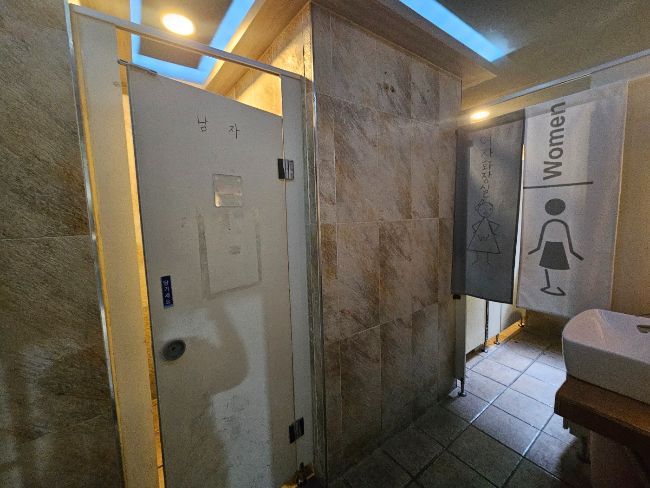 A public restroom in a building near Seocho-gu, Seoul. The stalls face each other, so male and female users often encounter each other when entering and exiting.
 [Photo by Lee Ji-eun]
Public Restrooms as Hotbeds of Sexual Crimes... An Average of 141 Cases Annually
As a result of inspecting public restrooms in 15 buildings near Exit 10 of Gangnam Station in Seocho-gu, Seoul, close to the site of the Gangnam Station murder case 8 years ago in May 2016, most were found not to comply with safety equipment regulations stipulated by current law. There were 3 places with "unisex restrooms" where men and women shared the same stall, and 2 places where men’s and women’s stalls were separate but faced each other sharing the entrance.
Safety equipment such as emergency bells and CCTV was also insufficient. Only 3 places had emergency bells installed, and 2 had CCTV, far less than half of the total. Public restrooms in major entertainment districts remain blind spots for crime.
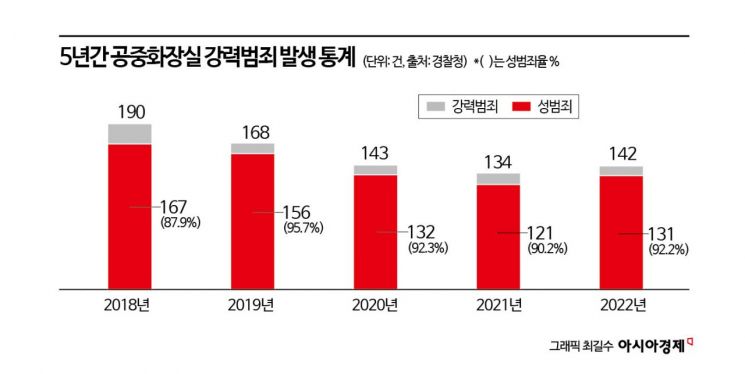
According to the National Police Agency, from 2018 to 2022, there were a total of 777 violent crimes in public restrooms nationwide over five years. In 2022 alone, there were 142 cases, with sexual crimes such as rape and forced molestation accounting for 92.2% (131 cases) of the total.
A representative from the Toilet Culture Citizens’ Coalition said, "Public restrooms, used by unspecified many and inherently enclosed, are structurally prone to various violent crimes including sexual offenses."
Law Revised but No Retroactive Application Creates 'Loopholes'
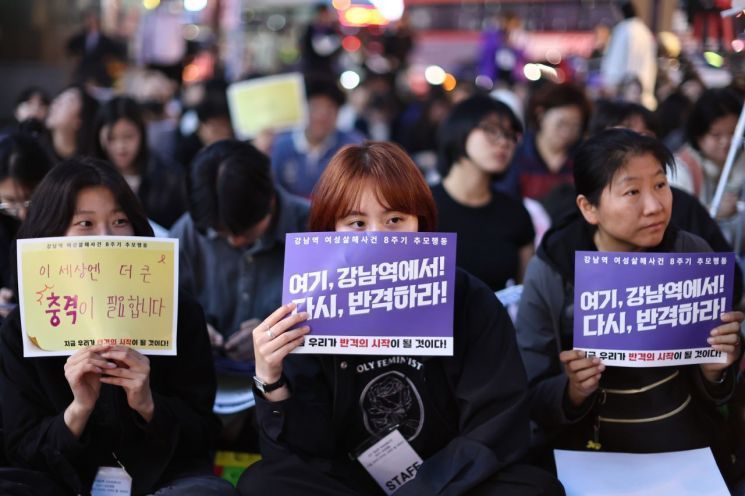 On the afternoon of the 17th, a memorial event marking the 8th anniversary of the Gangnam Station female murder case was held around Exit 10 of Gangnam Station in Seoul, hosted by the Seoul Women's Association and others. [Image source=Yonhap News]
According to the current "Act on Public Restrooms, etc.," business facilities and neighborhood living facilities such as shopping complexes with a total floor area of 2,000㎡ (605 pyeong) or more are required to install "separate restrooms for men and women." The law mandating separate restrooms for men and women was first enacted in 2004, initially excluding neighborhood living facilities, but was revised in 2017, one year after the Gangnam Station murder case. This legislation was enacted amid growing social awareness about unisex public restrooms.
However, existing buildings constructed before the law’s enforcement are not subject to this, creating loopholes mainly in older buildings. Since separation construction is costly and not mandatory, many building owners are reluctant to carry it out. Although the government and local governments provide subsidies to encourage separation of men’s and women’s restrooms in private buildings, participation rates remain low.
In fact, the Ministry of the Interior and Safety invested 2.2 billion won in 2019 to conduct a pilot project supporting the separation of men’s and women’s restrooms, but it ended early due to low participation. A ministry official said, "Separating restrooms requires securing additional space, and since it targets private buildings, many places are structurally unsuitable. We ran a local government subsidy project in 2019, but it ended after one year."
After the incident, local governments were urged to enact ordinances requiring installation of safety equipment such as emergency bells, but participation has also been minimal. As of the end of March, out of 228 local governments nationwide, 148 had ordinances regarding emergency bell installation, about 65% overall. As of May this year, the installation rate of emergency bells in seven metropolitan cities nationwide including Seoul, Incheon, Daejeon, Daegu, Ulsan, Gwangju, and Busan was only 40.7%.
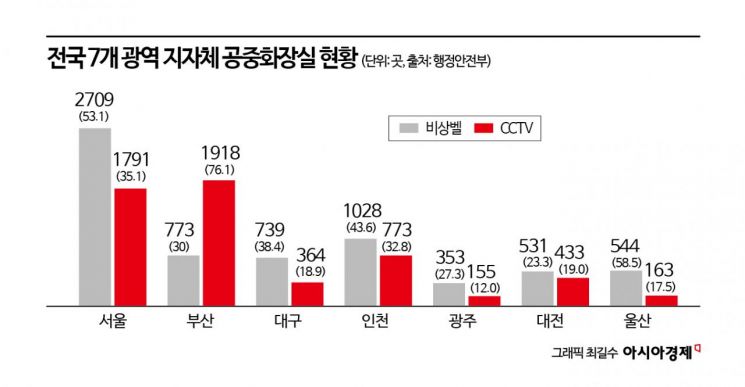
Experts advise that along with active promotion by the central government regarding restroom separation projects and emergency bell installation, building owners’ sense of responsibility must also be strengthened.
Pyoh Hyeryeong, head of the Toilet Culture Citizens’ Coalition, said, "The government and local governments are implementing support projects for separating men’s and women’s restrooms in private buildings, but because of the required self-payment, there are few cases where construction is actively pursued, and some are not well informed about the project. The government should promote restroom safety more actively, and building owners should also take an interest in restroom safety as a form of social contribution."
© The Asia Business Daily(www.asiae.co.kr). All rights reserved.



















