Inauguration Ceremony of Taiwan's New President on the Morning of the 20th
Calls for Resumption of Cross-Strait Exchanges and Regional Peace and Stability
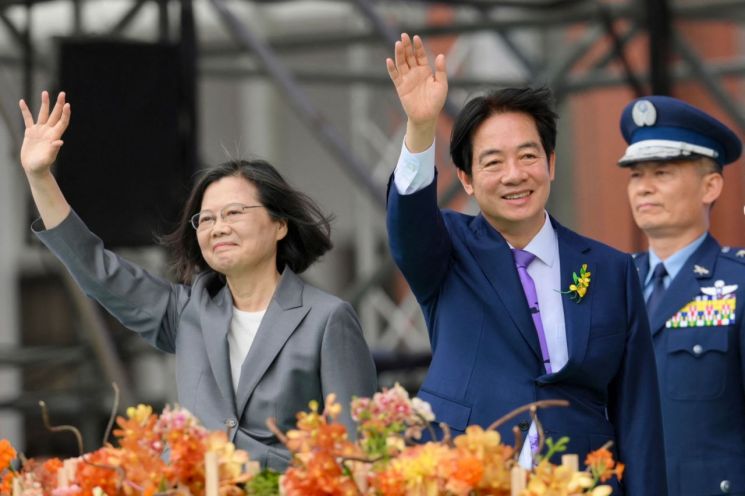
Raising the banner of 'pro-America and independence,' Taiwan's newly inaugurated President Lai Ching-te pledged to maintain the status quo in cross-strait relations between mainland China and Taiwan during his inauguration speech on the 20th, while calling on China for joint efforts toward peace.
In his inauguration address held in front of the Presidential Office Building in Taipei that morning, President Lai stated, "Because the future of cross-strait relations will decisively influence the global situation, we, inheriting a democratized Taiwan, will be the helmsmen of peace," emphasizing, "The new government will uphold the 'Four Noes' stance, maintaining the status quo without being either servile or arrogant (不卑不亢)."
The 'Four Noes' refers to the principles of cross-strait relations announced by the previous Tsai Ing-wen administration in 2021, which include ▲ forever upholding the free and democratic constitutional system ▲ maintaining mutual non-subordination between the Republic of China and the People's Republic of China ▲ rejecting any infringement on sovereignty or annexation ▲ and adhering to the future of the 'Republic of China Taiwan' and respecting the will of all Taiwanese people.
Addressing China, he called for the resumption of bilateral exchanges and for regional peace and stability. He said, "Peace and stability across the strait are the key to the world," adding, "I hope China can resume bilateral exchanges such as tourism and student exchanges and take concrete measures toward reconciliation with Taiwan by striving for peaceful coexistence." He further appealed, "I also urge China to cease threats against Taiwan, share global responsibilities with Taiwan, work to maintain peace and stability in the Taiwan Strait and the region, and help the world escape the fear of war."
Referring to the Ukraine war and the Gaza conflict, he said, "China's military actions and gray-zone threats (provocative acts with political objectives that fall short of full-scale war) are also considered the greatest strategic challenges to world peace and stability," emphasizing, "As China has not yet abandoned the possibility of a military invasion of Taiwan and continues various threats, we must demonstrate our determination to defend the nation."
He added, "I hope China faces the fact that the Republic of China (Taiwan) exists, respects the choices of the Taiwanese people, and shows sincerity," stating, "I hope that dialogue will replace confrontation and exchanges will replace encirclement under the principles of equality and dignity with Taiwan's legitimately elected government." He also said, "We can start with equal bilateral tourism, travel, and Chinese students studying in Taiwan, and together pursue peace and shared prosperity."
President Lai also outlined future tasks including ▲ strengthening national defense ▲ building economic security ▲ implementing stable and principled leadership in cross-strait relations ▲ promoting value-based diplomacy ▲ and exerting deterrence through forming communities with global democratic countries. He self-assessed, "Looking ahead to the future world, semiconductors are everywhere, and the wave of AI is sweeping across. Taiwan currently dominates advanced semiconductor manufacturing technology, stands at the center of the AI revolution, and as a core of the 'global democracy supply chain,' influences global economic development and the happiness and prosperity of humanity."
He said, "We must firmly maintain our core position in the global supply chain, seize business opportunities brought by geopolitical changes, and develop the 'five trusted industries' of semiconductors, AI, military, security, and next-generation communications," adding, "We want Taiwan to become the Asian hub of the 'drone democracy supply chain,' develop next-generation low-earth orbit satellites, and advance into the global space industry."
During the approximately 30-minute inauguration speech, President Lai mentioned the word 'democracy' an impressive 31 times, highlighting the differences between Taiwan and China. This was a significant increase compared to former President Tsai Ing-wen's speeches, which mentioned the term 24 times in 2016 and 9 times in 2020.
Meanwhile, Chinese media have been refraining from reporting on President Lai's inauguration ceremony. Among major outlets, the state-run English-language newspaper Global Times (GT) published an article the night before titled "Taiwanese people urge peace following Lai's inauguration." GT reported, "Many Taiwanese people are urging Premier Lai not to pursue hostile and separatist policies toward the mainland that would provoke the mainland or cause more regional tensions," adding, "Some fear that Taiwan authorities will further brutally suppress local unification activists, distort history textbooks in Taiwanese schools, and manipulate the media to sever historical ties with the mainland."
© The Asia Business Daily(www.asiae.co.kr). All rights reserved.
![User Who Sold Erroneously Deposited Bitcoins to Repay Debt and Fund Entertainment... What Did the Supreme Court Decide in 2021? [Legal Issue Check]](https://cwcontent.asiae.co.kr/asiaresize/183/2026020910431234020_1770601391.png)
















