Most Effective Incentive "Investor Choice"
Negative on Tax Benefits
Proven by Value-Up Effect and Corporate Stock Price Increase
National Pension Service Should Play an Active Role in Inducing Value-Up Implementation
The Daishin Economic Research Institute recently produced a meaningful analysis showing that the stock returns of Japanese listed companies selected as value-up outstanding companies were higher than Japan's representative stock index, the Nikkei 225. The Tokyo Stock Exchange selects the best disclosure cases for 10 indicators each year, and among them, the stocks of listed companies that performed well in specific indicators achieved remarkable returns. This is why Jaewook Baek, head of the Daishin Economic Research Institute, emphasized that "the most effective incentive of the corporate value-up program is the choice of capital market investors."
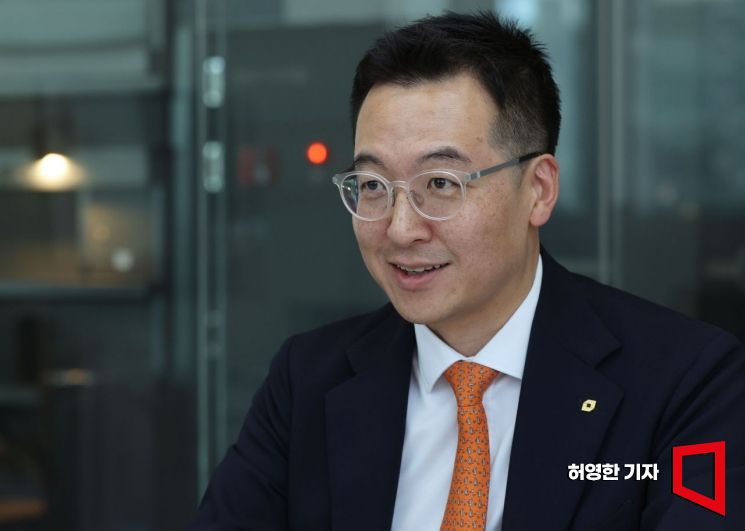 Baek Jae-wook, CEO of Daesin Economic Research Institute, is being interviewed by Asia Economy at the Euljiro office in Seoul. Photo by Huh Young-han younghan@
Incentives Should Not Drive Corporate Actions... Expecting a Virtuous Cycle of Corporate Value Enhancement → Investor Choice
In an interview with Asia Economy on the 16th, CEO Baek said, "It is not desirable for companies to act solely based on government incentives," adding, "Companies should be guided to implement value-up programs by looking at the market." Considering that policies may lack continuity depending on the administration or the number of seats held by ruling and opposition parties in the National Assembly, he pointed out that if incentives such as tax benefits disappear, the momentum for promoting value-up programs may weaken or the stock prices of related companies may plunge, causing adverse effects.
CEO Baek emphasized, "Companies consider ESG (environment, social, governance) as an important management factor not because of government pressure but due to strong demands from financial market investors," adding, "If companies become more attractive to investors, investors will naturally come in, and the resulting corporate value enhancement and capital raising can serve as a definite incentive for value-up implementation."
Some express concerns that since participation in the value-up program is left to corporate autonomy, participation may be low without carrots such as corporate tax benefits. However, CEO Baek expects that faithful implementation of value-up will lead to investments by investors who keep corporate value enhancement in mind, which in turn will create a virtuous cycle effect by increasing corporate value (stock price rise).
In fact, the Daishin Economic Research Institute tracked the stock prices of listed companies recognized as value-up outstanding companies by the Tokyo Stock Exchange. The Tokyo Stock Exchange evaluates listed companies based on 10 indicators divided into △analysis and evaluation of current management conditions △consideration and disclosure of utilization initiatives △communication with shareholders and investors. Detailed analysis of the best cases selected for each indicator and the disclosures of these companies showed that the cumulative returns of listed companies selected as outstanding cases in three categories?△multifaceted analysis and evaluation from the investor's perspective △explanation of implementation plans for mid- to long-term goals △active participation of management and the board of directors?were 50.2%, 56.5%, and 47.4% higher, respectively, than the cumulative return of the Nikkei 225 during the same period (July 2023 to April 2024).
CEO Baek emphasized, "While the JPX Prime 150 did not show significantly better performance than the Nikkei 225 during the analysis period (July 2023 to April 2024), the average performance of the 29 companies selected as outstanding cases consistently outperformed the market." This proves the effect of corporate value increase of listed companies selected as value-up outstanding companies in the market.
However, there may be counterarguments. One might question whether the stock price rise was simply due to the booming Japanese stock market and the semiconductor sector's prosperity. Regarding this, CEO Baek explained, "When comparing excess returns relative to the industry returns of these companies, the excess returns were 49.51% for multifaceted analysis and evaluation from the investor's perspective, 42.14% for mid- to long-term goals, and 34.78% for board participation."
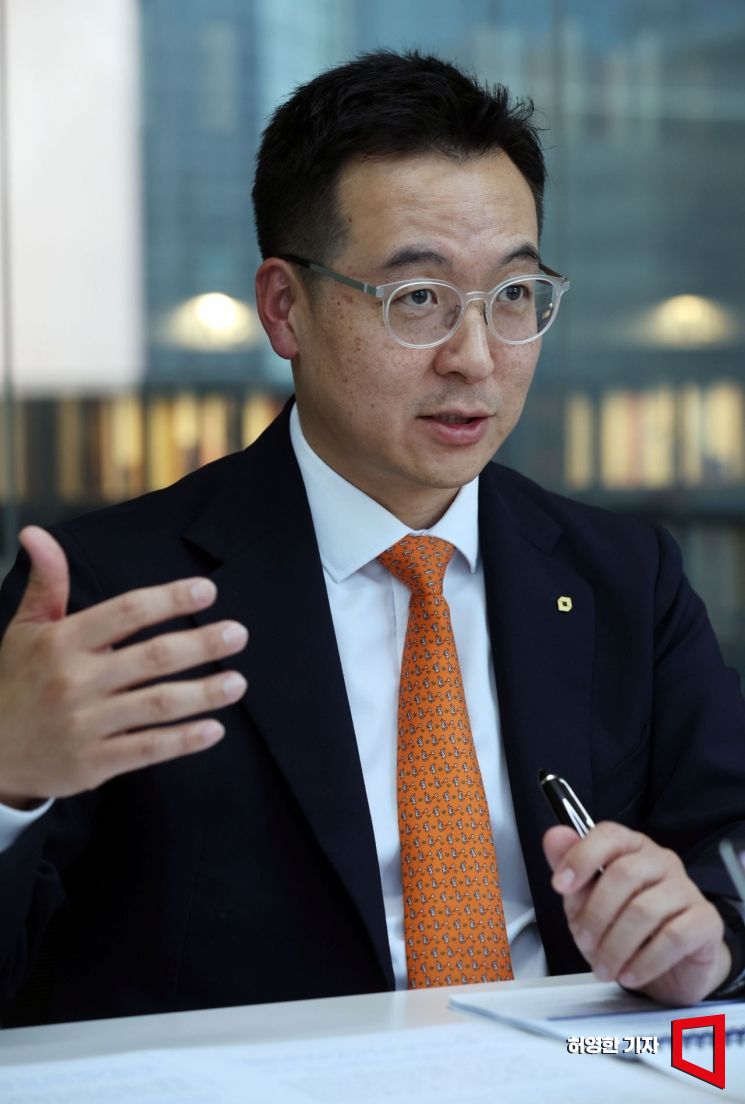 Baek Jae-wook, CEO of Daesin Economic Research Institute, is being interviewed by Asia Economy at the Euljiro office in Seoul. Photo by Huh Young-han younghan@
Qualitative Evaluation Should Be Weighted More Than Quantitative Indicators... Value-Up Will Show a Similar Trend to ESG Until Market Establishment
The second value-up guideline announced in early May did not include specific mentions of the listed company evaluation system. According to the Korea Chamber of Commerce and Industry, the evaluation system is the part domestic listed companies are most curious about in the final value-up plan. The criteria for selecting outstanding listed companies are directly linked to government incentives.
CEO Baek predicted, "Like the Japanese JPX Prime 150 selection criteria, investment indicators such as price-to-book ratio (PBR) and return on equity (ROE) will be combined with qualitative factors such as the completeness of disclosures and the reliability of goal implementation plans in the evaluation," adding, "To preserve the purpose of the value-up program, it is desirable to give a higher weight to qualitative evaluation than quantitative indicators."
He further explained that while most listed companies tend to focus on shareholder return policies such as dividend increases as a means of implementing the value-up program, improving governance through transparent board operations and strengthening the process of appointing outside directors is important in the long term. He predicted, "Ultimately, this will lead to improving ROE and lowering the cost of equity (COE)."
He believes that if the value-up policy works properly in the market, it will definitely help resolve the Korea discount. He said, "Most of the content of the value-up program aligns with what activist investors have demanded, so there will be a clear effect on enhancing corporate value."
He also expressed the opinion that the value-up program will show a similar trend to the spread of ESG culture until it is established in the market. If an investment atmosphere is created where the market invests in companies actively practicing the value-up program, and it is confirmed that companies faithfully implementing the program have an advantage in attracting funds, companies will inevitably follow the value-up program on their own.
CEO Baek explained, "Even though no penalties were imposed for ESG implementation, companies actively engaged in ESG management because investors demanded it," adding, "No matter how much the European Union (EU), United Nations (UN), and non-governmental organizations (NGOs) emphasized ESG, companies that did not budge started to move after the UN Principles for Responsible Investment (PRI) for capital raising."
Since the UN emphasized PRI in 2006, investment considering ESG has become standard. Many investment institutions have joined the UN PRI and do not invest in companies with insufficient ESG. He said, "Companies were induced to participate by giving favorable loan conditions to those faithfully implementing ESG," adding, "The growth graph of the responsible investment market size parallels the graph of active ESG implementation."
CEO Baek sees the role of the National Pension Service, Korea's representative institutional investor, as important. He said, "Looking at the National Pension Service's fiduciary responsibility activity process, it induces governance improvement of companies subject to key management issues through shareholder activities such as confidential dialogues and shareholder proposals," adding, "Requesting confidential dialogues with companies that do not disclose value-up program implementation to induce disclosure can be a stronger incentive than incentives."
Finally, he said the corporate perspective on activist investors needs to change. CEO Baek said, "Activist investors generally have a negative image such as corporate raiders or 'eat-and-run.' However, companies can build a friendly relationship with activist funds," adding, "Companies should communicate openly with activist investors who try to discover undervalued companies and initiate dialogue to improve undervaluation factors." He also added that asset management companies, which act as managers operating client assets rather than their own funds, should actively participate in decision-making related to corporate value and help increase corporate value.
© The Asia Business Daily(www.asiae.co.kr). All rights reserved.


















