Ministry of Environment Did Not Disclose River Facility Inspection Details
Inspection Reveals River Embankment Erosion and Drainage Gate Malfunction
Ministry of Environment Failed to Prevent Osong Disaster, Now in Full Flood Response Mode
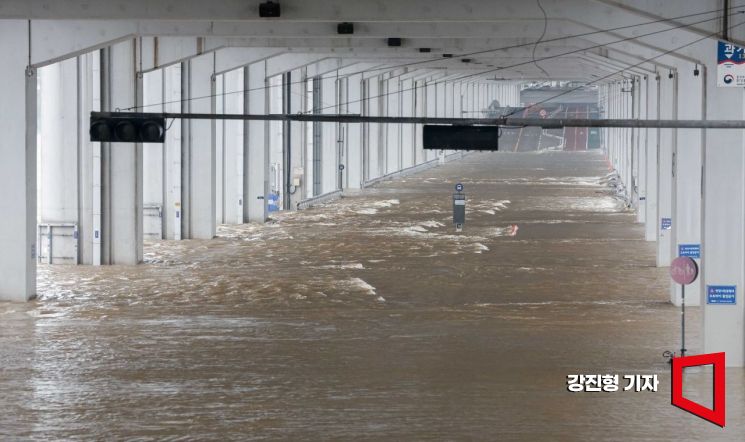 On July 14 last year, a heavy rain warning was issued across Seoul, leading to a complete traffic ban on the Jamsu Bridge in Seoul. Photo by Jin-Hyung Kang aymsdream@
It has been identified that over 130 flood prevention facilities on major national rivers have defects. Some key embankments have been eroded, and essential drainage gates for water level control were found to be non-functional. The Ministry of Environment, which has faced criticism in recent years for “lacking water management capabilities” due to various flood incidents, has decided under the minister’s directive to reinforce all facilities before the flood season. There is a widespread sense of crisis that if the Ministry of Environment, which took over all water management duties from the Ministry of Land, Infrastructure and Transport and others, fails to properly fulfill its role as the ‘water management ministry’ again this year, the very foundation of the ministry’s existence could be shaken.
Eroded Embankments and Non-Functional Drainage Gates
According to the meeting materials for the ‘2024 Flood Response Ministry of Environment-Local Governments Conference’ obtained by Asia Economy on the 21st, a total of 132 defects were found at major river facilities and construction sites. The Yeongsan River had the highest number with 49 cases, followed by the Geum River with 43 cases. Daegu had 19 cases, the Nakdong River 7 cases, and the Han River 5 cases.
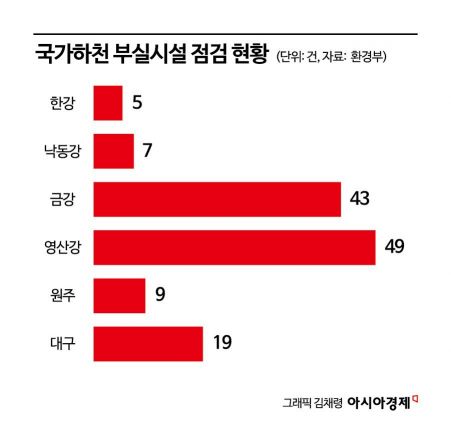
The deficiencies were revealed during safety inspections conducted by the Ministry of Environment in preparation for the flood season. Until last month, the Ministry, in cooperation with river associations, inspected 1,237 related facilities spanning 1,246 km. The results were announced on the 16th when the summer flood countermeasures were released, stating only that there were deficiencies to be reinforced, without disclosing detailed conditions.
The main problem identified by the Ministry of Environment was ‘embankment slope erosion.’ This means that embankments built to prevent river flooding have been eroded by water. If erosion is left unattended, embankments may collapse or soil may be washed away, causing damage to nearby areas. There were also cases where drainage gates were malfunctioning. These devices, which regulate river water levels and drain water, were not operating properly. The Ministry also found some facilities that were completely corroded or rivers where the embankments themselves were damaged.
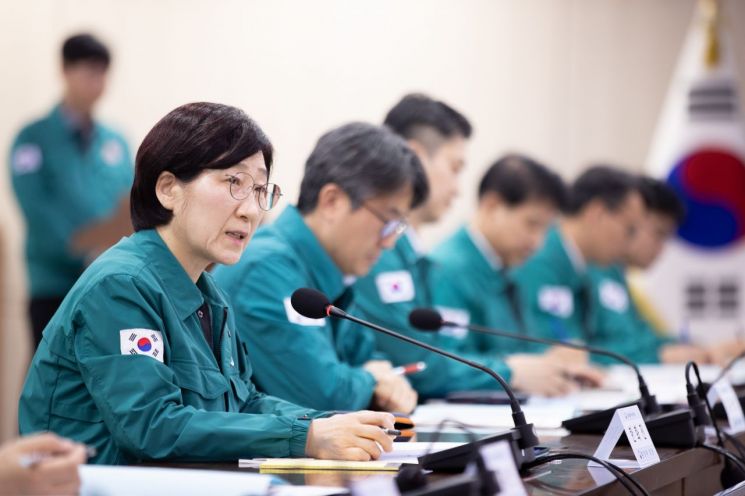 Han Hwa-jin, Minister of Environment, presiding over the 2024 Flood Preparedness Meeting between the Ministry of Environment and local governments at the Government Sejong Complex in Sejong City on the 29th of last month. Photo by Ministry of Environment
As defective facilities were continuously discovered during this investigation, Minister Han Hwa-jin personally ordered repairs and reinforcements. On the 29th of last month, Minister Han held a Ministry of Environment-local government meeting at the Sejong Government Complex and instructed, “Go directly to the flood-affected areas and river construction sites from last year to inspect,” and “Carry out emergency repairs on damaged river sections and focus on managing vulnerable areas.”
The Ministry plans to repair all defects by the 21st of next month, when the flood season begins. A Ministry official explained, “We will quickly reinforce issues related to flood control found in the safety inspection results, and complete less urgent matters like damaged walking trails within the year.”
“No Accidents Allowed”… Why the Ministry of Environment Is Sensitive to Flood Incidents
The Ministry of Environment conducted a full inspection of 1,237 major facilities because it is putting its utmost effort into flood preparedness. Inside the Ministry, there is a strong sense of vigilance that large-scale floods and resulting casualties must absolutely not occur this year. A senior Ministry official said, “As we approach the June flood season, the minds of senior officials including the minister will be filled with flood response,” adding, “For the Ministry of Environment, this year is the most critical turning point for flood response, and accidents must never happen.”
The Ministry’s heightened alertness to flood response is rooted in ongoing debates about which ministry should be responsible for water management. Currently, all water-related duties are handled by the Ministry of Environment. Originally, the Ministry of Land, Infrastructure and Transport and the Ministry of Agriculture, Food and Rural Affairs also had functions, but in 2018 under the Moon Jae-in administration, all were unified under the Ministry of Environment. The aim was to eliminate overlapping duties between ministries and create efficient, integrated water policies. As a result, the Ministry of Environment took on river management and flood response in addition to existing water quality and quantity tasks.
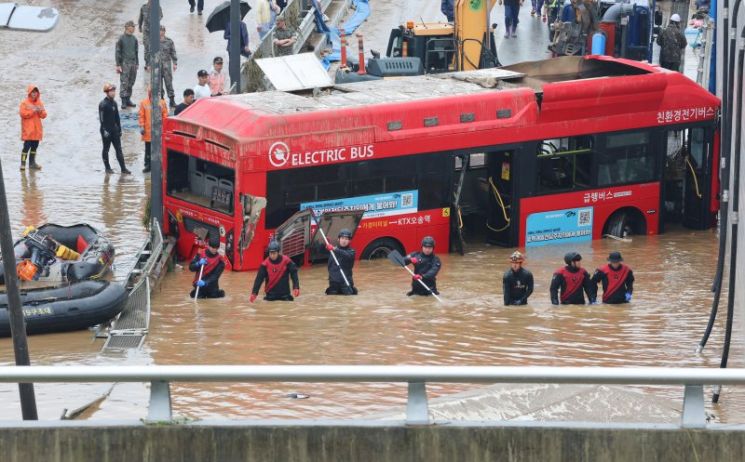 On July 16 last year, 119 rescue workers are searching for missing persons at Gungpyeong 2 Underpass in Osong-eup, Cheongju-si, Chungbuk, which was flooded due to the collapse of the Miho River embankment.
 [Image source=Yonhap News]
However, various water-related accidents have continuously sparked controversy over the Ministry of Environment’s lack of capability. During the heavy rains in 2020, criticism arose that dam policies failed due to the rapid increase in discharge from Yongdam and Seomjin Rivers. Residents in areas such as Geumsan, Chungnam, and Muju, Jeonbuk, filed damage claims against the state in July of that year, alleging harm caused by the discharge policy. Last year, nearly 50 people died due to heavy rains in the central and southern regions. It was the largest loss of life in decades, and criticism was raised that the cause of the Osong disaster, where 14 people died, was poor management of the Miho River.
If the Ministry fails to properly respond to heavy rains again this year, it will not be able to avoid responsibility. It may have to return the water policy functions it received from other ministries. Last year, as flood damage worsened, President Yoon Suk-yeol reportedly reprimanded Minister Han directly, saying, “Manage water affairs properly.” At that time, Kim Ki-hyun, leader of the People Power Party, also held a supreme council meeting and argued, “It is necessary to review whether it is appropriate for the Ministry of Environment, rather than the Ministry of Land, to manage water resources.”
Increasing AI Forecasts and Navigation Guidance to Avoid Risk Areas
The Ministry of Environment’s strategy to prevent flood damage involves utilizing artificial intelligence (AI). Starting this month, the number of flood forecast points using AI technology has increased from 75 to 223. At these points, when heavy rain occurs, AI automatically predicts floods and issues warnings. River water level monitoring will be operated at 673 points with a one-minute interval. The ‘urban flood forecast’ first implemented last year at Dorimcheon in Seoul has been expanded this year to Hwangryong River in Gwangju, Naengcheon River in Pohang, and Changwoncheon in Changwon.
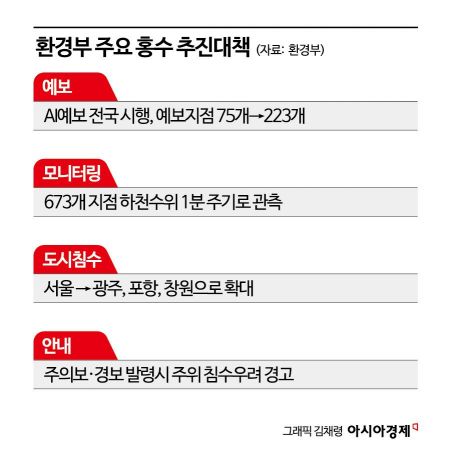
From July, navigation systems will automatically guide drivers along safe routes in flood risk areas. When a vehicle approaches a flood warning point or dam discharge site, the system will automatically alert the driver that it is a risk area. In particular, it aims to prevent a second Osong disaster by directing traffic to avoid underpasses or low-lying areas. Safety alert messages have also been changed to use mobile phone location information to provide users with information about their area and nearby flood-prone zones.
Separately, the Ministry of Environment is conducting simulation drills with officials from other ministries and local governments. On February 26, disaster communication drills were held at the Han and Nakdong Rivers, and on the 27th at the Geum and Yeongsan Rivers. On March 27, the same drills were completed at four flood control centers. Four joint drills for initial response to disaster situations were conducted last month and this month. The flood control centers also conducted four checks of the forecast system and internal simulation drills. Meetings and workshops with local governments and watershed groups have also been completed.
Minister Han recently stated, “We will swiftly complete inspections and measures at river construction sites during the remaining period before the flood season to eliminate blind spots in flood response and protect the safety of the public from this summer’s heavy rains.”
© The Asia Business Daily(www.asiae.co.kr). All rights reserved.
![User Who Sold Erroneously Deposited Bitcoins to Repay Debt and Fund Entertainment... What Did the Supreme Court Decide in 2021? [Legal Issue Check]](https://cwcontent.asiae.co.kr/asiaresize/183/2026020910431234020_1770601391.png)

















