Newly inaugurated Taiwanese President Lai Ching-te held his inauguration ceremony on the 20th, officially beginning his term as the 16th president. Known for his pro-American and pro-independence stance, he emphasized a "status quo" policy in cross-strait relations during his inaugural address, while mentioning the word "democracy" an impressive 31 times to highlight the differences between Taiwan and China.
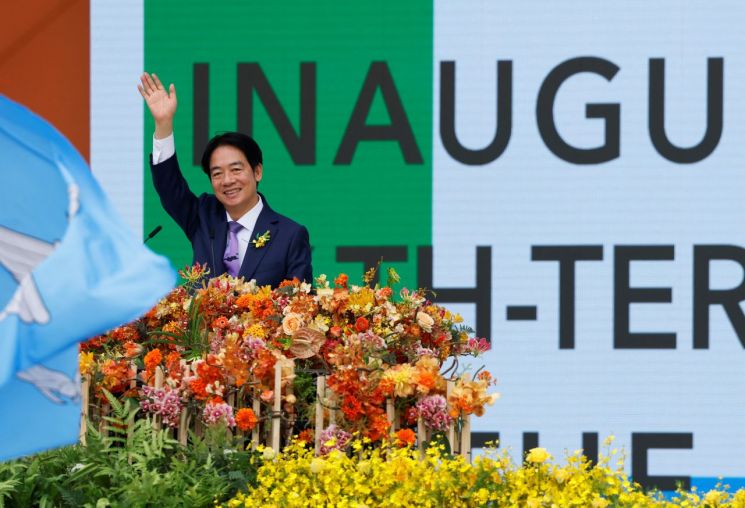
On the day, President Lai took the oath of office at the Presidential Office in Taipei alongside Vice President Xiao Meiqin, and received the "National Seal of the Republic of China" and the presidential seal from Legislative Yuan Speaker Han Kuo-yu.
In his inaugural speech, he stressed, "Democracy, peace, and prosperity are Taiwan's national roadmap," adding, "This is also the link that connects us to other parts of the world." He further described Taiwan as "one of the most vibrant democracies in the world." The Guardian reported that President Lai mentioned democracy 31 times in his first speech, using democracy to emphasize the differences between Taiwan and China.
Regarding the cross-strait issue, often called a global powder keg, he urged China to cease hostile military threats in the Taiwan Strait and fulfill its responsibility to maintain regional peace and stability. President Lai assessed, "China's military actions and gray-zone threats are the greatest strategic challenge to world peace and stability." He added, "As long as China does not abandon the use of force against Taiwan, Taiwan must demonstrate its determination to defend the nation," pointing out that "China's threat to annex Taiwan will not simply disappear."
He also emphasized, "The future of cross-strait relations will decisively impact the global situation," and declared, "I will inherit a democratized Taiwan and become a helmsman of peace." Continuing the policy direction of former President Tsai Ing-wen's eight-year administration by maintaining the status quo, he declared that he would be "neither servile nor arrogant" (不卑不亢). This can be interpreted as a sign that, despite being regarded as a hardline pro-independence leader, President Lai will avoid excessively provoking China in the early stages of his term. He stressed, "Peace is the only option," and added, "China must jointly safeguard peace with Taiwan. The world must live without the fear of war."
However, he also expressed his intention to respond to China's military threats in coordination with the international community. He stated, "There is a strong international consensus that peace and security in the Taiwan Strait are indispensable to global security and prosperity," and voiced hope that "mutual benefit and win-win prosperity become common goals." He further urged China to "face the existence of the Republic of China (Taiwan) and respect the choices of the Taiwanese people," calling for dialogue and exchanges starting with equal bilateral tourism, travel, and student admissions.
Additionally, he emphasized Taiwan's importance not only in terms of geopolitical security but also as a semiconductor supply chain, stating, "The future we decide is the future of our country and the world."
Major foreign media outlets predicted that President Lai, classified as a hardline pro-independence figure, would not excessively provoke mainland China considering the complex geopolitical risks. However, they noted that it is highly unlikely China will recognize Taiwan's sovereignty as implied in President Lai's inaugural message. China's representative social network service, Weibo, blocked hashtags containing President Lai's name on the day. Hashtags with the name of former President Tsai Ing-wen were also restricted. The Guardian reported that Chinese state media made almost no mention of President Lai's inauguration ceremony, reflecting the prevailing atmosphere.
Instead, on the day of the inauguration, Chinese authorities unleashed pressure tactics targeting Taiwan and Western allies, including sanctioning Boeing's defense sector for involvement in arms sales to Taiwan. The previous day, they initiated anti-dumping investigations on chemical imports from the European Union (EU), the United States, Taiwan, and Japan. Chinese President Xi Jinping, who has emphasized the "One China" policy, has consistently conveyed the message that Taiwan's unification is inevitable.
Meanwhile, Taiwan's Ministry of Foreign Affairs announced that 51 country delegations and over 500 overseas guests attended the inauguration. From the United States, a delegation led by former National Economic Council (NEC) Chairman Ryan Dyes and former Deputy Secretary of State Richard Armitage participated. U.S. Secretary of State Antony Blinken sent a congratulatory message to President Lai, expressing hope to deepen U.S.-Taiwan relations and maintain peace and stability in the Taiwan Strait.
© The Asia Business Daily(www.asiae.co.kr). All rights reserved.

















