A soft micro medical robot that can freely change its shape within the human body and dissolve without inflammation after completing its mission has been developed domestically.
On the 20th, the Korea Research Foundation announced that a joint research team led by Professor Ko Gwang-jun of Chosun University, Professor Choi Eun-pyo of Chonnam National University, and the Korea Micro Medical Robot Research Institute succeeded in developing a soft micro medical robot.
The developed medical robot can move according to external environments such as humidity, chemical components, near-infrared rays, high-frequency heating, temperature, and magnetic fields. It is praised for its advantages including biocompatibility, biodegradability, and real-time in vivo monitoring functions.
Previously developed soft robots focused on mimicking biological movements through shape changes, resulting in extremely limited application fields.
In particular, due to material limitations, it was difficult to secure biocompatibility, biodegradability, and real-time in vivo monitoring functions, making it challenging to use soft robots in medical and life science applications that require non-invasive diagnosis and treatment, as well as considerations of shape change, actuation, and stimulation.
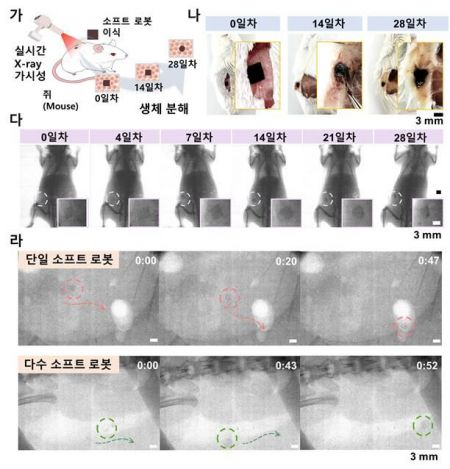 Conceptual diagram verifying the function of soft micro medical robots using small animals (Mouse). Photo by Gwangjun Ko, Professor of Mechanical Engineering at Chosun University
The research team developed a new type of soft medical robot that overcomes these limitations. By utilizing biodegradable natural polymers (chitosan) and magnetic nanoparticles as magnetic responsive materials, the robot maintains the soft movements of existing soft robots while enabling movement and tracking to desired locations.
Above all, the soft medical robot developed by the research team is expected to increase its utilization in medical and life science fields in the future, thanks to its ability to dissolve on its own after completing its mission.
First, the team engraved micro-patterns on the robot’s surface to allow it to bend toward the desired direction with an error margin of 1℃, and designed it to move to desired locations by utilizing the magnetic responsiveness of magnetic nanoparticles.
Through this, it was possible to implement various biomimetic movements (petals, vines, larvae, fingers) like existing soft robots.
In experiments, the research team confirmed real-time reading of the soft robot’s movement through X-ray imaging and observed that it gradually decomposed over four weeks without toxicity or inflammatory response.
Professor Ko Gwang-jun said, “The soft micro medical robot developed in this study overcame the material limitations of existing soft robots and demonstrated the potential to expand application fields into medical and life sciences. The research team will continue its research to enable the results to be used as a platform in medical and life sciences fields such as disease treatment and regeneration, ex vivo disease models, and drug screening.”
© The Asia Business Daily(www.asiae.co.kr). All rights reserved.
![Clutching a Stolen Dior Bag, Saying "I Hate Being Poor but Real"... The Grotesque Con of a "Human Knockoff" [Slate]](https://cwcontent.asiae.co.kr/asiaresize/183/2026021902243444107_1771435474.jpg)
















