'Cello Square Media Day' Held at Jamsil Campus
Establishing Logistics Risk Analysis and Response Strategies Through AI
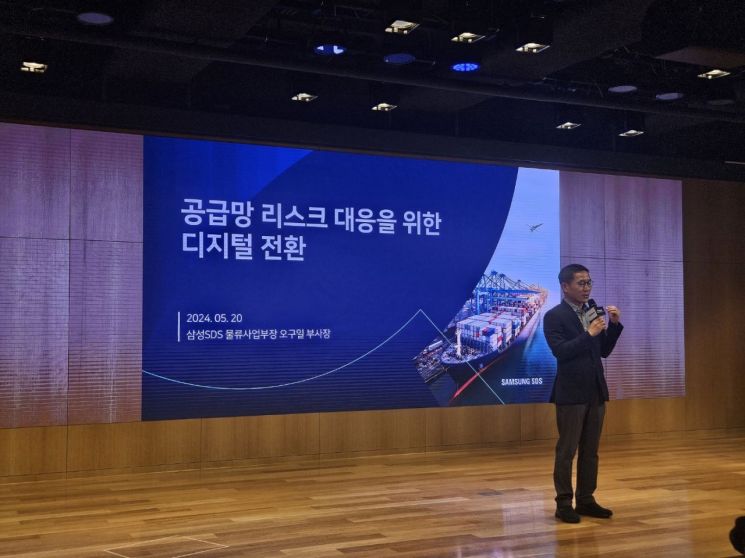 O Gu-il, Vice President and Head of Samsung SDS Logistics Division, is explaining digital transformation for supply chain risk response at the 'Cello Square Media Day' held on the 20th.
"We cannot make risk zero. However, we aim to minimize the impact."
Samsung SDS has presented a supply chain risk response plan utilizing artificial intelligence (AI) and is targeting the market. It is expected to help identify supply chain risk factors in advance and assist in establishing response strategies through AI.
On the 20th, Samsung SDS held the 'Cello Square Media Day' and announced ways to respond to global supply chain risks through digital logistics using AI.
Samsung SDS is detecting supply chain risks in real-time and quickly establishing response strategies by leveraging machine learning and generative AI.
Since COVID-19, the global supply chain has faced ▲geopolitical risks such as the Russia-Ukraine war and the Red Sea logistics crisis ▲restructuring of the global supply chain due to strengthened protectionism in the U.S. and Europe ▲climate issues such as climate change and carbon emission regulations. O Gu-il, Vice President and Head of Samsung SDS Logistics Division, explained, "Supply chain risks cannot be solved by IT or digital transformation," but added, "However, we are considering how to respond to the severity and impact of these risks."
Samsung SDS automatically extracts logistics risks from more than 60,000 global news items collected daily using machine learning. Then, the extracted risks are assessed and classified into three levels of severity using generative AI. Samsung SDS developed a model to judge risk levels based on about 20,000 past global logistics risk cases and trained generative AI to make risk assessments.
Once the potentially affected content is automatically generated, Samsung SDS logistics experts quickly establish response plans based on data analysis and expertise. The time required to develop these plans has been reduced from one day to two hours, significantly increasing the speed of risk response.
In fact, last month, Samsung SDS immediately detected the conflict between Israel and Iran and informed customers of the impact on air logistics scheduled to arrive in Israel. Preparing for escalation, they proposed an alternative transport plan by shipping to a nearby port by sea and utilizing neighboring countries, completing the transport on schedule.
Additionally, Samsung SDS is implementing hyper-automation of customer service and logistics operations using generative AI. Previously, users had to click through menus on Samsung SDS’s digital logistics platform, Cello Square, to obtain information. Now, services such as quote inquiries and container quantity estimation can be easily accessed through conversations with generative AI. This supports interactive communication with customers and automates workflow integration.
Samsung SDS is also automating simple and repetitive logistics operation tasks that were difficult to automate before by using generative AI. While personnel previously checked logistics information and settlement data for each customer separately in the system, generative AI is being implemented to extract customer-specific cargo volume and logistics cost data at once through conversation.
Currently, Samsung SDS provides real-time information on cargo movement status, vessel delays, port congestion, and container status through Cello Square. By analyzing past data, it calculates estimated vessel travel times and port dwell times to provide more precise estimated time of arrival information.
It also supports companies by predicting abnormal situations such as port berthing fees or vessel detentions, as well as maritime and air freight rates. Through Cello Square, information on carbon emissions and carbon intensity by transportation mode?air, sea, land, and rail?is available, supporting ESG (Environmental, Social, and Governance) management, and solutions for reducing carbon emissions are being prepared.
Vice President O Gu-il said, "Due to ongoing global risks since COVID-19, customers’ demands for logistics digital transformation are increasing," adding, "Samsung SDS will provide uninterrupted and sustainable logistics services despite major changes in the global supply chain by utilizing digital technology and AI."
Meanwhile, on the same day, Samsung SDS held the 'Cello Square Conference 2024' to share changes in the global situation, market trends, and digital transformation solutions to resolve supply chain risks.
© The Asia Business Daily(www.asiae.co.kr). All rights reserved.

















