Apple shows no cold damage due to late blooming... Overall good fruit set condition
The government recently projected that the growth of major fruits such as apples, pears, and peaches is better than last year, making it possible to achieve production levels above the average this year.
On the 20th, the Ministry of Agriculture, Food and Rural Affairs announced that as of May, the growth status of major horticultural products, including fruit trees, is generally favorable.
This is the result of monitoring and field surveys of 2,723 sample farms for seven items including apples, pears, watermelons, and oriental melons conducted by the Korea Rural Economic Institute, combined with forecasts from the Rural Development Administration (item-specific research institutes and field surveys), and additional feedback from major producer organizations and local agricultural cooperatives in key production areas.
According to this, apples, whose production significantly decreased last year due to weather disasters such as low temperatures and hail, are showing favorable growth this year with no cold damage due to later blooming compared to the previous year, and production is expected to be at average levels. A Ministry of Agriculture, Food and Rural Affairs official explained, "Although the number of blooms (flowers) in some farms this year is lower than average, considering that farmers cultivate by thinning flowers and fruits to leave about 100 to 150 fruits per tree for better marketability (normally 300 to 500 flower buds form per tree), the impact on production is expected to be minimal, and the fruit set condition has been confirmed to be generally good."
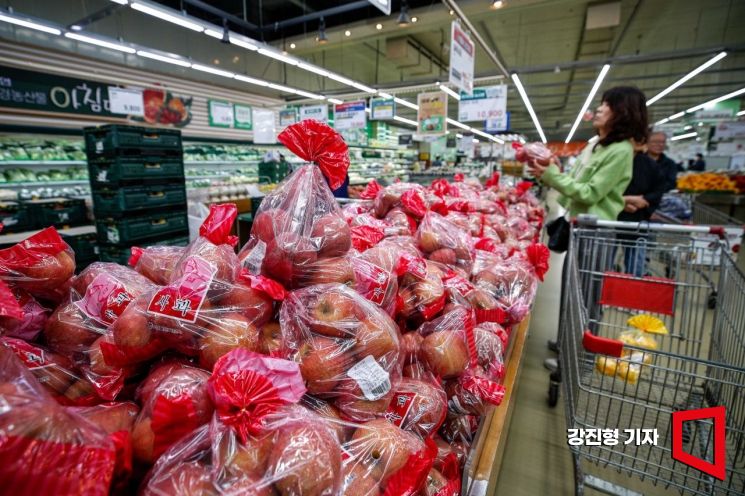
According to the Ministry of Agriculture, Food and Rural Affairs, pears, which experienced reduced production due to cold damage last year, have increased bloom quantity compared to the previous year and average, and the blooming condition was generally good. Artificial pollination was also smoothly conducted, resulting in a better fertilization rate compared to last year. Therefore, the ministry expects production this year to be above average levels.
Peaches, which also saw reduced production due to cold damage, have increased bloom quantity compared to last year, and with high temperatures maintained after blooming and less frost occurrence, the blooming condition is favorable, leading to expectations of average production levels. However, according to field surveys by the Rural Development Administration, some varieties in the Jeonnam region have insufficient fruit set due to decreased pollinator activity caused by heavy rain during the blooming period, but the impact on production is expected to be minimal. For grapes, favorable weather conditions during the blooming period (May) have accelerated blooming and improved growth compared to last year, so production is expected to be at average levels.
The Ministry of Agriculture, Food and Rural Affairs is promoting the 'Apple Safety Project' to ensure stable apple production. Since January, it has also been operating a fruit tree growth management council to proactively manage risk factors during each growth stage.
In particular, to prevent cold damage like last year, cold damage prevention facilities such as micro-sprinklers and wind fans were installed early on 447 hectares (515 farms) before the late March to early April period when last year's cold and frost damage occurred. Cold damage prevention nutrients were sprayed over 19,760 hectares, and 10,000 copies of a cold damage prevention manual were produced and distributed as part of the response efforts.
Additionally, following the outbreak of fire blight in fruit trees on the 13th in Chungju, Chungbuk and Cheonan, Chungnam, efforts to monitor and prevent its spread have been strengthened. The Rural Development Administration has set up a situation room and is operating on-site situation rooms in affected cities and counties. The outbreak alert level has been raised from 'interest' to 'caution,' and in cooperation with local governments, rapid confirmation and control are being pursued through on-site diagnostic offices and enhanced surveillance.
A Ministry of Agriculture, Food and Rural Affairs official stated, "Based on current weather conditions and growth status, major fruits such as apples are expected to have yields above average levels, but remaining challenges include responding to weather disasters such as hail, heavy rain, and typhoons, and minimizing the occurrence of diseases and pests such as anthracnose. Since growth management of horticultural products is crucial depending on weather conditions, we will continue to thoroughly manage growth through the growth management council until harvest to secure stable production volumes."
© The Asia Business Daily(www.asiae.co.kr). All rights reserved.

















