The Korea Forest Service will create nectar forests annually, covering an area 13 times larger than Yeouido, to protect the honeybee ecosystem and the beekeeping industry.
According to the Korea Forest Service on the 20th, the density of managed bee colonies in South Korea ranks first in the world. As the number of beekeeping households, colonies, and scale of management continue to increase, competition for food among honeybees is intensifying.
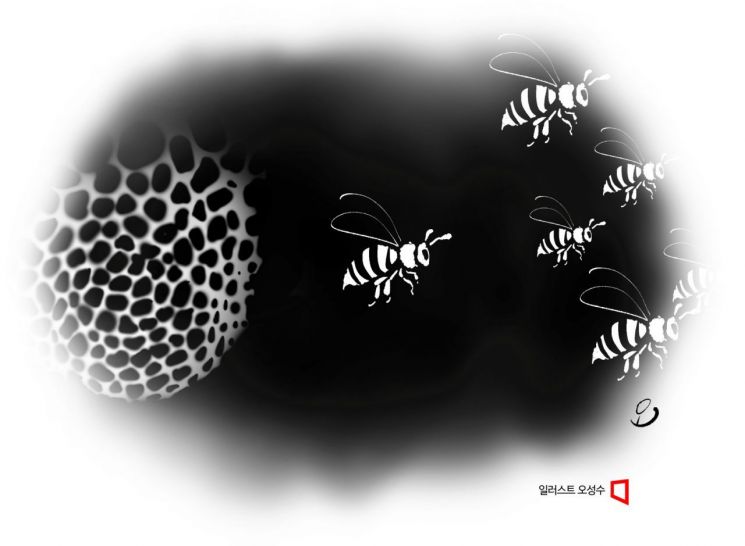
In fact, the number of beekeeping households increased from 19,987 in 2011 to 24,629 in 2017, and 26,427 last year. During the same period, the number of colonies rose from 1,531,609 to 2,388,237, and then to 2,543,965.
As of 2014, South Korea's colony density was 18.5 colonies per square kilometer, ranking first in the world. Considering the average honey production (14,000 tons) and productivity (13.7 kg per colony), calculations indicate that an additional 1.02 million colonies are needed. As of 2021, the number of colonies requiring additional establishment was 2.79 million.
Climate change has also contributed to intensified competition for honeybee food by reducing the difference in blooming periods of locust trees between southern and northern regions. Due to the shortened honey collection period, the difference in locust tree blooming times between the southern and Gyeonggi/Gangwon regions shortened from 30 days in 2007 to 20 days in 2014, and further to 16 days in 2017.
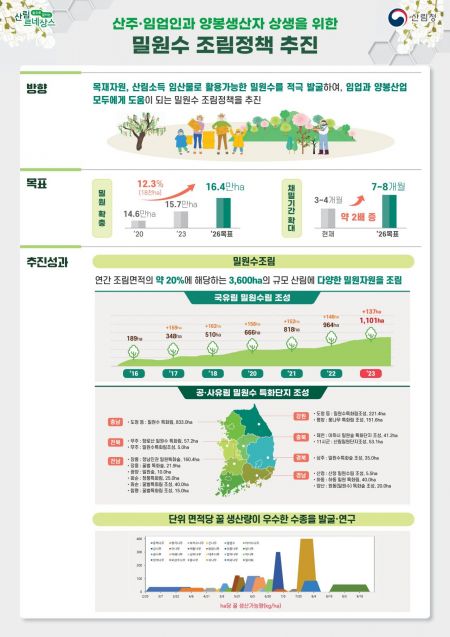
The Korea Forest Service is strengthening research and development to expand nectar forests and restore the health of related honeybee ecosystems to address problems caused by intensified competition for honeybee food. In particular, it has set a goal to create nectar forests nationwide each year covering an area 13 times that of Yeouido (290 hectares).
They plan to establish nectar forests covering 150 hectares annually in national forests and plant nectar resources on 20% (3,600 hectares) of the annual afforestation area in public and private forests.
Earlier, in January, the Korea Forest Service amended the "Act on the Management and Administration of National Forests" to allow beekeepers to install beehives and raise honeybees in national forests. The key point of the amendment is to permit the placement of beehives for beekeeping even in conservation national forests.
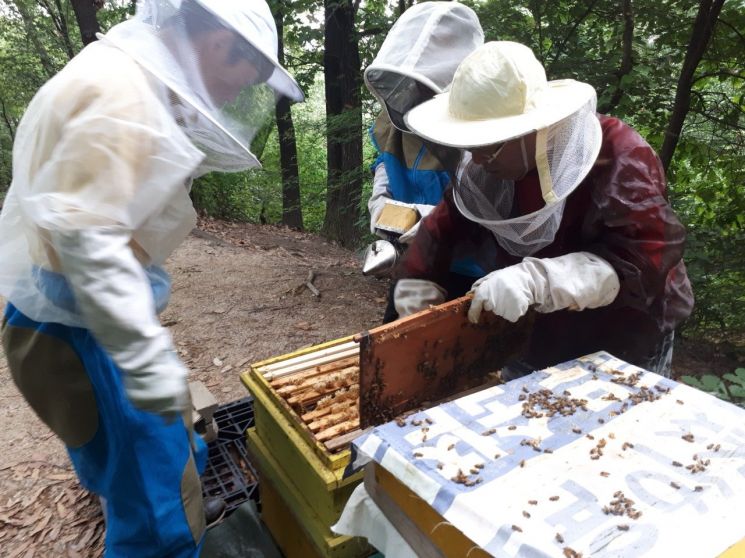
The National Institute of Forest Science, through research and development, has identified tree species with excellent honey production per unit area, including Shinamu (Ailanthus altissima), Hutsgae tree (Hovenia dulcis), Gwangnamu (Viburnum dilatatum), Inamu (Ilex integra) (♂), Awaenamu (Elaeagnus umbellata), Kwangkwang tree (Viburnum dilatatum) (♂), and Pinamu (Alnus japonica). The honey production per hectare of these species is evaluated to be over 90 kg, more than twice that of locust trees (38 kg).
Based on a standard honey glass jar of 2.4 kg commonly distributed, the potential honey production per hectare is 16 jars for locust trees and 37 or more jars for superior species.
The Korea Forest Service plans to collaborate with the Rural Development Administration, Korea Meteorological Administration, and other agencies to conduct multi-agency joint research projects to prepare scientific evidence for expanding nectar resources. These joint projects will focus on improving the productivity of nectar plantations, breeding superior nectar tree varieties, protecting honeybees, and conserving ecosystems. The multi-agency joint research will be conducted until 2030 with a total budget of 48.4 billion KRW.
Nam Sung-hyun, Administrator of the Korea Forest Service, stated, "Honeybees have high public value in maintaining natural ecosystems," and defined the expansion of nectar trees, which are honeybee food resources, as an important task of afforestation policy.
He added, "The Korea Forest Service will actively discover nectar trees that can be utilized as timber resources and forest income non-timber products, and strive to promote nectar tree afforestation policies that benefit both the beekeeping industry and forestry workers."
© The Asia Business Daily(www.asiae.co.kr). All rights reserved.



















