200km Remote Island, Likely Entered by Cargo Ship
'Eradication' Impossible... Focus on Survey and 'Management'
The number of rats on Dokdo has surged, prompting authorities to initiate the development of a systematic management plan.
On the 19th, the Daegu Regional Environmental Office of the Ministry of Environment announced that by May next year, through a research project, they plan to identify the habitat status of house rats on Dokdo and establish eradication and management measures as well as measures to prevent further influx.
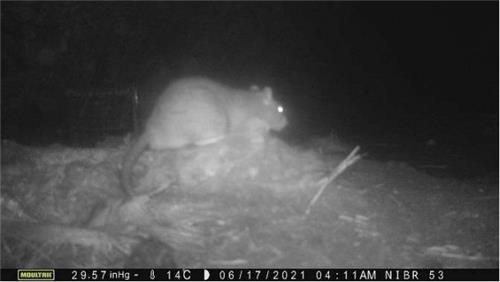 A house mouse captured by an unmanned sensor camera installed on Dokdo in 2021. [Photo by Daegu Regional Environmental Office]
A representative from the Daegu Regional Environmental Office explained, "We were aware of the house rat issue on Dokdo, but due to difficulties in accessing Dokdo and selecting the executing agency, the management project did not progress well. Recently, however, related organizations have united their will to devise countermeasures," adding, "The project will focus on conducting a field survey and establishing appropriate management plans."
The fact that house rats had infiltrated Dokdo, which is designated as the first specific island and a natural protected area, was officially confirmed for the first time in 2010 during the Dokdo ecosystem monitoring when a carcass was found near the gravel beach of Seodo's Molgol. House rats have been confirmed on Dongdo since 2015.
House rats are currently the only confirmed mammal species inhabiting Dokdo. According to last year's Dokdo ecosystem monitoring report, aside from humans, the Sapsal dogs raised by the Dokdo Coast Guard, and one seal observed near Dongdo's Buchae Rock in March last year, house rats are the only mammals present.
The number of house rats on Dokdo was estimated to be between 100 and 150 in 2021. Since they consume sea swallows and grass species and dig burrows throughout the area, disrupting the ecosystem, control measures are necessary.
According to three field surveys conducted last year, during the first survey, rat droppings were found at seven locations on Dongdo, and burrows dug by rats were identified near the solar power facility and the lighthouse. On Seodo, droppings were found at five locations, and burrows were observed behind fishermen's accommodations.
In the second survey, traces of house rats were found at a total of eight locations, with two burrows confirmed. During the third survey, Seodo was not surveyed, but on Dongdo, droppings were found at six locations, and two burrows were observed.
 A model of Dokdo installed at the Dokdo Volunteer Defense Corps Memorial Hall in Ulleung-gun, Gyeongbuk.
 Photo by Yonhap News
The area presumed to have the highest population of house rats on Dokdo is the Seodo residents' accommodations. Analyzing 29,410 images captured by five unmanned sensor cameras installed and operated on Dokdo from May to October last year, house rats were recorded a total of 716 times. The most frequent appearances, 359 times, were in videos taken near the Seodo residents' accommodations, followed by 126 times at Dongdo helicopter pad, 96 times at the lighthouse deck, 88 times at upper Seodo, and 47 times at Dongdo Manghyangdae.
A representative from the Daegu Regional Environmental Office stated, "The population density of house rats on Dokdo is increasing," and added, "The number of times they are captured by unmanned sensor cameras is also rising."
As with the exact number of rats, it is unclear how house rats arrived on this remote island about 200 km away from the mainland (Uljin-gun, Gyeongbuk). It is only presumed that they came aboard ships carrying people and cargo to Dokdo. Rats are good swimmers and can swim from a ship to the island even if the ship does not dock but only approaches close to the island.
The Daegu Regional Environmental Office plans to focus on appropriate management rather than complete eradication of house rats on Dokdo.
House rats are omnivorous with a diverse diet. Although their eyesight is weak, their sense of smell, taste, hearing, and touch are highly developed. Their reproductive capacity is strong enough that a pair can produce up to 460 offspring in a year, making eradication impossible. Moreover, eradication efforts can cause significant side effects.
In fact, the 2019 Dokdo ecological monitoring showed that after the government and private organizations conducted aggressive rat control on Dongdo and Seodo in 2018, the rats temporarily disappeared but surged again starting in 2019.
Furthermore, to prevent additional influx of house rats, human traffic would need to be halted, which is difficult considering Dokdo's historical and cultural significance.
Researchers who conducted a detailed ecological survey of Dokdo in 2020 pointed out, "Unlike other wild mammals, it is difficult to estimate the population of house rats," and noted, "The sudden expansion of the house rats' activity area on Dokdo appears to be related to past failed control efforts."
They added, "As the activity area and frequency of house rats have increased, a control strategy must be quickly established and actual control measures implemented," emphasizing, "The control period should not be short-term, nor should it be stopped midway."
© The Asia Business Daily(www.asiae.co.kr). All rights reserved.
![From Hostess to Organ Seller to High Society... The Grotesque Scam of a "Human Counterfeit" Shaking the Korean Psyche [Slate]](https://cwcontent.asiae.co.kr/asiaresize/183/2026021902243444107_1771435474.jpg)

















