Children's Ecological Education Program 'EQube School' Launches
Utilizing Everland's Massive Infrastructure
Learning Nature Love and Environmental Protection through Plant and Animal Experience and Research
Educational Programs Using Art Museum and Rides Included
"How many kilograms of food does a tiger eat in a day? The chicken we are currently feeding is about 1 kg."
"Yes. They eat about 7 kg. So that means they eat about 7 chickens."
"(Opening a box containing tiger teeth) These are tiger baby teeth. Would you like to see them up close? Tigers usually live 15 to 20 years, but these friends are 4 years old. Tigers are considered almost adults once they pass 3 years old."
Tiger Valley inside Samsung Everland in Yongin-si, Gyeonggi-do. Opening a small door on the right, two tigers appeared. Despite the considerable rain, the eyes of children and adults alike widened. They listened attentively to the caretaker's explanation, and cameras on mobile phones popped up here and there to take pictures.
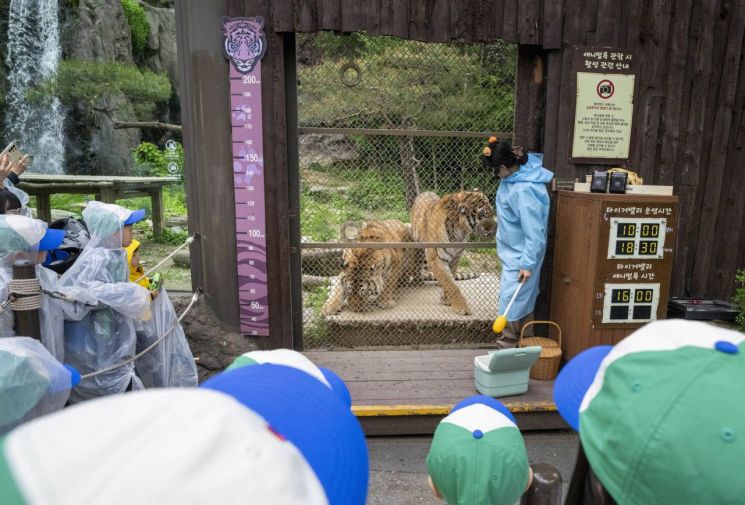 On the 15th, a zookeeper at Samsung Everland Tiger Valley opened the door to show a tiger to families participating in the E-Cube School and explained the tiger's characteristics. Photo by Samsung C&T Corporation
The tiger exploration was the highlight of the 'E³School Press Corps Experience Event' hosted by Samsung Everland on the 15th. Families accompanying the reporters recalled the moment they saw the tigers as the most memorable scene. It was especially so because they had never seen tigers so close in their lives. The large body weighing about 110 kg moving side to side and climbing the protective net is still vivid in their minds. It seemed clear why ancestors mentioned battles with tigers as a measure of strength. Many folktales and old documents describe heroes as warriors by telling stories like "He fought and defeated a tiger, carrying its skin back home." What was certain was that seeing tigers up close that day was a rare experience for both children and adults. The caretaker also explained, "During the Japanese colonial period, Japanese people hunted tigers extensively, but recently, as mountains and forests have been heavily developed, places where tigers can live have disappeared, so nowadays, tigers are almost never seen in our country."
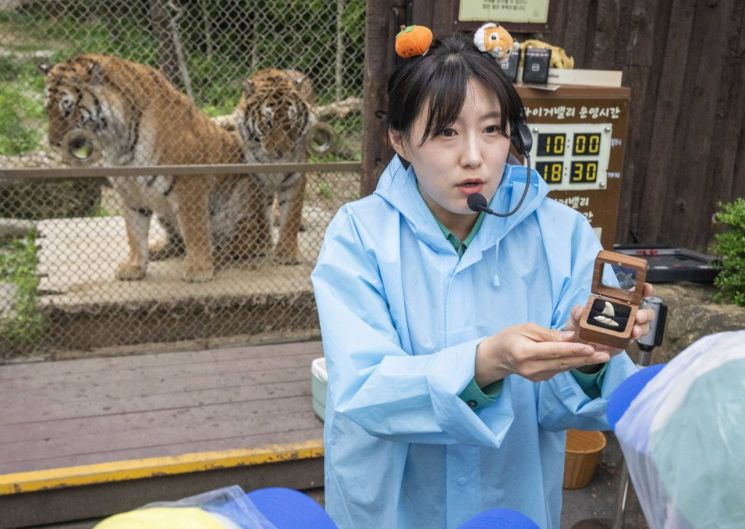 At Samsung Everland Tiger Valley, a zookeeper is showing the teeth of a tiger to families participating in the E-Cube School and explaining about them. Photo by Samsung C&T Corporation
E³School is a children's ecological education program run by Everland, operated by Samsung C&T Resort Division. It is an upgraded version of the animal and plant love group that Everland originally conducted. Children from pre-elementary to 4th grade can participate. Participating students explore animals and plants at E³School and develop a love for nature, environmental protection awareness, and insight through this. The purpose of the program is to enrich the lives of young students. The program was developed with the participation of educational experts, including the Korean branch of the U.S. edutech company Wonderland Education and the Korea Environmental Education Institute, which cooperates with public institutions on ecological and environmental education, to foster children's creativity and convergent thinking. Students were recruited on a first-come, first-served basis from March 25 to 27, and the program started this month and will run until February next year.
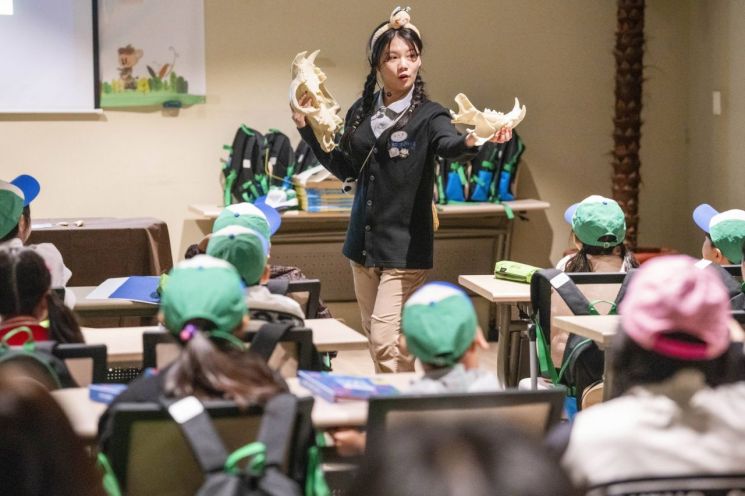 On the 15th, a teacher at Samsung Everland E-Cube School is showing and explaining a tiger skull to participating students. Photo by Samsung C&T Corporation
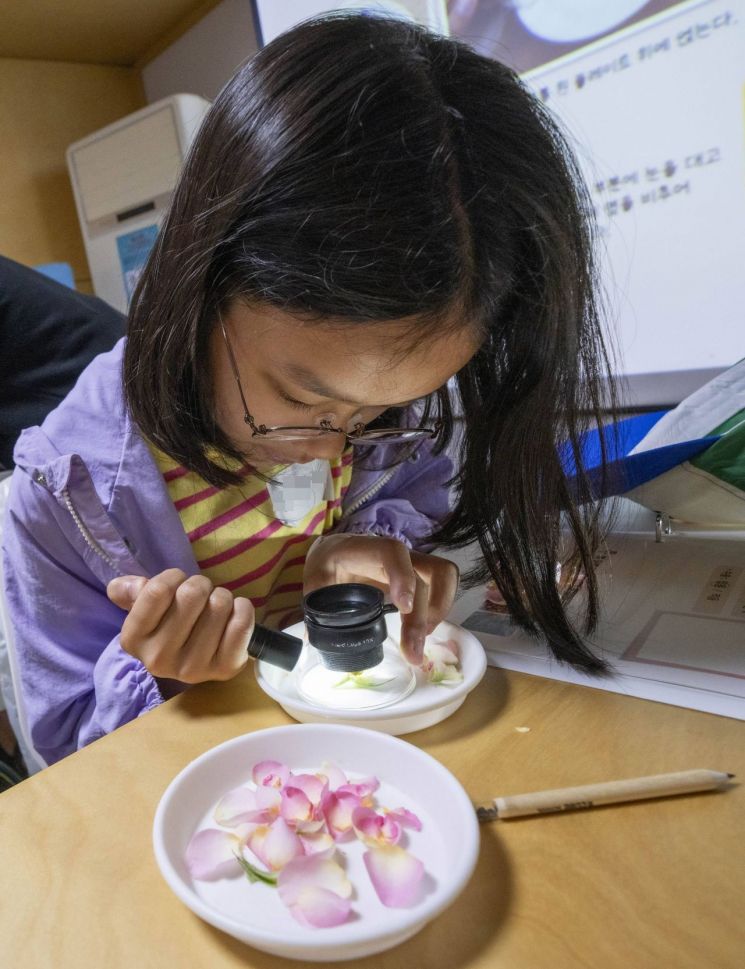 A student participating in Samsung Everland E-Cube School is observing a rose with a mini microscope. Photo by Samsung C&T Corporation
E³School seemed to be born from Everland's shift in perspective. Beyond a simple amusement park, it has leveraged its vast infrastructure to become a new educational venue. An Everland official mentioned "the world's largest school" as one direction Everland aims to pursue through E³School. Looking closely, Everland has the potential to be the best educational place for children. There is a zoo where they can experience ecosystems firsthand, and nearby cultural facilities such as Hoam Art Museum can be linked. The rides embody principles of motion found in physics, and the machinery's equipment and installation methods offer aspects for children to observe.
It appears Everland did not overlook this point. E³School is structured into three main courses: Club, Project, and Leadership. Within these are programs such as 'Make-KArt,' where children build and ride small electric cars; 'Living Lab,' which uses scientific experiments to explain why people feel tense and scared on roller coasters; and 'Goldberg Machine,' where children learn the principles behind rides and design and build machines themselves. During the E³School experience event on the 15th, participants studied tigers and roses. Although tigers belong to the cat family, they have unique characteristics, and the red leaves and thorns of roses were examined. Following the program concept of writing a 'Secret Exploration Notebook to Future Life Scientists 200 Years from Now,' the students summarized their research in letters to conclude the education.
Everland stated, "We developed E³School to offer children a more systematic and scientific approach to animals and plants," adding, "We hope this will foster love for nature and surrounding living beings."
© The Asia Business Daily(www.asiae.co.kr). All rights reserved.



















