"Companies Secretly Conduct Construction for Prospective Tenants to Hide Poor Quality"
Repeated Poor Construction Caused by Unrealistic Time Reduction
An apartment in Daegu is alleged to have carried out repair work by shaving about 16cm off the already constructed emergency staircases to meet the floor-to-floor height regulations before completion.
According to Yonhap News on the 18th, prospective residents of an apartment in Dalseo-gu reported, "The construction company shaved the stairs late at night," and "They secretly carried out the work to cover up defects without informing the prospective residents."
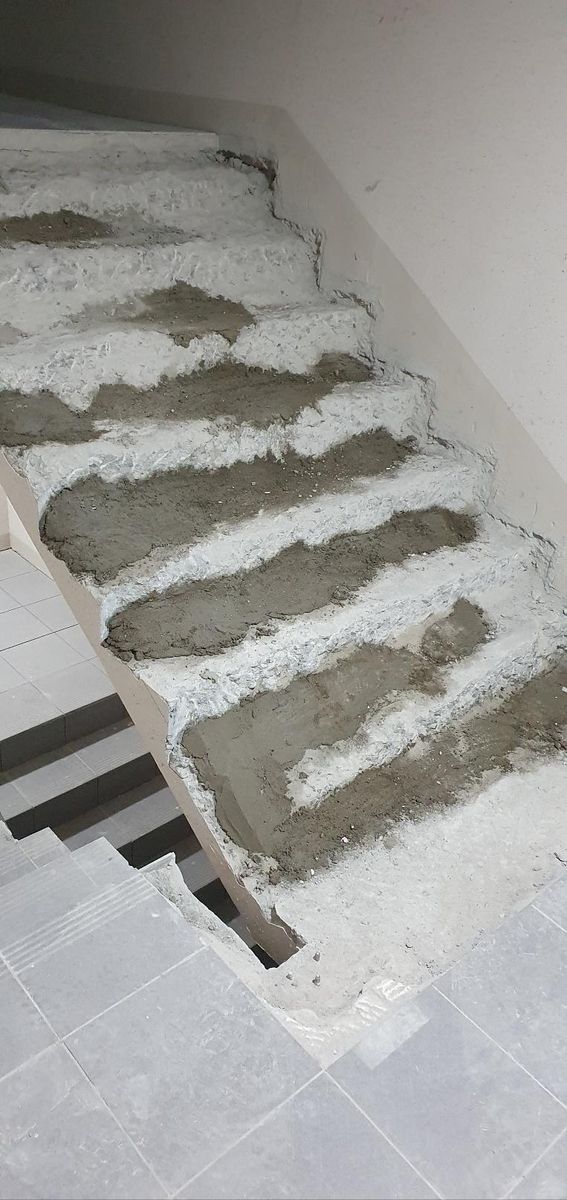 An allegation has been raised that an emergency staircase was secretly cut down to adjust the floor height in an apartment in Daegu nearing completion.
 Photo by Yonhap News
According to the "Regulations on Standards for Evacuation and Fireproof Structures of Buildings," the effective height between stair floors must be at least 2.1 meters. However, some stair floor heights in this apartment measure only 1.94 meters.
Ultimately, the prospective residents claim that the construction company shaved each stair by about 16cm to meet the 2.1-meter standard.
They expressed outrage, saying, "It seems they forced the work to secure the stair height because they feared they would not receive completion approval due to violating the Building Act," and "If people crowd on the shaved stairs, a collapse accident could occur, leading to a major disaster."
They also reported ongoing defect complaints such as wall warping, parking lot cracks, and leaks, urging authorities to conduct a thorough investigation. Currently, the local district office has received a request for completion approval for the apartment.
A district office official stated, "The person in charge plans to visit the site for investigation," and added, "If it is judged that there is a safety issue making residence impossible, we have no choice but to withhold completion approval."
Meanwhile, disputes over defects in newly built apartments due to poor construction are occurring nationwide. Anxiety and dissatisfaction among prospective residents are growing, with tens of thousands of defects reported in some apartments.
In Daegu Buk-gu, 'Hillstate Daegu Station Opera' (1,207 households) has over 60,000 defects found, including wallpaper contamination and tile damage, leading about 300 prospective residents to hold a protest rally at the apartment construction site.
Additionally, in Gyeongsan, Gyeongbuk, 'Gyeongsan I-Park' (997 households) faced issues during a pre-inspection about a month before move-in at the end of March, such as improperly installed doors and lighting, water dripping from ceiling lights, torn wallpaper, and cracked exterior walls, all caused by poor construction.
One of the recurring causes of poor construction is the aggressive shortening of construction periods. Recently, developers and contractors prioritize shortening construction time to recover profitability lost due to high interest rates and rising raw material costs.
Lowest-price bidding and illegal subcontracting practices are also cited as major causes. Since clients prioritize cost reduction, construction companies lower their bids, and subcontractors cut material and labor costs to save expenses, inevitably leading to construction problems.
Given that about 4,000 defect-related dispute cases are handled annually by the Defect Dispute Mediation Committee, there are calls for social public discussion on this issue.
Ko Jong-wan, president of the Korea Asset Management Research Institute, said in an interview with TV Chosun, "From the perspective of prospective residents, even if defects occur due to poor construction, many hesitate to speak out openly because they fear it will negatively affect housing prices," and added, "There is a need to establish a public interest organization to publicize defects caused by poor construction and to resolve them promptly."
© The Asia Business Daily(www.asiae.co.kr). All rights reserved.
![User Who Sold Erroneously Deposited Bitcoins to Repay Debt and Fund Entertainment... What Did the Supreme Court Decide in 2021? [Legal Issue Check]](https://cwcontent.asiae.co.kr/asiaresize/183/2026020910431234020_1770601391.png)















