12.3% of Paramedics in 2022 Unqualified
Most Drivers Lack Medical Certifications
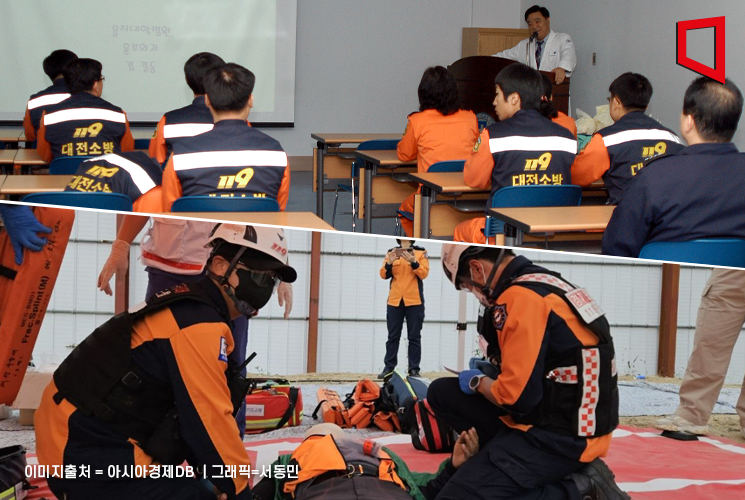
It has been revealed that a significant number of ambulance drivers transporting emergency patients to medical institutions are unqualified personnel without medical-related certifications. Since drivers also perform various auxiliary tasks on-site, there are calls to strengthen the qualification requirements to support them in obtaining medical-related certifications.
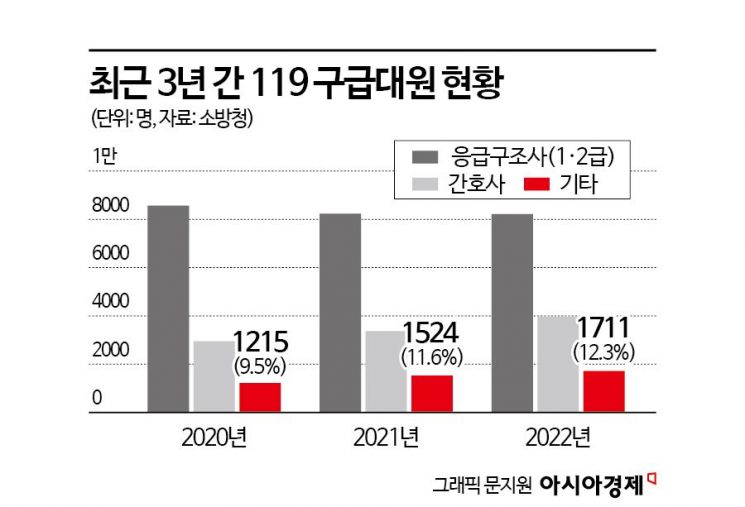
According to the '2023 Statistical Yearbook' by the National Fire Agency on the 20th, the proportion of 'unqualified' ambulance personnel without medical-related certifications among all 119 emergency responders increased by 3 percentage points from 9.5% in 2020 to 12.3% in 2022. The number of unqualified ambulance personnel has steadily increased over the past three years. They numbered 1,215 in 2020, rising to 1,524 in 2021 and 1,711 in 2022.
An official from the National Fire Agency explained, "Unqualified ambulance personnel are those who have completed emergency training conducted by the National Fire Agency but do not hold any medical-related certifications. Depending on the school, the total fire training period they receive is about six months, of which the emergency training period is approximately two weeks."
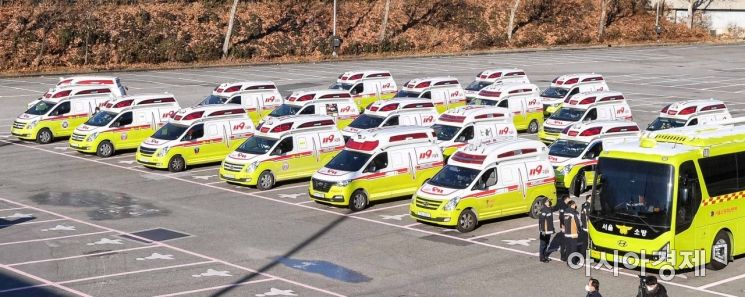 On December 14, 2020, when confirmed cases of the novel coronavirus infection (COVID-19) were rapidly increasing in the Seoul metropolitan area, an order to mobilize additional 119 ambulances was issued to support the transport of COVID-19 patients at the Jamsil Sports Complex parking lot in Songpa-gu, Seoul. Photo by Kang Jin-hyung aymsdream@
According to current law, ambulance personnel allowed to board an ambulance are broadly classified into four categories: ▲ medical professionals (those who have obtained a nursing license) under Article 2, Paragraph 1 of the Medical Service Act; ▲ persons who have obtained a Level 1 emergency medical technician certification under Article 36, Paragraph 2 of the Emergency Medical Service Act; ▲ persons who have obtained a Level 2 emergency medical technician certification under Article 36, Paragraph 3 of the Emergency Medical Service Act; and ▲ persons who have completed emergency work training conducted by the National Fire Agency.
Among these, those who have completed emergency work training conducted by the National Fire Agency are individuals without medical-related certifications who complete approximately six months of training conducted by the National Fire Agency before being assigned to the field. Since they are effectively unqualified, they cannot perform direct emergency treatment and can only perform ambulance driving and auxiliary tasks related to emergency services.
Because professional personnel with medical certifications are deployed as treatment staff, most drivers are filled by unqualified personnel. Han Mo (37), an ambulance worker in Suwon, Gyeonggi Province, said, "Due to the severe shortage of personnel dispatched to the field, most professional personnel with nursing or emergency medical technician certifications are assigned as treatment staff by the patient's side, and unqualified personnel take the driver's seat. Drivers are those who have completed a few weeks of training at the fire academy, and their medical knowledge level is almost no different from that of ordinary people."
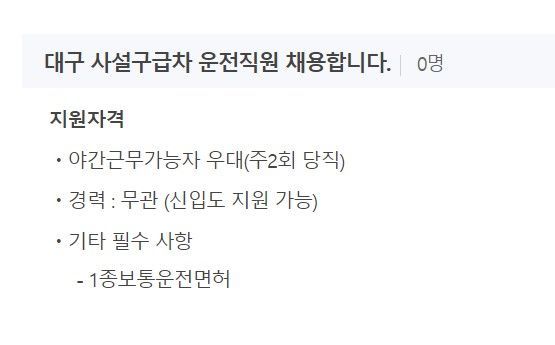
The situation is somewhat better for the 119 ambulance teams. According to the investigation, in private ambulance teams, most drivers only hold a 'Class 1 regular driver's license' and do not undergo mandatory medical-related training. In fact, job postings seeking private ambulance drivers specify only a 'Class 1 driver's license' as a required qualification, with no medical certification required.
Emergency responders working on-site expressed difficulties due to the high number of unqualified drivers. Depending on the situation, drivers are also deployed for various auxiliary tasks, and without relevant medical knowledge, this could potentially harm patients.
Choi Mo (42), who has been working as an emergency medical technician for 13 years, said, "When personnel are insufficient, there are times when a team of just a professional and a driver is dispatched, and in such cases, the driver is inevitably involved in auxiliary tasks. Drivers should also be composed of individuals who have obtained relevant certifications to prepare for severe cases or CPR patients."
Experts also unanimously agreed that qualification requirements for ambulance drivers should be strengthened. Kang Kyung-soon, an adjunct professor in the Department of Emergency Medical Services at Gachon University, stated, "It is problematic that drivers cannot do anything during emergencies or when manpower is lacking. In some countries, drivers are required to have medical knowledge comparable to treatment personnel as a basic standard. The domestic situation also needs improvement."
© The Asia Business Daily(www.asiae.co.kr). All rights reserved.














