Urging Medical Professionals to Join the Medical Reform Special Committee
Raising the Need for Establishing the National Defense Medical College
Requesting Opposition Party for Cooperation to Resolve Livelihood Issues
The People Power Party expressed its welcome on the 17th regarding the court's dismissal of the injunction lawsuit to suspend the expansion of medical school quotas, and urged medical professionals to return to the field.
On the same day, Chu Kyung-ho, the floor leader, said this during the People Power Party's floor strategy meeting held at the National Assembly in Yeouido, Seoul, in the morning, adding, "Please return to your original positions. We hope you will come back to the negotiation table."
The Seoul High Court Administrative Division 7 (Chief Judge Gu Hoe-geun) dismissed or rejected the injunction application filed by 18 people including medical school professors, residents of university hospitals, and medical students against the Ministers of Health and Welfare and Education, requesting the suspension of the effect of the decision to increase and allocate 2,000 medical school quotas. The court recognized the applicants' eligibility but ruled that there is a concern that it could have a serious impact on public welfare.
Floor leader Chu said, "The judiciary's judgment cannot solve all problems, but we will continue a close cooperative system with the government so that the public no longer feels confused," and urged medical professionals to also participate in the Medical Reform Special Committee.
Early Resolution of Social Confusion over Medical School Quota Expansion Needed... Launch of the Establishment of the Defense Medical College
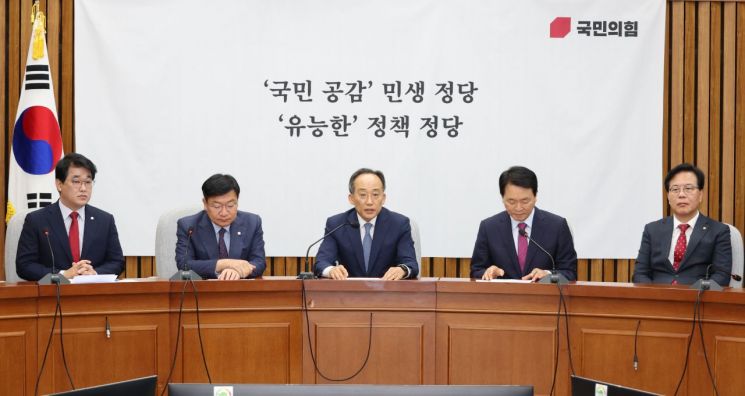
There were also calls to end the confusion related to the expansion of medical school quotas following this ruling. Policy Committee Chair Jeong Jeom-sik said, "The court has taken a very serious view that the current reality, where essential medical services are collapsing and regional medical gaps are worsening, can no longer be ignored," adding, "We hope that the social confusion and conflicts surrounding the medical school quotas will be resolved early with the appellate court's ruling."
Regarding medical reform such as improving treatment for essential and regional medical services, he emphasized, "We will do our best to ensure that the government's proposed special account for essential medical services and the establishment of the Regional Medical Development Fund can be implemented promptly."
The necessity of establishing a Defense Medical College was also reiterated. Secretary General Sung Il-jong pointed out, "In the past 10 years, the number of long-term military medical officers has not exceeded single digits," adding, "We are in a very serious situation where there is a shortage of skilled medical personnel who can treat severe trauma patients in emergencies. Among the total military personnel of 480,000, there are only about 130 long-term military medical officers." This underscores the need for skilled military doctors to ensure the safety and health of soldiers and to prepare for large-scale non-medical emergencies such as pandemics.
Secretary General Sung continued, "The establishment of the Defense Medical College is both a matter of public livelihood and national security," and said, "As the floor whip of the 21st National Defense Committee, I had proposed this bill. I plan to reintroduce it in the 22nd National Assembly," urging bipartisan cooperation between the ruling and opposition parties.
Ruling Party Hopes for Cooperation with Woo Won-sik and the Opposition... Critical Voices Toward Lee Jae-myung
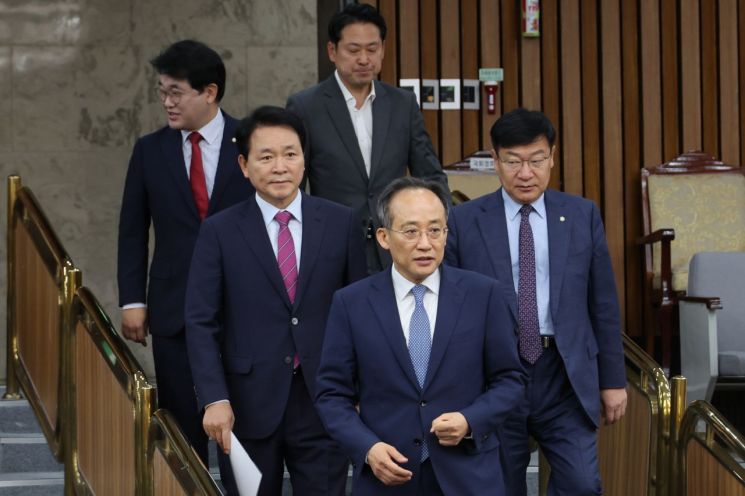
The importance of cooperation to resolve livelihood issues was also reiterated. Floor leader Chu recalled Woo Won-sik, a member of the Democratic Party who won the first half of the 22nd National Assembly Speaker election, saying, "I remember that when Woo was the floor leader of the Democratic Party in 2017, he formed a consultative body for cooperation among the ruling party, opposition, and government, and he earnestly worked for compromise at key moments."
He added, "In the National Assembly, the atmosphere of dialogue is important, and Woo's words that he will respect negotiations and consultations between the ruling and opposition parties resonate deeply and raise great expectations," and expressed hope that "he will serve as a bridge to enable cooperation through dialogue and compromise rather than conflict and struggle between the ruling and opposition parties in the future."
Senior Deputy Floor Leader Bae Jun-young said, "The unilateral passage of bills without bipartisan agreement often results in the president exercising the veto power. I deeply regret that this has been repeated due to the Democratic Party's dominance in this government," and proposed that the 22nd National Assembly should create coexistence and cooperation.
On the other hand, he repeatedly criticized Lee Jae-myung, the leader of the Democratic Party. Secretary General Sung evaluated the victory of Woo, not Chu Mi-ae, who was known as 'Myeongshim,' in the Speaker election as "a stern warning to Lee, who tried to manipulate the Speaker position by going against public opinion with Myeongshim and relying on 'Gaeddal' (a term for Lee's supporters)."
He added, "This result also sends a serious message to the Democratic Party leadership election scheduled for August," emphasizing, "If dictatorship within the party occurs again, it will inevitably bring great misfortune to the Republic of Korea."
© The Asia Business Daily(www.asiae.co.kr). All rights reserved.
!["The Woman Who Threw Herself into the Water Clutching a Stolen Dior Bag"...A Grotesque Success Story That Shakes the Korean Psyche [Slate]](https://cwcontent.asiae.co.kr/asiaresize/183/2026021902243444107_1771435474.jpg)

















