Manufacturing Employment Increases by 100,000
Unemployed Also Rises to 80,000s... Largest Increase in Over 3 Years
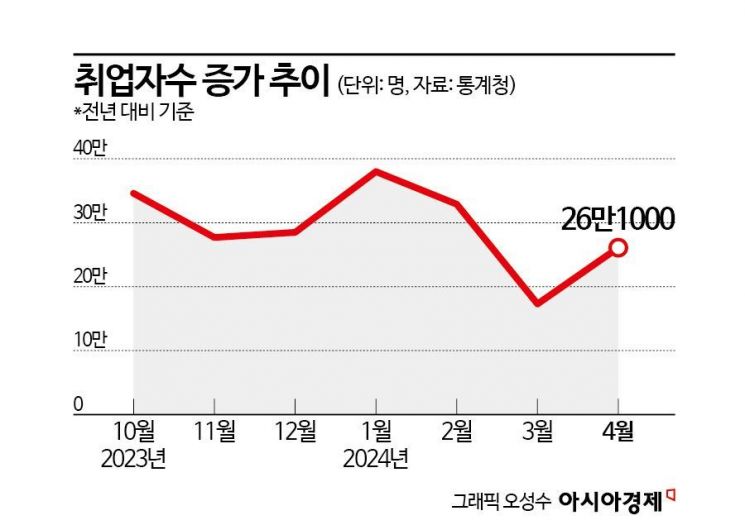
The number of employed people in April increased by 261,000 compared to the same month last year, restoring the employment growth rate to the 200,000 range. Manufacturing employment rose by 100,000 due to strong exports. The employment rate hit an all-time high since statistics began. However, the number of unemployed also increased by more than 80,000, marking the largest rise in over three years.
According to the 'April Employment Trends' released by Statistics Korea on the 17th, the number of employed people aged 15 and over last month was 28,693,000, up 261,000 from the same month last year. The employment growth, which had maintained the 300,000 range in January and February this year, sharply dropped to 173,000 in March but returned to an upward trend after three months. Employment has been increasing for 38 consecutive months since March 2021.
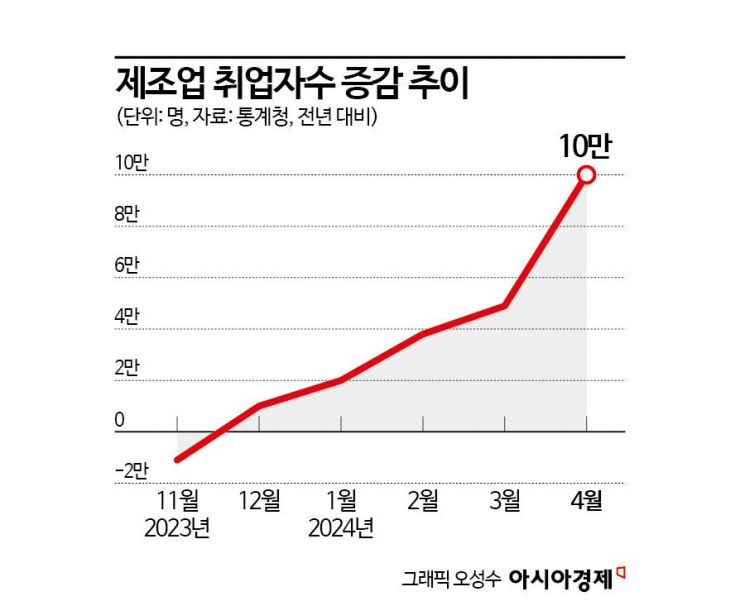
The increase in employment was particularly notable in manufacturing. Influenced by strong exports and a recovery in the semiconductor market, manufacturing employment rose by 100,000. This is the largest increase since November 2022, when it rose by 101,000. In February and March, it increased by 38,000 and 49,000 respectively. Manufacturing employment has increased for five consecutive months. Seounju, Director of the Social Statistics Bureau at Statistics Korea, explained, “Although there are differences by industry, the increase in employment due to strong exports has slightly expanded, and the decrease in other sectors has lessened, which collectively influenced the overall trend.”
With rising demand for care services, employment in health and social welfare services also increased by 93,000. Employment in information and communication industries rose by 68,000. However, employment decreased in business support and rental services (-66,000), education services (-49,000), and wholesale and retail trade (-39,000).
By age group, employment among youth (ages 15-29) decreased by 89,000, continuing an 18-month decline since November 2022. The youth unemployment rate rose by 0.4 percentage points year-on-year to 6.8%. However, the youth employment rate also increased by 0.2 percentage points from the previous year to 46.2%, returning to an upward trend after two months. The main employment age group in their late 20s saw the employment rate rise for 37 consecutive months, reaching 72.7%. Among those aged 60 and over, employment increased by 292,000, marking the largest growth. Those in their 30s and 50s also saw increases of 132,000 and 16,000 respectively.
The number of unemployed increased by 81,000 compared to the previous year, marking the largest increase in 3 years and 2 months since February 2021 (201,000). The number of unemployed has been rising for six consecutive months since November last year. By age, increases were seen among those aged 60 and over (39,000) and those in their 50s (26,000). The unemployment rate rose by 0.2 percentage points year-on-year to 3.0%, marking five consecutive months of increase.
Director Seo explained, “The number of unemployed was greatly influenced by the cumulative base effect from 2022 and last year, when employment increased significantly and unemployment decreased during the process of overcoming COVID-19.” He added, “In the case of those aged 60 and over, both employment and unemployment increased due to a significant rise in population.”
The employment rate for those aged 15 and over and the OECD comparison standard of 15-64 years both rose together. The employment rate for those aged 15 and over was 63.0%, up 0.3 percentage points from a year ago, the highest for April since monthly statistics began in July 1982. The employment rate for ages 15-64 also rose by 0.6 percentage points to 69.6%, the highest for April since related statistics began in January 1989.
The economically inactive population decreased by 174,000 (1.1%) from a year ago to 15,961,000. By gender, the number of inactive men was 5,972,000, up 32,000 (0.5%) year-on-year, while inactive women numbered 9,989,000, down 206,000 (-2.0%).
The Ministry of Economy and Finance forecasted that, amid a recovery trend centered on exports, signs of domestic demand recovery are also emerging, suggesting that favorable employment trends will continue for the time being. The ministry stated, “Both the employment rate and economic activity participation rate (65.0%) recorded all-time highs for April, maintaining a solid employment trend. However, risks such as sluggish construction orders remain, so we will support the creation of quality jobs in the private sector through dynamic economic implementation.”
© The Asia Business Daily(www.asiae.co.kr). All rights reserved.
![Clutching a Stolen Dior Bag, Saying "I Hate Being Poor but Real"... The Grotesque Con of a "Human Knockoff" [Slate]](https://cwcontent.asiae.co.kr/asiaresize/183/2026021902243444107_1771435474.jpg)


















