Vietnam's Correlation Between Public Import Volume and US Export Volume at 96%
White House Ends Tariff Exemption on Solar Panels from Vietnam and Others
ADB: "US Likely to Change Vietnam Policy After Presidential Election"
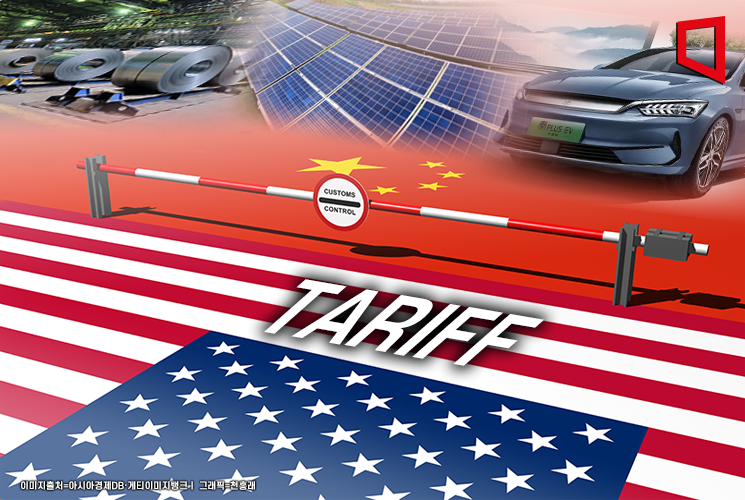
As the United States strengthens trade sanctions against China, there is renewed analysis that China is significantly increasing its indirect exports through Vietnam. With the Biden administration sharply raising tariffs on Chinese imports, there are expectations that after the November presidential election, the U.S. may also raise tariff barriers on imports from Vietnam. On the same day, the White House ended the tariff exemption on solar panels from four Southeast Asian countries, including Vietnam, to block China's indirect export routes.
According to major foreign media on the 16th (local time), Vietnam achieved a trade surplus of $105 billion through trade with the U.S. last year. Compared to 2018, when the Trump administration imposed high tariffs on Chinese imports, Vietnam's trade surplus with the U.S. increased by 2.5 times. As a result, Vietnam became the fourth largest region with a trade surplus with the U.S., following China, Mexico, and the European Union (EU).
What is noteworthy is that in recent years, the amount Vietnam imported from China and the amount Vietnam exported to the U.S. are similar. As of the first quarter of this year, the scale of U.S. imports of Vietnamese products was $29 billion. This is similar to the $30.5 billion Vietnam imported from China during the same period. According to the World Bank (WB), the correlation between these two figures was only 84% during the Trump administration but has now risen to 96%.
Darren Tay, Senior Economist at market research firm BMI, diagnosed, "The simultaneous increase in Vietnam's exports to the U.S. and the surge in Vietnam's imports from China suggests that Chinese companies are using Vietnam to evade additional tariffs imposed on their products."
This is analyzed as the effect of Chinese companies exporting parts to Vietnam, assembling finished products there, and then re-exporting them to the U.S. Chinese companies are relocating their production bases to Vietnam, a manufacturing hub in Southeast Asia, disguising their products as "Made in Vietnam" and pushing them into the U.S. market.
Some speculate that although the White House is currently silent on Vietnam's trade surplus with the U.S. due to inflation concerns, it will seriously address this issue after the November presidential election.
Nguyen Ba Hung, Senior Economist at the Asian Development Bank (ADB), said, "Regardless of who wins the election, changing policy toward Vietnam is a plausible scenario," adding, "However, U.S. import costs are expected to rise."
The U.S. government is taking steps to block China's indirect exports to the U.S. On the 14th, the White House sharply raised tariffs on Chinese electric vehicles and semiconductors, and on the same day decided to end the tariff exemption on Southeast Asian solar panels targeting China. Until now, the U.S. had temporarily exempted tariffs on solar panels produced in four Southeast Asian countries: Thailand, Vietnam, Cambodia, and Malaysia. However, judging that Chinese companies are assembling and exporting solar modules in Southeast Asian countries to evade U.S. tariffs, this exemption will end on the 6th of next month. Additionally, the 14.25% tariff exemption on bifacial solar panels targeting China will be reinstated.
The U.S. also plans to block China's exports to the U.S. via Mexico.
At a discussion at the Center for American Progress (CAP), a think tank in Washington D.C., White House National Economic Council Chair Lael Brainard emphasized cooperation with Mexico to prevent China from using factories in Mexico to indirectly export steel, electric vehicles, and other products to the U.S. She explained that the upcoming 2026 review of the United States-Mexico-Canada Agreement (USMCA) would be an opportunity for this. The U.S. applies lower tariffs on Mexican products based on the USMCA.
Chair Brainard stressed, "There must not be a second China shock in the U.S.," and added, "We will cooperate with our partners in the Group of Seven (G7) and Group of Twenty (G20) to promote our shared interests."
© The Asia Business Daily(www.asiae.co.kr). All rights reserved.
![Clutching a Stolen Dior Bag, Saying "I Hate Being Poor but Real"... The Grotesque Con of a "Human Knockoff" [Slate]](https://cwcontent.asiae.co.kr/asiaresize/183/2026021902243444107_1771435474.jpg)











