Arm swings freely below the shoulder
32 feet is the average 2-putt 'break-even point'
Reverse overlapping grip advantageous for distance control
Blade putter preferred over mallet putter needed
It is the perfect season for a round. The course conditions are gradually improving. However, as the greens get faster, weekend golfers find themselves in a dilemma. The culprit is the dreaded ‘3-putt.’ Even after a perfect tee shot and iron shot that successfully reach the green in regulation, players struggle on the green. A 3-putt is a ‘frustration’ that can occur throughout the round. Pars turn into bogeys, and bogeys become double bogeys. Despite good shots, collapsing on the green ruins the score. Cutting 3-putts in half can give you a significant advantage over your playing partners.
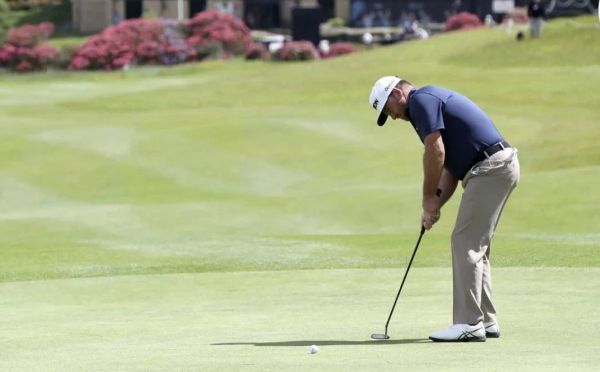 Graeme McDowell advised that to reduce three-putts, the arms should move freely below the shoulders at address.
 [Photo by Golf.com]
Most 3-putts result from poor distance control. This happens because of inconsistent contact and a lack of distance feel during the putting stroke. Without this skill, strokes are easily lost. Graeme McDowell (Northern Ireland), who won the 2010 major US Open, shared a tip to avoid 3-putts. He advised creating enough space for the arms to swing freely below the shoulders during the putting stroke address.
This allows for a smooth tempo swing without overusing the wrists or shoulders. Extending the arms fully or bending them excessively prevents an accurate stroke. The practice method is as follows: stand straight and extend your arms forward, holding the putter parallel to the ground. Bring your elbows inward until they almost touch the bottom of your rib cage. Bend forward until the putter touches the ground. Keep your elbows relaxed and make the stroke.
Jim Murphy, one of the top 100 instructors in the US, recommends practicing distance control on longer putts rather than short ones on the practice green. Murphy revealed that the optimal putting practice distance is 32 feet (approximately 9.7536 meters). This distance is the ‘break-even point’ for an average of 2-putts. Tour players tend to make more 1-putts than 3-putts when inside 32 feet, but beyond 32 feet, 3-putts occur more frequently than 1-putts. Putting from 32 feet allows practice of speed control and aim. Place three balls at 32 feet and putt them. If all are finished with 2-putts, move the hole to a different location and repeat the stroke.
The grip used is ‘reverse overlapping,’ not ‘left hand low.’ It is the same as gripping other clubs. When setting up the reverse overlapping grip, let both arms hang naturally, set the putter toward the target with the right hand, then place the left hand on top. This grip feels comfortable for amateur golfers as it is similar to gripping irons and makes distance control easier on long putts. Above all, a smooth tempo is crucial. Slightly push the ball during the impact phase.
Choosing the right putter is also important. If distance control is poor, opt for a blade rather than a mallet. When holding a blade putter with the middle of the shaft resting on the palm, the toe of the head points downward at an angle greater than 45 degrees. The toe opens and then slightly moves inward during impact, naturally creating an arc. The blade is thin and has a relatively high center of gravity, requiring precise center strikes and control. It is advantageous for distance control but has the drawback of a narrow sweet spot, making it more sensitive.
© The Asia Business Daily(www.asiae.co.kr). All rights reserved.












