The first indication of whether the government's plan to increase medical school admissions by 2,000 students will proceed as planned or be derailed according to the medical community's wishes will be decided at 5 p.m. on the 16th. This is because the Seoul High Court is scheduled to announce its appellate decision on whether to grant the suspension of enforcement requested by medical students, medical school professors, and residents against the government's decision to increase and allocate medical school admissions.
Even if granted, residents unlikely to return immediately
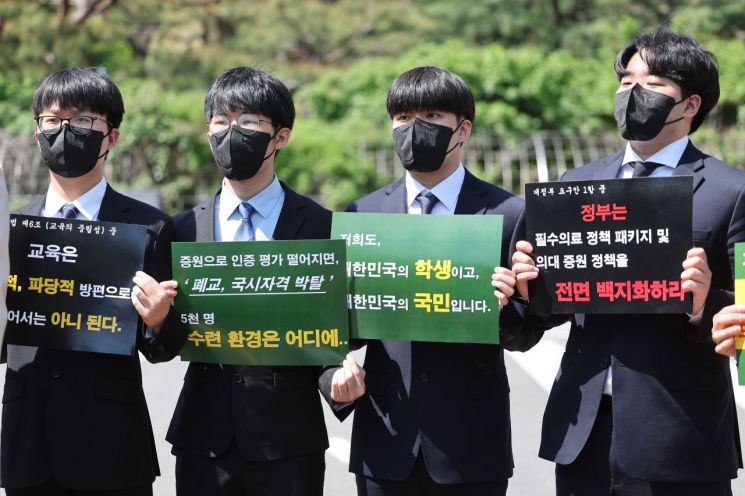 On the afternoon of April 22, local medical students held a press conference in front of the Seoul Central District Court in Seocho-gu, Seoul, regarding a provisional injunction lawsuit against the president of their university to prohibit changes to the university admission screening implementation plan.
 [Image source=Yonhap News]
If the Seoul High Court grants the suspension of enforcement, the Ministry of Health and Welfare's plan to increase medical school admissions by 2,000 will come to a complete halt. The Ministry has stated that it will immediately appeal to the Supreme Court if the suspension is granted, but since the number of admissions per university must be finalized by the end of this month, there will not be enough time for a final decision to be made before then, making it impossible to increase admissions for the 2025 academic year.
The key to resolving the medical service gap lies in whether residents return. Even if the provisional injunction is granted, residents who have resigned are unlikely to return to hospitals immediately. One former resident said, "Professors are creating an atmosphere that if the injunction is granted, residents should return to the hospital, but residents feel that the injunction should not be the end and that the government must provide a final confirmation to completely cancel the increase."
The decision on whether residents will return at the level of the Korean Intern Resident Association (KIRA) is also uncertain. A KIRA official said, "Regarding the residents who resigned on February 20, the decision on whether to return will be made through a general meeting of the entire association," adding, "The decision on returning can only be made after the KIRA general meeting is held."
The medical community is also expected not to soften its hardline stance even if the injunction is granted. Im Hyun-taek, president of the Korean Medical Association, responded, "Regardless of the injunction's outcome, we will do our best to oppose the flawed increase policy and the abolition of the essential medical package."
On the other hand, the government plans to continue pushing forward with the medical school admissions increase even if the court grants the injunction, so the medical service gap and emergency treatment situation are expected to continue for some time. Park Min-soo, the second vice minister of the Ministry of Health and Welfare, said at a briefing on the 13th, "If the injunction is granted, we will immediately appeal and seek a swift decision from the Supreme Court."
Meanwhile, if the injunction is granted, the Ministry's '4 Major Essential Medical Packages' announced in early February will also face difficulties. At that time, the government announced four major medical reform tasks focusing on ▲expanding medical personnel ▲strengthening regional medical care ▲establishing a safety net for medical accidents ▲enhancing fairness in the compensation system. Since the core of the essential medical package is the increase in medical school admissions, if the court grants the suspension of enforcement injunction, the entire package will lose its driving force.
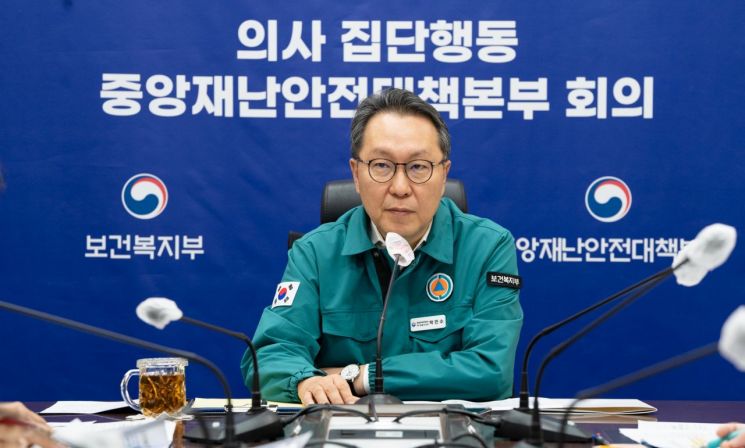 Park Min-su, Vice Minister of Health and Welfare, attending the 44th meeting of the Central Accident Response Headquarters for the medical community's collective action on the 14th.
 [Image source=Yonhap News]
If the Seoul High Court dismisses or rejects the suspension of enforcement application, the Ministry of Health and Welfare's plan to increase medical school admissions by 2,000 will be virtually confirmed. However, the intensity of opposition from the medical community, especially residents, is expected to increase further.
Kim Jong-il, chairman of the Seoul National University Medical School Professors' Association, said, "If the injunction is granted, residents who have any intention of returning hope to use this as a reason to come back, but if it is dismissed, the reason for returning will completely disappear." Im Hyun-taek, president of the Korean Medical Association, said, "Regardless of the dismissal of the injunction application, we will do our best to oppose the flawed increase policy and abolish the essential medical package." Lee Byung-chul, lawyer representing medical school professors and students (Law Firm Chanjong), said, "If the injunction is dismissed, we will immediately file a re-appeal."
If the injunction is dismissed, it is also of interest whether the government will carry out administrative sanctions such as license suspension against residents who have left. Since President Yoon Seok-yeol mentioned 'flexible sanctions' on the 25th of last month, the Ministry has suspended its original plan for 'mechanical sanctions.' Accordingly, the administrative procedures for license suspension against residents who violated the order to resume work (return) are currently on hold. A Ministry official said, "We have not yet reviewed any changes in administrative sanctions against residents who left due to the court's injunction decision."
Meanwhile, even if the injunction is dismissed or rejected, if the residents who left do not return within this month, it is highly likely that their specialist qualification exams will be postponed until next year in principle. According to regulations on specialist training and qualification recognition, if a resident experiences a training gap within the training year, additional training must be completed, and if the additional training period exceeds three months, the timing of obtaining specialist qualification is delayed by one year. Since residents will have been away from medical sites for more than three months by the 20th, if they do not return within this week, their specialist qualification acquisition may be delayed by one year.
Vice Minister Park Min-soo firmly stated, "In principle, we are not considering any relief procedures such as postponing the specialist exam." At the briefing on the 13th, when asked whether various orders such as work resumption orders or prohibition of resignation acceptance orders would be withdrawn to induce residents to return, Vice Minister Park replied, "We are not considering that."
© The Asia Business Daily(www.asiae.co.kr). All rights reserved.
![Clutching a Stolen Dior Bag, Saying "I Hate Being Poor but Real"... The Grotesque Con of a "Human Knockoff" [Slate]](https://cwcontent.asiae.co.kr/asiaresize/183/2026021902243444107_1771435474.jpg)

















