Na "Distrust in pensions arises from low birth rates"
'Childbirth credit' applied from second child
Should apply to both parents from first childbirth
While promoting pension reform, there was an opinion that the 'childbirth credit' system should be significantly expanded and reorganized to simultaneously address low birth rates and population issues.
Na Kyung-won, the elected member of the People Power Party for Dongjak-eul, Seoul, and Yoon Chang-hyun, a member of the People Power Party, held a seminar titled “Low Birth Rate and Pension Reform for a Sustainable Tomorrow in Korea” at the National Assembly Members' Office Building on the 16th to discuss these issues.
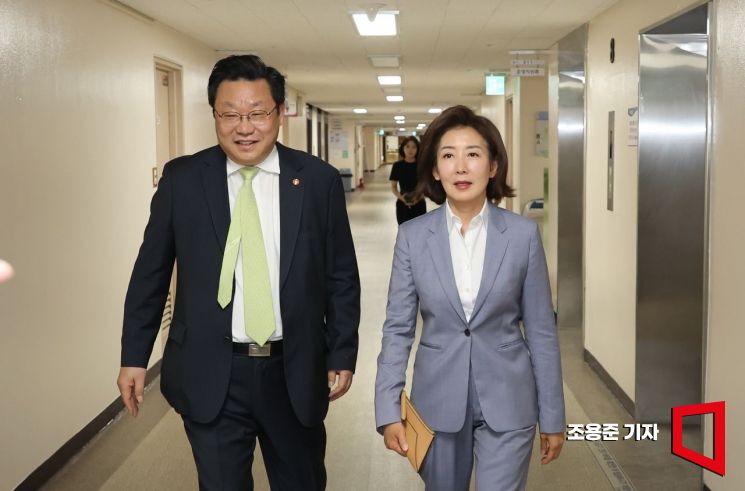 Na Kyung-won, the elected member of the People Power Party (former Vice Chair of the Low Birthrate and Aging Society Committee), visited the Low Birthrate and Aging Society Committee at the Government Seoul Office in Jongno, Seoul, on the 10th, receiving guidance from Vice Chair Joo Hyung-hwan. Photo by Jo Yong-jun jun21@
In her opening remarks, Na said, "Along with low birth rates, the pension issue is emerging," adding, "Distrust in pensions arises because of low birth rates. The concern is who will supplement the pension I paid when there is no future generation of future generations." She continued, "When thinking about whether there is a way to solve low birth rates linked to pensions, there is the childbirth credit system," and said, "There are criticisms that the linkage is not practically sufficient, so we need to reconsider it. We held this seminar to explore ways to increase the birth rate through pensions."
Yoon Chang-hyun, who co-hosted the seminar, also said, "The pension system is about trust. There must be confidence that future generations will receive pensions after paying pension premiums throughout their lives, but that confidence is lacking." Yoon emphasized, "I will do my best to create a good plan that future generations can accept."
Dr. Kwon Da-eun, a researcher at the Population Policy Research Office of the Graduate School of International Policy at the Korea Development Institute (KDI), who presented at the seminar, proposed revising the 'childbirth credit' system as a pension reform measure from the perspective of low birth rates.
Introduced in 2008, the childbirth credit system grants additional National Pension subscription periods to subscribers who have given birth to or adopted a second or subsequent child: 12 months for the second child and 18 months per child for the third child or more. The maximum recognized period is up to 50 months. As of June 2021, there were 2,494 childbirth credit recipients, of whom only 39 were women. The childbirth credit is recognized as subscription periods when National Pension subscribers who have paid premiums for more than 10 years claim old-age pensions. However, many women do not receive the actual credit benefits because they fail to meet the 10-year subscription period required for pension eligibility due to career interruptions caused by childbirth and childcare.
Dr. Kwon argued that "childbirth credits are applied economically more to men rather than to women, who are the main parties responsible for childbirth and childcare," and proposed that childbirth credits should be ▲recognized from the first child, granting 2 years per child (1 year for the father + 1 year for the mother), ▲supported at the time of occurrence rather than at the pension payment stage, and ▲renamed from 'childbirth credit' to 'childcare credit.' The discussion included Yoon, who focused on pension reform issues in the 21st National Assembly, Lee Kang-gu, a research fellow at KDI’s Fiscal and Social Policy Research Department, and Jung In-young, an associate researcher at the National Pension Research Institute’s Pension System Research Office. They shared the opinion that the financial requirements for each childbirth credit plan should be fully funded by the national treasury.
Meanwhile, as the low birth rate issue is expected to be the biggest topic in the 22nd National Assembly, about 20 elected members and current lawmakers, including Hwang Woo-yeo, the emergency committee chairman of the People Power Party, and Choo Kyung-ho, the floor leader, attended the seminar. Chairman Hwang said, "(Low birth rates) cannot be solved by a single measure; the entire nation must undergo readjustment and restructuring to resolve this issue," adding, "I hope this issue will be intensively discussed and a solution will be found in the 22nd National Assembly." Floor leader Choo added, "In the 22nd National Assembly, all members will unite to find alternatives that the public will welcome, trust, and accept."
© The Asia Business Daily(www.asiae.co.kr). All rights reserved.


















