'Financial Astrology' Linking Celestial Bodies and Stock Market Trends
Unpredictable Financial Markets Overflow with Superstitions
On the 8th of last month, when the total solar eclipse over the North American continent captured the world's attention, some Wall Street investors were preoccupied with observing a different phenomenon: whether the New York stock market would rebound in sync with the eclipse. It may sound absurd, but from 1990 to 2017, there were a total of 13 total solar eclipses over the American continent, and reportedly, the stock market rose 10 times during those events.

How did this recent total solar eclipse fare? On April 8, the three major U.S. stock indices closed flat. However, it cannot be conclusively said that there was no 'eclipse effect' at all, as the market appeared to somewhat recover from the overall weakness of the previous week.
Is it possible to read stock market movements through celestial phenomena? With the advancement of astronomy, astrology has long been relegated to the realm of superstition and pseudoscience. Yet surprisingly, even on Wall Street, which has developed the most advanced financial engineering on Earth, there are still a very small number of investors who explore 'financial astrology.'
'Are there investors who use astrology?'
Modern finance is a highly complex engineering discipline. Equity analysis and research mobilize cutting-edge data science, mathematics, computer engineering, and even artificial intelligence (AI) models. It is not uncommon for famous AI startups to be founded by engineers from investment firms or hedge funds.
Is there really room for superstition like astrology to intrude into such a highly developed industry? Ironically, belief in financial astrology has coexisted with the financial industry for quite some time.
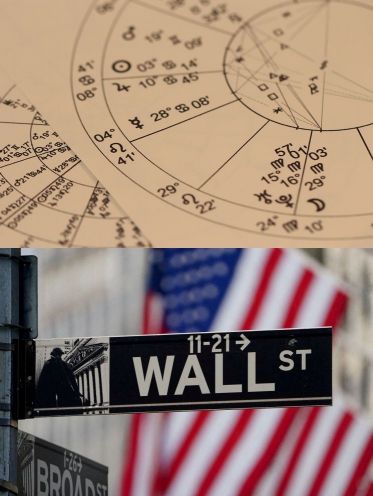
For example, the possibility of an 'eclipse rally' was already a hot topic days before this year's total solar eclipse. Local U.S. news and financial newsletters engaged in intense debates about the Dow Jones Index's movements during past eclipses.
In the past, financial astrologers even worked directly as 'predictors' on Wall Street. A magazine called 'Wall Street Predictor' forecasted movements of the U.S. stock market and Treasury yields using astrology from 1992 to 2008, and in 2002, it even achieved the highest accuracy among forecasting institutions. Although very few, there are asset managers and analysts who promote financial astrology as a stock analysis tool.
Experts also stumble in this unpredictable industry... 'Superstition' is inevitable
So, does financial astrology actually exist? The answer is very likely 'no.' Even if someone claiming to predict stock values through astrology shows a high accuracy rate.
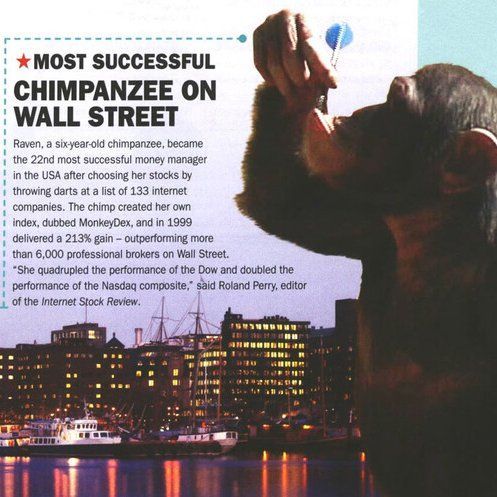 In 1999, the chimpanzee "Raven" made headlines by outperforming 6,000 professional Wall Street investors. It remains a prime example of how sometimes financial market predictions can be utterly meaningless. [Image source=Guinness Book X]
The problem lies in the fact that financial market movements are inherently extremely difficult to predict. For example, in 1999 in the U.S., a chimpanzee named 'Raven' threw darts to select stocks, creating a portfolio called 'MonkeyDex,' which outperformed about 6,000 professional Wall Street investors that year.
In other words, even completely randomly selected data can, when lucky, outperform investors with professional knowledge in the financial market. When market volatility is too high, predictions themselves may become meaningless. This explains why financial astrology's forecasts sometimes appear to be accurate.
However, thanks to the market characteristic of 'uncertainty,' financial astrology has survived to this day. Various superstitions or sayings still hold sway in the financial industry. Examples include the belief in the 'calendar effect,' which holds that market trends repeat periodically, and 'Sell in May,' the idea that the stock market declines in May.
There are so many such superstitions that Ken Fisher, founder of Fisher Investments, published a book titled The Investment Betrayal, debunking 50 Wall Street superstitions. Although the effects of superstitions like financial astrology have not been proven, they still seem to provide comfort to some investors and clients.
© The Asia Business Daily(www.asiae.co.kr). All rights reserved.
![Clutching a Stolen Dior Bag, Saying "I Hate Being Poor but Real"... The Grotesque Con of a "Human Knockoff" [Slate]](https://cwcontent.asiae.co.kr/asiaresize/183/2026021902243444107_1771435474.jpg)












