The atmosphere that was once favorable to K-defense has recently been changing, which poses a burden for our defense companies. As the war prolongs, the need to secure independent defense capabilities has emerged, and the global defense market is shifting toward a trend of prioritizing the use of domestic weapons.
Not only Poland, where a pro-European new government took office at the end of last year, but also Europe as a whole has begun to actively curb K-defense. French President Emmanuel Macron, in a speech last month at Sorbonne University in Paris to European Union (EU) parliament officials, advocated purchasing European-made weapons instead of Korean ones. Earlier, the EU Commission announced the European Defence Industrial Strategy (EDIS) in March, aiming to increase the share of European-made weapons from the current 20% to 50% by 2030 and to expand joint weapon procurement. Financial support for regional defense companies is also being pursued.
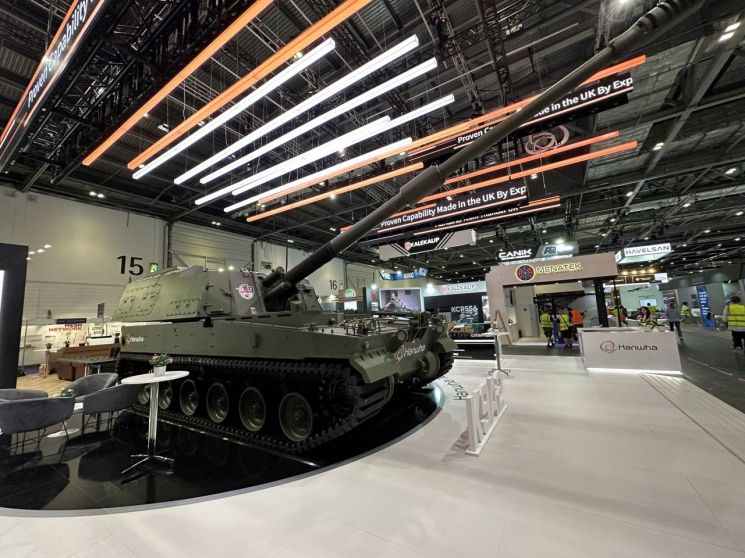 The new K9A2 self-propelled howitzer displayed at the center of the Hanwha booth at the global defense exhibition (DSEI) held in London, UK, from September 12 to 15 last year.
 [Photo by Hanwha Aerospace]
Recently, the United Kingdom decided not to even participate in the bidding for the next self-propelled artillery project and instead signed a sole-source contract with Germany, choosing the German RCH155, which is more expensive than Korea’s K9 self-propelled howitzer. Last year, Norway also selected the German-made tank, which is twice as expensive as Korea’s K2, for its new tank project. As the European trend to curb K-defense becomes more pronounced, the outcome of the Romanian government’s competition for self-propelled artillery and tank projects, involving Korea, Germany, and T?rkiye, cannot be guaranteed.
Japan, which had been quiet, has joined the defense competition by attempting to revise its defense guidelines to export next-generation fighter jets. The Japanese government allocated a record-high defense budget of 7.9496 trillion yen (approximately 70.7 trillion won) for the 2024 fiscal year (April 2024 to March 2025).
In the face of global containment, if the orders that Korean defense companies have secured through fierce competition fall through, it may be difficult to seize opportunities again. A defense industry official said, "There is still a preference for Korean weapons in Poland, but since the new government took office, there is a movement on the other side to replace them with domestic self-propelled artillery," adding, "Our government needs to take a more proactive approach."
© The Asia Business Daily(www.asiae.co.kr). All rights reserved.
!["I'd Rather Live as a Glamorous Fake Than as a Poor Real Me"...A Grotesque Success Story Shaking the Korean Psyche [Slate]](https://cwcontent.asiae.co.kr/asiaresize/183/2026021902243444107_1771435474.jpg)
















