Use of Self-Service Kiosks Increased 5 Times Compared to 2019 Last Year
More Usage in Franchises and Larger Sales Scale
Sales Increased by 8.9% When Using Self-Service Kiosks
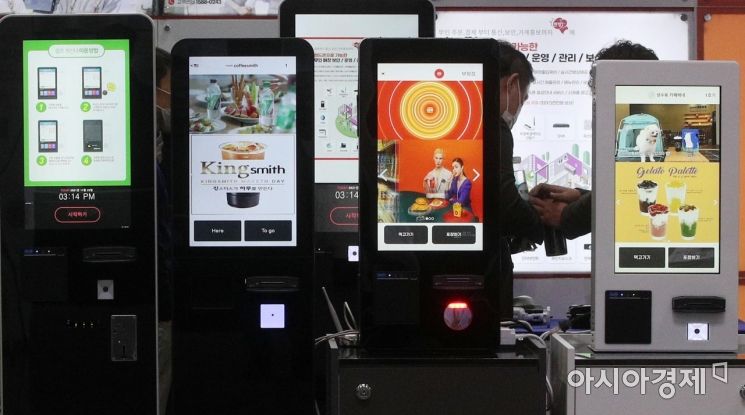
The food service industry is rapidly adopting food tech technologies such as unmanned ordering machines to address labor shortages and wage issues. Last year, the adoption rate of unmanned ordering machines among domestic food service businesses increased more than fivefold compared to 2019.
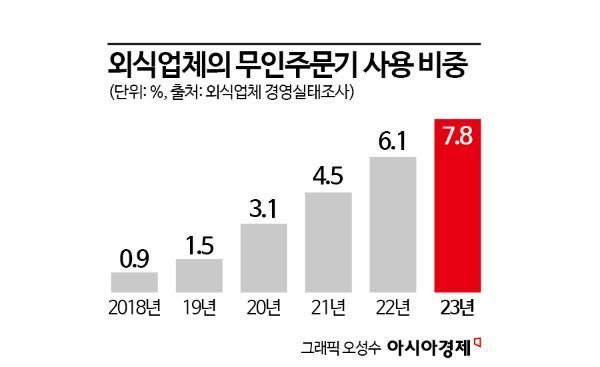
According to the "Analysis of the Impact of Unmanned Ordering Machine Utilization on Sales and Employment in Food Service Businesses" by the Korea Rural Economic Institute on the 15th, the proportion of domestic food service businesses using unmanned ordering machines last year was 7.8%. The usage rate, which was around 0.9% in 2018 when the survey began, rose to 1.5% the following year, and after the COVID-19 pandemic, it increased steadily to 3.1% in 2020, 4.5% in 2021, and 6.1% in 2022.
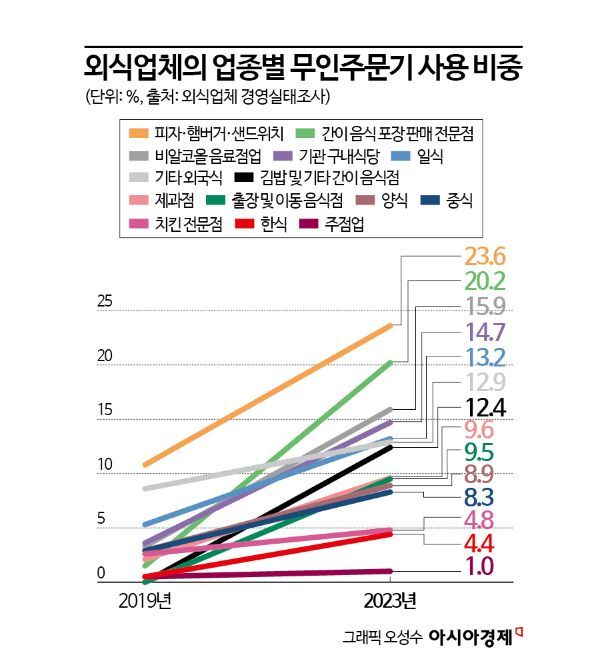
Looking at the usage status by industry, as of last year, pizza, hamburger, sandwich, and similar food service businesses had the highest usage rate at 23.6%, followed by simple food packaging specialty stores (20.2%) and institutional cafeterias (14.7%), which also showed high tendencies to use unmanned ordering machines. On the other hand, pubs had the lowest adoption rate at 1.0%, and Korean food (4.4%) and chicken specialty stores (4.8%) also had relatively low usage rates of unmanned ordering machines.
By operation type, unmanned ordering machines were mainly used in food service businesses operated as franchises. This is interpreted as consistent with the high adoption rates in franchise-operated sectors such as pizza and hamburgers. As of last year, the usage rate of unmanned ordering machines in franchise businesses was 17.0%, nearly four times higher than the 4.7% in non-franchise businesses.
Additionally, the larger the sales scale of the food service business, the higher the usage rate of unmanned ordering machines. As of last year, the usage rates by sales scale were highest for businesses with sales over 500 million KRW at 11.6%, followed by those with sales between 100 million and 500 million KRW (8.8%), 50 million to 100 million KRW (5.1%), and under 50 million KRW (3.3%). However, the usage rate is rapidly increasing even among food service businesses with sales under 100 million KRW, indicating that the use of unmanned ordering machines is spreading increasingly among small-scale food service businesses.
The reason food service businesses are actively expanding the adoption of unmanned ordering machines is that their use directly leads to increased sales. In fact, the survey found that the use of unmanned ordering machines increases food service business sales by approximately 8.9%. The use of unmanned ordering machines enables faster ordering, increasing store turnover rates, and the provision of menu photos is believed to raise the probability of additional orders.
On the other hand, the number of regular employees decreased by 0.054 persons, while the number of non-regular employees increased by 0.114 persons. Labor savings from using unmanned ordering machines mainly result from reductions in regular employees, while additional labor demand due to increased sales is met through non-regular employees. According to the report, since the duties of regular and non-regular employees in food service businesses are not clearly distinguished, the differing effects of unmanned ordering machine adoption by employment status are thought to be due more to employment flexibility and relative wage differences than to the content of the replaced tasks.
Meanwhile, kiosk-type unmanned ordering machines accounted for 67.0%, making up more than two-thirds, followed by customer smartphones (28.3%) and tablet PCs (4.0%).
© The Asia Business Daily(www.asiae.co.kr). All rights reserved.














