Disagreement Over 7.5% Base Salary Increase
Crew Members "Should Raise More" VS Office Workers "Let's Accept for Now"
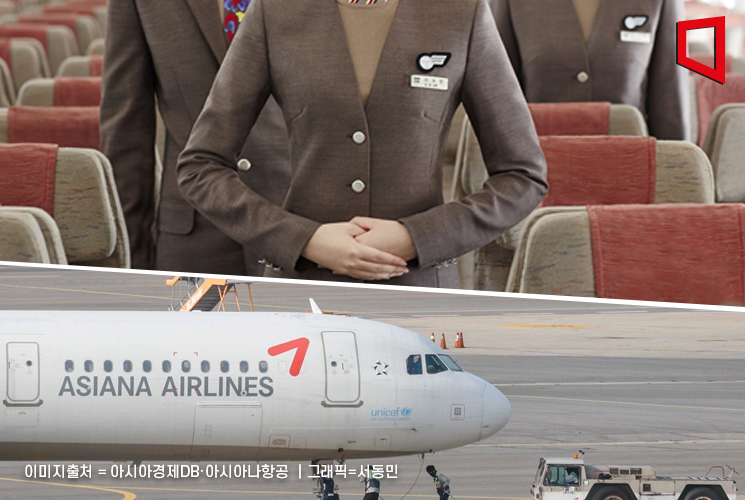
Wage negotiations to increase the base salary by 7.5% have ultimately failed due to disagreements between Asiana Airlines flight attendants and general staff. Tensions are rising among union members within Asiana Airlines ahead of the merger with Korean Air.
According to industry sources on the 14th, the Asiana Airlines General Staff Union held a vote among its members on a proposal from management at the end of last month, which included a 7.5% base salary increase and payment of safety incentives equivalent to 100% of the base salary, but the proposal was rejected. This was largely due to strong opposition from the cabin crew, who make up the majority of the general staff. Earlier this month, the pilots' union accepted a similar agreement involving a 7.5% base salary increase and 100% safety incentive payment, which has further fueled discontent among other general staff members in maintenance, office, and field departments.
Flight attendants argue that since their annual salary structure consists of a low base salary and high allowances, a higher rate of increase is necessary. They believe there are relatively fewer promotion opportunities compared to other general staff, so there are limited chances to significantly raise their wages, making it essential to substantially increase the base salary at this time.
Another source of dissatisfaction is the historically low wage increase rates by the company. In fact, wages for Asiana Airlines employees were frozen from 2019 to 2021, the period most severely impacted by COVID-19. The only increase was a 2.5% base salary raise in 2022. Considering inflation rates, real income has effectively declined over the past four years. As of last year, the average annual salary including pilots was around 75 million KRW, while the average for general staff was only about 60 million KRW.
On the other hand, general staff excluding flight attendants expressed frustration, saying they have no choice but to accept the company's proposed increase rate. One employee said, "Even accepting the 7.5% base salary increase proposal would provide some relief and allow us to receive proper compensation if we change jobs," adding, "Wage negotiations have stalled and promotions are completely 'on hold,' which is very frustrating."
The resumption of wage negotiations by the general union appears unlikely in the near future. Since the entire executive committee resigned following the rejection of the increase proposal vote, a new chairman must be elected and a negotiation team formed before talks can restart.
© The Asia Business Daily(www.asiae.co.kr). All rights reserved.

![Clutching a Stolen Dior Bag, Saying "I Hate Being Poor but Real"... The Grotesque Con of a "Human Knockoff" [Slate]](https://cwcontent.asiae.co.kr/asiaresize/183/2026021902243444107_1771435474.jpg)















