Low-Cost Chinese Imports
Cause Decline in US Solar Industry
90% of Imports Are Bifacial Panels
Exempt from Tariffs
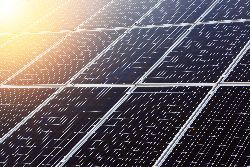
The United States is set to soon impose tariffs on bifacial solar panels targeting China. It is also reported that tariffs on electric vehicles and lithium batteries will be significantly increased. Analysts interpret this as a hurried move to apply pressure as the domestic industrial ecosystem faces disruption from a tsunami of advanced Chinese products.
Bloomberg reported on the 12th (local time) that the Biden administration is expected to announce supplementary measures following a tariff review on Chinese products, including imposing tariffs on bifacial panels, which account for the majority of the country's solar panel imports.
Earlier, Hanwha Q CELLS, which has invested in Georgia, officially petitioned the U.S. Trade Representative (USTR) in February to repeal the tariff exemption on bifacial solar panels. This petition was supported by seven U.S. solar manufacturers, including First Solar and Suniva.
The U.S. administration has imposed about a 14% tariff on imported solar panels, but bifacial panels, mainly used in large power projects, had been exempted.
The problem was that about 90% of the solar panels imported by the U.S. were bifacial panels, leading to an oversupply of low-priced Chinese panels and fueling a collapse in panel prices. This explains why the solar manufacturing industry had no choice but to continue its downturn despite subsidies provided under the Biden administration’s Inflation Reduction Act (IRA). Mike Carr, Executive Director of the U.S. Solar Manufacturing Coalition, pointed out, “Due to market conditions, there has been a significant headwind for new manufacturing investments.”
Currently, U.S. solar companies are halting or indefinitely postponing various factory construction plans due to the onslaught of Chinese panels. CubicPV, located in Massachusetts, withdrew its plan to establish a solar wafer factory in the U.S. in February. Mission Solar Energy in Texas aimed to increase its solar energy manufacturing capacity to 1 gigawatt (GW) annually, more than triple its existing capacity, but it is reported that no concrete schedule has been set for project completion yet.
Art Fletcher, Head of Content at Inbenergy, said at the BloombergNEF summit held last month in New York City, “Demand for locally produced panel components in the U.S. is expected to continue increasing, but building factories and becoming competitive is very difficult,” emphasizing, “The U.S. must now protect the rapidly growing solar panel industry.”
The U.S. also plans to raise trade barriers on other green industries such as electric vehicles and lithium-ion batteries, which China has begun to dominate in recent years. The Wall Street Journal (WSJ) previously reported that the Biden administration plans to increase tariffs on Chinese electric vehicles from the current 25% to 100%, a fourfold increase, and additional tariff hikes on batteries are expected to be unavoidable. Last month, President Biden also directed tariffs on Chinese steel and aluminum products to be raised from 7.5% to 25%, more than tripling the previous rate.
With China set to implement a tariff law allowing retaliatory tariffs starting this December, the world appears tense about whether the expanding frontlines of U.S.-China trade conflicts will cause spillover effects.
© The Asia Business Daily(www.asiae.co.kr). All rights reserved.
![Clutching a Stolen Dior Bag, Saying "I Hate Being Poor but Real"... The Grotesque Con of a "Human Knockoff" [Slate]](https://cwcontent.asiae.co.kr/asiaresize/183/2026021902243444107_1771435474.jpg)















