Suwon, Seongnam, Yongin, Hwaseong Mayors "B/C Ratio Significantly Higher in Preparation for Line 3 Extension"
50.7 km Connection from Sports Complex to Suseo, Seongnam, Yongin, Suwon, Hwaseong
Four local governments in the southern Gyeonggi region are pushing for the establishment of a new railway line connecting Seoul's Gangnam area and Hwaseong City. Instead of extending the existing Seoul Subway Line 3, the plan envisions a metropolitan railway connecting Seoul Sports Complex Station with Seongnam, Yongin, Suwon, and Hwaseong.
On the 10th, Lee Jae-jun, Mayor of Suwon; Lee Sang-il, Mayor of Yongin; Shin Sang-jin, Mayor of Seongnam; and Jeong Myeong-geun, Mayor of Hwaseong, held a meeting at the Suwon Convention Center and agreed to jointly promote this new line. The mayors of the four cities adopted a joint petition requesting that the new route be included in the Ministry of Land, Infrastructure and Transport’s '5th National Railway Network Construction Plan' as a metropolitan railway project.
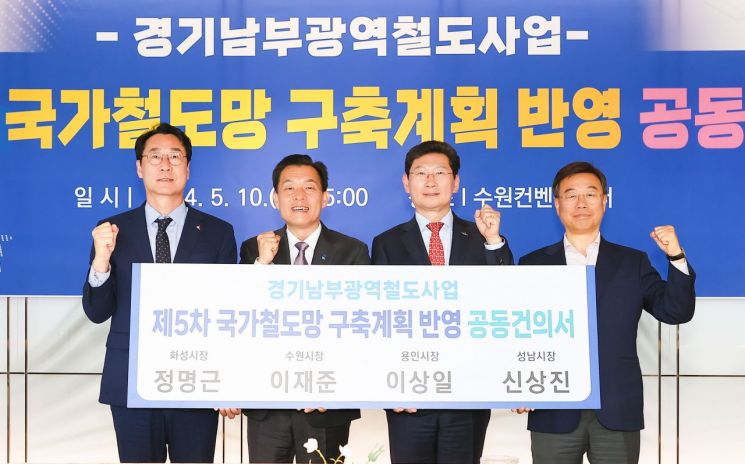 At the Gyeonggi Southern Metropolitan Railroad Project meeting held on the 10th at the Suwon Convention Center, Hwaseong Mayor Jeong Myeong-geun (from left), Suwon Mayor Lee Jae-jun, Yongin Mayor Lee Sang-il, and Seongnam Mayor Shin Sang-jin pledged to successfully advance the project.
 [Photo by Yongin City]
The four cities explained that the results of the 'Basic Plan and Preliminary Feasibility Study for the Extension of Seoul Subway Line 3 and Southern Gyeonggi Metropolitan Railway,' jointly commissioned last August, showed that the new metropolitan railway line has a higher benefit-cost ratio (B/C) compared to the Line 3 extension.
The proposed route by the local governments spans 50.7 km, connecting Sports Complex Station?which is a transfer station for Seoul Subway Lines 2 and 9?through Suseo Station (Lines 3, SRT, GTX-A, and Suin-Bundang Line) to Seongnam, Yongin (Sinbong and Seongbok), Suwon, and Hwaseong. The study found that operating trains with five or fewer cars at five-minute intervals is the most economical option, rather than 10-car trains.
The study results showed that the B/C of this route is 1.2, indicating sufficient economic feasibility. According to the local governments, this is more feasible than the previously proposed Line 3 extension plan, which had a B/C of 0.71.
The total project cost for the new route was estimated at 5.275 trillion KRW, which is 62.6% of the estimated 8.4229 trillion KRW for the Line 3 extension plan. Operating costs are also expected to be significantly lower; extending the 10-car heavy trains of Line 3 to Hwaseong would cost about 148 billion KRW annually, whereas the new alternative is estimated to cost 62.4 billion KRW, about 42% of that amount.
The four cities agreed that railway network construction is urgent to improve transportation convenience for over 4 million residents and decided to jointly strive to have the new alternative included in the metropolitan railway projects of the '5th National Railway Network Construction Plan.'
In their petition, the mayors of the four cities pointed out that "Yongin, Suwon, Seongnam, and Hwaseong, which account for 32% of Gyeonggi Province’s traffic volume, are core cities in the Seoul metropolitan area with high population density and heavy traffic," and that "large-scale development plans such as the 3rd New Town are underway, exacerbating citizen inconvenience due to traffic congestion and air pollution."
They also requested that the southern Gyeonggi metropolitan railway be included in the 5th National Railway Network Construction Plan, noting that "these cities host national key industries such as advanced information technology (IT) and semiconductor industries and account for 40% of the province’s gross domestic product."
Lee Sang-il, Mayor of Yongin, said, "The mayors of the four cities in the 8th local government term have pooled their strength and wisdom toward the single goal of establishing a metropolitan railway network in southern Gyeonggi, resulting in a highly economical railway line." He added, "The four cities will do their best to ensure that the new route is reflected in the 5th National Railway Network Construction Plan by working together."
Meanwhile, the Ministry of Land, Infrastructure and Transport is known to plan a briefing session on proposed projects from local governments in June, followed by a public hearing in April next year, and to announce new projects to be included and additional projects for further review in the national railway network plan around July of the same year.
© The Asia Business Daily(www.asiae.co.kr). All rights reserved.
![From Bar Hostess to Organ Seller to High Society... The Grotesque Con of a "Human Counterfeit" [Slate]](https://cwcontent.asiae.co.kr/asiaresize/183/2026021902243444107_1771435474.jpg)
















