An analysis has emerged that China is losing its reputation as the 'best investment destination' among European Union (EU) companies. There is also a growing trend of companies turning their attention to Southeast Asia and other regions instead of China.
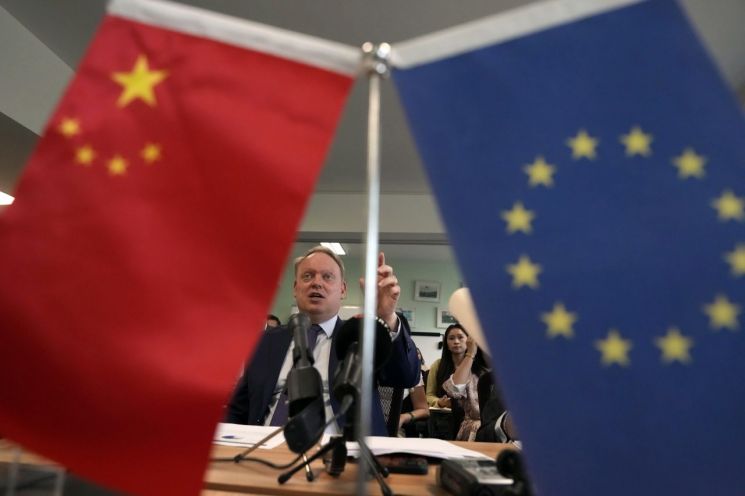
Bloomberg News reported this on the 10th, citing a survey conducted by the EU Chamber of Commerce in China. According to the survey conducted earlier this year targeting member companies of the Chamber, only 13% of the responding companies chose China as the best investment destination. This is the lowest figure since the survey began in 2010. In 2021, the proportion of companies that selected China for the same question was 27%.
This result is seen as confirming that despite Chinese President Xi Jinping’s announcement at the end of last year to increase open measures to expand foreign investment, the investment appeal of China is fading among foreign companies. Currently, EU companies appear to be shifting investments to the Association of Southeast Asian Nations (ASEAN) and other regions to mitigate the effects of decoupling and seek opportunities elsewhere.
Jens Eskelund, Chairman of the EU Chamber of Commerce in China, analyzed, "We can see that this perception of domestic economic issues is beginning to take on a permanent character," adding, "Companies are starting to adjust their expectations regarding China."
In this survey, more than two-thirds of the responding companies said that doing business in China has become more difficult than before last year. This is the highest rate since the question was included in the survey in 2014. By sector, the construction industry was found to have experienced particularly significant difficulties. In the construction sector, the market slowed due to the impact of China’s real estate crisis, and it was pointed out that market competition itself is tilted more favorably toward Chinese companies rather than foreign firms.
This is directly related to the recent visits to China by foreign leaders such as German Chancellor Olaf Scholz and U.S. Treasury Secretary Janet Yellen, who expressed complaints to the Chinese government that their own and other foreign companies are receiving unfair treatment within China.
Additionally, the main business challenges faced by each company were identified as China’s economic slowdown, global economic slowdown, U.S.-China conflicts, and geopolitical risks. More than half of the responding companies, 55%, cited China’s economic slowdown as a major issue this year. This is 20 percentage points higher than the previous year. More than half of the surveyed companies said they plan to reduce costs, and one in four announced plans for workforce reductions.
Furthermore, companies pointed to ambiguous rules and an unpredictable legal environment as the regulatory obstacles that must be resolved as a top priority in China. One-third of the surveyed companies also identified overproduction across industries in China as a problem. Overproduction was especially prominent in the construction and automotive sectors. These companies criticized that competition within China is intensifying due to overinvestment and lack of demand, which fuel overproduction.
The proportion of companies that said they would expand their business in China this year was only 42%. This is the lowest level since the question was first surveyed in 2012. The EU Chamber of Commerce in China noted this as "a factor that could further worsen economic problems within China." Bloomberg News reported, "As China loses its appeal as an investment destination for EU companies, ASEAN has emerged as the beneficiary of capital, followed by Europe, India, and North America."
© The Asia Business Daily(www.asiae.co.kr). All rights reserved.

















