10th, 2nd Meeting of Medical Reform Special Committee
Advanced General Hospitals Focus on Severe and Essential Care
Encouraging Large Hospitals to be 'Specialist-Centered'
The Presidential Commission on Medical Reform (the Commission) discussed detailed operational plans on the 10th, including specifying the four priority reform tasks for medical reform and finalizing the composition of four specialized committees under the Commission.
On this day, the Commission held its second meeting at the Government Seoul Office in the morning, chaired by Chairman Noh Yeon-hong, with government members from six ministries?Ministry of Health and Welfare, Ministry of Economy and Finance, Ministry of Education, Ministry of Justice, Ministry of the Interior and Safety, Financial Services Commission?and 16 private sector members. The Commission serves as a social discussion body for structural reform tasks to overcome the crisis in essential and regional healthcare, with its first meeting held on the 25th of last month.
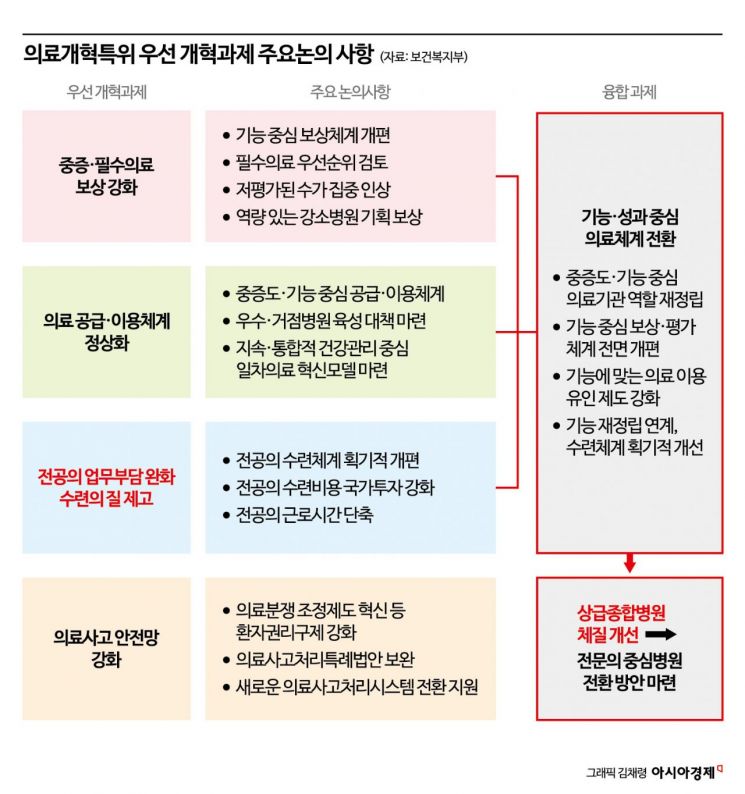
At the second meeting, the Commission specified the priority reform tasks selected at the first meeting: ▲strengthening compensation for severe and essential medical care ▲normalizing the medical supply and utilization system ▲alleviating residents’ workload and improving training quality ▲strengthening the medical accident safety net.
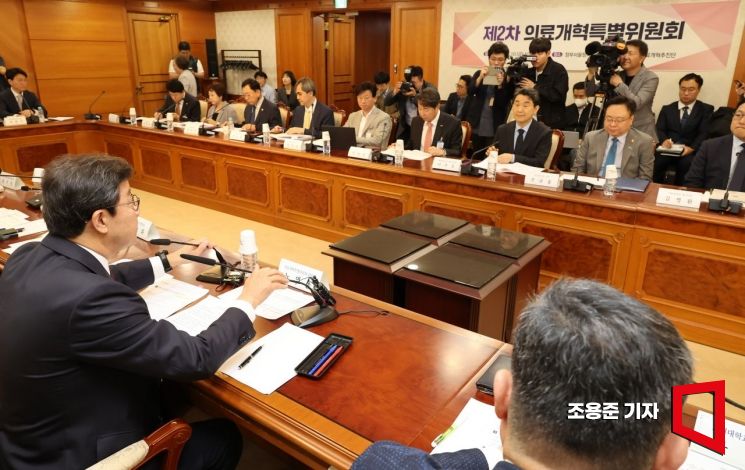 Noh Yeon-hong, Chairman of the Special Committee on Medical Reform, is speaking at the 2nd meeting of the Special Committee on Medical Reform held at the Government Seoul Office in Jongno-gu, Seoul on the 10th. Photo by Jo Yong-jun jun21@
Reorganizing Medical Supply and Compensation Systems Focused on 'Function and Performance'
First, regarding strengthening compensation for severe and essential medical care, it was decided to reorganize the compensation system centered on 'function.' This means improving the current compensation and evaluation structure, which favors providers who see more patients regardless of function or performance. To this end, the plan is to significantly raise undervalued fees and expand compensation for capable small and medium-sized hospitals, reforming the payment system to ensure fair compensation.
To implement this, the plan is to invest "10 trillion won plus alpha (α)" in essential medical care by 2028. So far, an investment of 1.2 trillion won has been confirmed in the essential medical field, with an additional investment of 150 billion won plus α planned for this year.
Additionally, the Commission discussed normalizing the medical supply and utilization system so that tertiary general hospitals focus on treating severe patients. Until now, the roles of medical institutions from tertiary general hospitals to local clinics have been unclear, resulting in a distorted structure where tertiary hospitals and local clinics compete over mild outpatient cases. To effectively respond to the most severe and intractable diseases and emergency conditions requiring timely treatment within the golden hour, the medical supply and utilization system will be reorganized functionally according to patient severity. When mild patients or those without a referral from a secondary hospital visit tertiary general hospitals, their out-of-pocket costs will be increased, and the current paper referral system will be gradually replaced with electronic referrals that include clear physician opinions. The plan also includes fostering excellent and hub hospitals by specialty.
Regarding resident training environments, the Commission discussed reforming the training system aligned with the functional reorganization of medical institutions. First, a cooperative training system among medical institutions will be established so that residents can train evenly across tertiary general hospitals, regional general hospitals, and clinics. Currently, residents are mainly affiliated with specific tertiary general hospitals and have limited opportunities to experience treatment at regional hospitals or clinics outside their affiliated hospital. The plan is to concretize a network training system covering university hospitals to primary care institutions to allow residents to gain diverse experiences. The Commission will also consider gradually shifting hospital operation structures, which heavily rely on residents, to specialist-centered models. Furthermore, the current resident training system, including the internship system, will be completely overhauled to establish a solid integrated training system within the existing 4 to 5-year framework, covering years 1 to 5. To this end, comprehensive improvements in human and material standards, such as resident training curricula and placement criteria for supervising specialists, will be developed. The Commission will also specify directions for reducing resident working hours, including reviewing appropriate working hours for quality training.
Regarding strengthening the medical accident safety net, a task force within the Korea Medical Dispute Mediation and Arbitration Agency will be formed to promote innovation in the medical dispute mediation and arbitration system. In February, a draft bill for the "Special Act on Medical Accident Handling" was prepared and a public hearing was held.
Commission to Hold Monthly Meetings... Four Specialized Committees Established to Swiftly Specify Medical Reform Tasks
On this day, the Commission finalized the composition of four specialized committees under it to conduct in-depth reviews of reform tasks by field: ▲Medical Workforce Committee ▲Delivery System and Regional Medical Care Committee ▲Essential Medical Care and Fair Compensation Committee ▲Medical Accident Safety Net Committee.
The specialized committees will be composed mainly of experts recommended by provider and consumer organizations and will hold meetings every two weeks to rapidly specify reform tasks by field.
The Medical Workforce Committee will address measures to improve the quality of medical education, the national responsibility system for resident training, hospital workforce operation system improvements (specialist-centered hospitals, shared workforce operation, etc.), advanced license management, and workforce supply and demand. The Delivery System and Regional Medical Care Committee will discuss redefining the roles of medical institutions based on severity and function, improving system resilience, and fostering excellent secondary and tertiary hub hospitals. The Essential Medical Care and Fair Compensation Committee will review issues related to fair and sufficient compensation for essential medical care and establishing an appropriate non-reimbursable management system. The Medical Accident Safety Net Committee will examine issues related to the Special Act on Medical Accident Handling and innovations in the medical dispute mediation system.
Commission to Mediate Not Only Medical Reform Discussions but Also Government-Medical Community Conflicts
The Commission stated that the discussion contents and results will be transparently disclosed through press releases and post-meeting briefings, and that it will broadly collect opinions from the public and the medical community through public forums, hearings, and citizen proposal programs during the reform task derivation process. Furthermore, to swiftly specify medical reform tasks, the Commission will hold meetings monthly.
It also plans to jointly set major collaborative agendas with government committees related to medical reform, such as the Local Era Committee and the Low Birthrate and Aging Society Committee, to strengthen regional medical care and address pediatric and childbirth measures, thereby enhancing the momentum for reform.
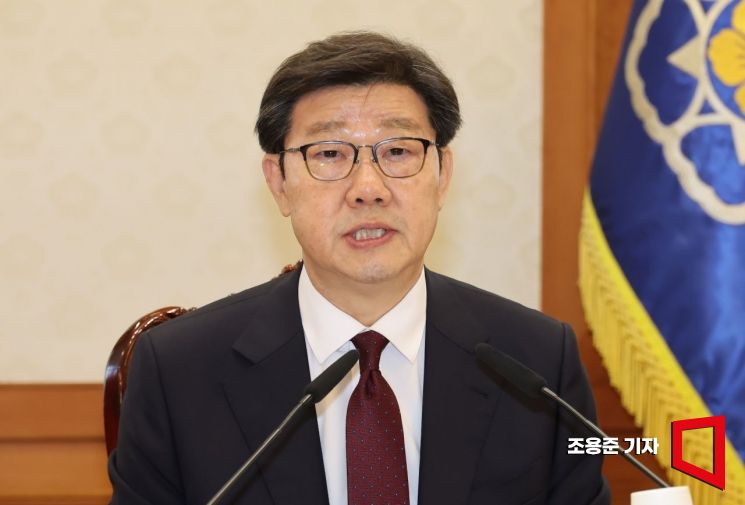 Noh Yeon-hong, Chairman of the Special Committee on Medical Reform, is speaking at the 2nd meeting of the Special Committee on Medical Reform held at the Government Seoul Office in Jongno-gu, Seoul on the 10th. Photo by Jo Yong-jun jun21@
Chairman Noh Yeon-hong said, "The Presidential Commission on Medical Reform will fulfill its role as a forum for discussing reform tasks to normalize Korea’s healthcare system and as a body to mediate and coordinate accumulated conflicts to reach social consensus. As the first step toward building trust among the government, medical community, and the public regarding medical reform, we plan to swiftly specify priority reform tasks to strengthen essential and regional medical care."
He added, "By intensively operating this Commission and its specialized committees, we will promptly prepare detailed implementation plans for medical reform tasks and, through transparent and open communication, build broad consensus and social agreement so that effective policies that the public can feel will be swiftly established."
© The Asia Business Daily(www.asiae.co.kr). All rights reserved.



















