Young Generation Weary of High Prices
"Old Scenery Feels New" Popular on SNS
Limitations of Visiting Only Restaurants and Cafes
On the morning of the 8th around 10 a.m., I visited Mangwon Market in Mapo-gu, Seoul. Despite it being a weekday morning, the market was bustling with people of various age groups. Notably, young-looking customers caught my eye, each holding cups filled with hotteok and dakgangjeong in both hands.
Kang Hyun-jun (23), a university student, said, “My friends in their 20s are also visiting traditional markets,” adding, “Vintage and retro trends are popular in travel and fashion these days, and it seems this trend is spreading to food as well.” Park Woo-jin (21) also said, “I heard there are many good restaurants in the market, so I went to Gwangjang Market with my friends,” and added, “The less famous the place, the cheaper the prices, and the feeling of seeing old scenery is interesting, so I want to visit other places in the future.”
Lee Jung-eun (27), who sells fruit drinks at Mangwon Market, said, “Many celebrities come and film videos eating food here,” and added, “On weekends, 8 out of 10 customers are in their 20s and 30s, and many foreigners visit, making it look like a tourist spot.”
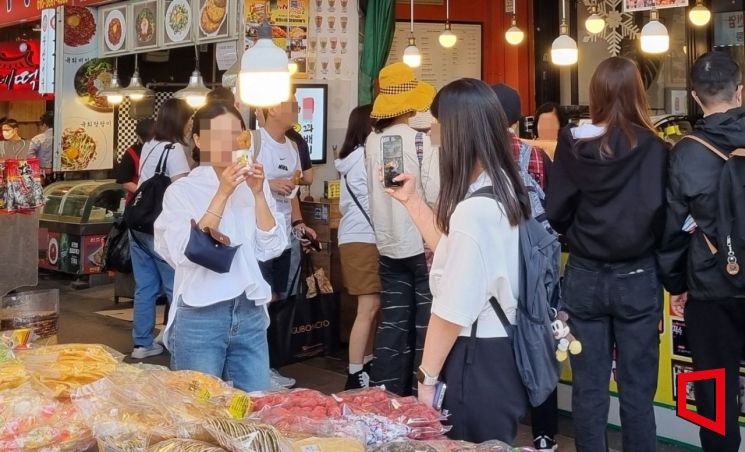 At around 5 p.m. on the 9th, young people are taking commemorative photos holding twisted doughnuts in front of a twisted doughnut shop at Gwangjang Market in Jongno-gu, Seoul.
 [Photo by Shim Seong-a]
The number of young people visiting traditional markets is increasing. There is also an analysis that the younger generation, enthusiastic about retro sensibilities, is forming new trends in traditional markets following the so-called 'Hipjiro' (Hip + Euljiro).
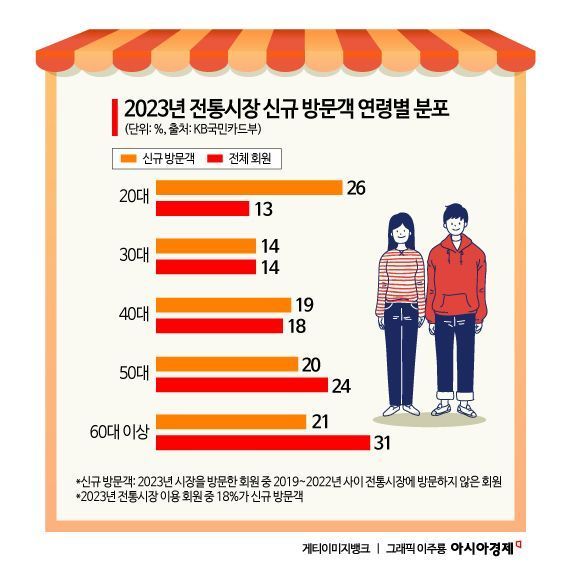
According to the ‘Traditional Market Card Consumption Data Analysis’ released by KB Kookmin Card on the 18th of last month, 18% of members who visited markets last year had not visited traditional markets for four years (2019?2022). Among them, those in their 20s accounted for the largest share at 26%. The most frequently visited stores were restaurants and coffee/beverage shops.
Namdaemun Market is also one of the traditional markets that young people are returning to. During lunchtime, famous alleys such as ‘Kalguksu Alley’ and ‘Galchi Alley’ were filled with customers. Alongside elderly and middle-aged people, young people in their 20s were also noticeable. Kim Sun-eun (28) said, “My coworkers introduced me to the market, saying accessories are cheap and there are many delicious foods, so I came,” adding, “Compared to the current dining-out prices, it definitely feels cheaper, so I’m thinking about where to have lunch.”
Google search trend analysis also shows the keyword ‘market restaurants’ rising. Until 2021, the numbers fluctuated, but from the first half of 2022, they started to rise, and now the search trend figures have increased about 3 to 6 times compared to two years ago.
The high inflation rate is also a significant factor in the increased visits to traditional markets by young people. According to Statistics Korea, the consumer price index rose sharply from 99.4 in 2019 to 113.99 in April 2024. The dining-out price increase rate is 3.0%, higher than the average consumer price increase rate of 2.9%. Kang Min-jun (19), who was browsing Dongmyo Market with friends, said, “It’s so expensive these days that I hesitate to buy food outside, but the food sold at the market is still affordable and popular among friends,” adding, “I mainly visit market restaurants introduced by influencers on Instagram and TikTok.”
Although the age group visiting traditional markets is getting younger and the markets are becoming livelier, the fact that their spending is concentrated on restaurants and cafes is seen as a limitation. Shin (65), who has operated a butcher shop in Namdaemun Market for 40 years, said, “On weekends, young people come and line up in front of the hotteok shop to eat,” adding, “They don’t buy meat or vegetables at the market; they just eat snacks and look around before leaving.”
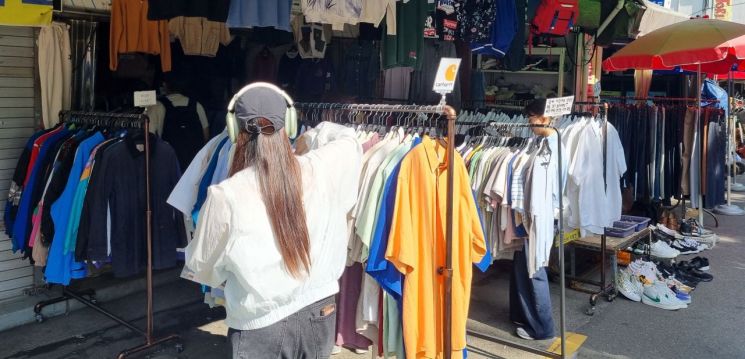 On the afternoon of the 8th, a young man in his 20s was selecting secondhand clothes at Dongmyo Market in Jongno-gu, Seoul.
 [Photo by Shim Seong-ah]
Kim (70), who has sold balloon flower roots at Gyeongdong Market for 10 years, said, “It’s good that young people keep coming, bringing vitality to the market, but it’s a pity that they only visit restaurants or cafes,” adding, “I hope the market maintains its unique character without turning into just a food alley.”
Professor Choi Cheol of the Department of Consumer Economics at Sookmyung Women’s University advised, “If the elements that consumers want are well understood, people of many age groups will continue to visit the market,” and added, “Local governments should research and invest in ways to highlight the market’s unique cultural elements tailored to consumer characteristics to revitalize the market.”
© The Asia Business Daily(www.asiae.co.kr). All rights reserved.