The Supreme Court has ruled that a licensed real estate agent preparing a key money contract is beyond the scope of the agent's duties and violates the Administrative Procedures Act.
According to the legal community on the 9th, the Supreme Court's Second Division (Presiding Justice Shin Sook-hee) upheld the lower court's ruling that suspended the imposition of a 1 million won fine on real estate agent A, who was indicted for violating the Administrative Procedures Act.
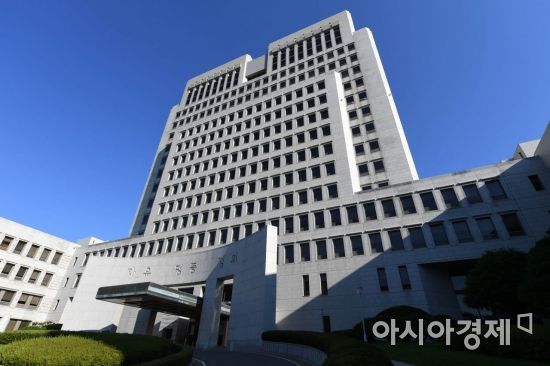
The court stated the reason for dismissing A's appeal was that "there was no error in the lower court's judgment that violated the rules of logic and experience, exceeded the limits of free evaluation of evidence, misunderstood the legal principles regarding the establishment of the crime of violating the Administrative Procedures Act, or applied unconstitutional laws."
Article 3 (Prohibited Acts for Non-Administrative Agents) Paragraph 1 of the Administrative Procedures Act stipulates that "a person who is not an administrative agent shall not engage in the duties prescribed in Article 2 as a business, except in cases permitted by other laws." It prohibits non-administrative agents from engaging in duties defined as administrative agent work under Article 2 Paragraph 1, such as ▲preparing documents submitted to administrative agencies (Item 1) and documents related to rights, obligations, or certification of facts (Item 2) ▲translating documents related to administrative agency work (Item 3) ▲acting as an agent for submitting the above documents (Item 4) ▲acting as an agent for applications, claims, or reports to obtain permits or licenses (Item 5) ▲responding to consultations or advice regarding administrative laws and administration (Item 6) ▲fact-finding and verification of entrusted affairs under laws (Item 7).
Violation of this is punishable under Article 36 (Penalties) Paragraph 1 Item 1 of the Administrative Procedures Act by imprisonment for up to three years or a fine of up to 30 million won.
Meanwhile, Article 2 (Definitions) Item 1 of the Licensed Real Estate Agents Act defines "brokerage" as "mediating acts related to the acquisition, loss, or change of rights such as sale, exchange, lease, etc., between parties to a transaction concerning brokerage objects under Article 3." Article 3 of the same law defines brokerage objects as ▲land ▲buildings and other fixtures on land ▲other property rights and goods prescribed by Presidential Decree.
A, who worked as an employee at a real estate agency operated by licensed real estate agent B, was prosecuted along with B for violating the Administrative Procedures Act after preparing a "consulting contract," which was a key money contract, while brokering a leasehold transfer contract for a daycare center in August 2020 and receiving a commission of 2.5 million won. The prosecution judged that the consulting contract prepared by A was essentially related to key money payment and corresponded to "documents related to rights, obligations, or certification of facts," which should be prepared only by administrative agents under the Administrative Procedures Act.
The first-instance court found A and B guilty of violating the Administrative Procedures Act. However, the court suspended the imposition of a 1 million won fine, considering ▲the defendants' lack of strong criminal intent ▲the common practice of key money contracts being conducted together with lease contracts, leading to low social awareness of the illegality of such acts ▲and the defendants being first-time offenders without prior criminal records.
A suspended sentence means that the court recognizes guilt but postpones sentencing, and if two years pass from the suspension date without further offenses, the sentence is considered dismissed.
The trial focused on whether A's preparation of a contract related to key money payment between the existing tenant and the new tenant falls within the scope of brokerage permitted under the Licensed Real Estate Agents Act.
A and B argued that ▲the consulting contract prepared by A mainly involved the new tenant receiving services to obtain daycare center approval and payment for such services, thus not corresponding to "documents related to rights, obligations, or certification of facts" under the Administrative Procedures Act ▲even if the consulting contract is considered a key money contract, brokerage of key money contracts falls within the scope of brokerage acts defined by the Licensed Real Estate Agents Act ▲even if brokerage of key money contracts is not within the scope of brokerage acts under the Licensed Real Estate Agents Act, key money contracts are inseparably linked with lease contracts, so their brokerage should be allowed under the Act ▲and even if their acts constitute violations of the Administrative Procedures Act, they should not be punished due to a legal error in not recognizing the prohibition.
However, the court rejected all of A and B's claims.
The court ruled, "This consulting contract is not a simple 'service contract' as claimed by the defendants but corresponds to a key money contract related to the transfer of business goodwill for the daycare center. Therefore, A's brokerage of the key money contract and preparation of the key money contract document constitute 'preparing documents related to rights, obligations, or certification of facts' as defined in Article 2 Paragraph 1 Item 2 of the Administrative Procedures Act."
Furthermore, the court stated, "Key money is the transfer or usage fee for a certain period of intangible property values such as business facilities, equipment, clientele, credit, business know-how, or business advantages due to store location in commercial buildings. Brokerage of key money contracts related to the transfer of business goodwill and preparation of key money contract documents do not fall within the scope of brokerage work defined as the duties of licensed real estate agents under the Licensed Real Estate Agents Act and its enforcement decree."
A appealed, but the appellate court dismissed the appeal.
In the appeal, A additionally argued that the Administrative Procedures Act and its enforcement decree applied to him violated the principle of legal clarity.
However, the court stated, "The transfer of leasehold rights means the tenant transfers the leasehold rights to a third party while maintaining identity under the contract. Considering the circumstances of the consulting contract and lease contract, the parties involved, and contract contents, the consulting contract and lease contract brokered by the defendant cannot be considered a leasehold transfer contract between the new tenant and the existing tenant where the original lease contract remains effective," and pointed out, "The consulting contract corresponds to the transfer of business goodwill related to the daycare center and the related key money contract, and it is clear that the key money contract is not a brokerage object under the Licensed Real Estate Agents Act."
Regarding the claim of violation of the principle of legal clarity, the court said, "Considering the wording of the Administrative Procedures Act and its enforcement decree, the legislative history and purpose of the Administrative Procedures Act, and the regulatory framework, it cannot be said that the relevant legal provisions violate the principle of legal clarity."
A filed a final appeal, but the Supreme Court found no problem with the appellate court's judgment.
A Supreme Court official explained, "It is natural for licensed real estate agents to prepare contracts and receive brokerage fees when mediating real estate sales or lease contracts. However, key money contracts cannot be considered necessarily accompanying sales or lease contracts. Lease contracts are concluded between lessors and lessees, but key money contracts are usually made between previous tenants and new tenants, which do not coincide with the parties to the brokerage. Therefore, the ruling means that licensed real estate agents, who are not administrative agents, cannot engage in preparing key money contracts, which are outside the scope of their duties."
© The Asia Business Daily(www.asiae.co.kr). All rights reserved.

















