Jangseong Mine Submitted Preliminary Closure Application on 29th Last Month
Early Closure Special Compensation of 32.9 Billion Won and More to Be Paid
Taebaek City's Damage from Closure Estimated at 3.3 Trillion Won
"Will Foster Alternative Industries and Request Employment Crisis Area Designation"
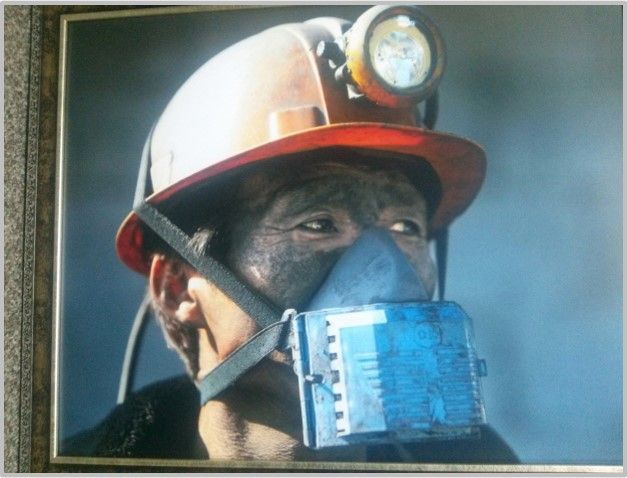
Taebaek Jangseong Mining Site, the last coal mine in Korea, has entered the full-scale process of mine closure. This decision comes as global eco-friendly trends reduce coal demand and mining profitability worsens, making it impossible to maintain the mine any longer. Taebaek City, which expects a loss of 3 trillion won from the closure, is putting all its efforts into fostering alternative industries and securing government support.
According to the Korea Mine Reclamation Corporation on the 9th, Taebaek Jangseong Mining Site submitted a preliminary mine closure application on the 29th of last month. The preliminary application is a mandatory step for coal companies to receive various national supports upon mine closure and is considered the first stage of mine closure. The expected closure month is July. Mining operations ended last month.
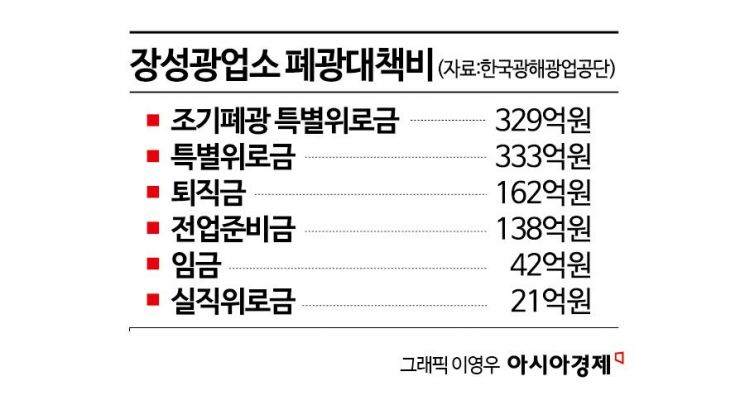
Following the preliminary application, the support funds for Jangseong Mining Site amount to 103.484 billion won. Among this, the majority, 102.811 billion won, is allocated for worker support measures. The worker support funds will be used for early mine closure special compensation (32.92 billion won), special compensation (33.332 billion won), severance pay (16.276 billion won), and job transition preparation funds (13.887 billion won). The mining operator support fund of 673 million won will be used for facility relocation and disposal costs.
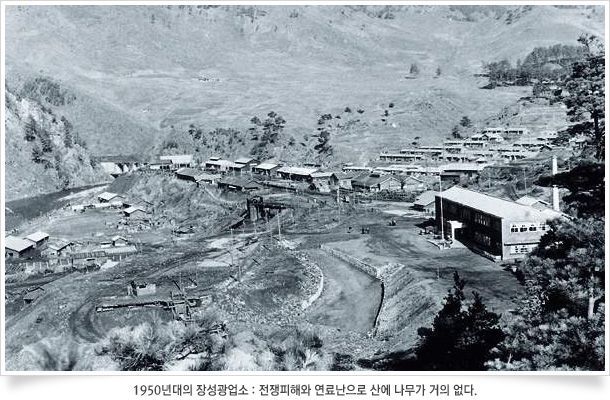
Jangseong Mining Site officially started in 1950 with the establishment of the Korea Coal Corporation and is the largest coal mine in the country. Tracing back to the Japanese colonial period, it operated under the name Samcheok Coal Mine from 1936. It has been maintained for 87 years to date. Coal production reached 1 million tons in 1959 and peaked at 2.28 million tons in 1979. Because of this, it is recognized as having played a key role as the main energy supplier during the industrialization era.
Taebaek City Faces 3 Trillion Won Impact... "Fostering Alternative Industries, Requesting Employment Crisis Area Designation"
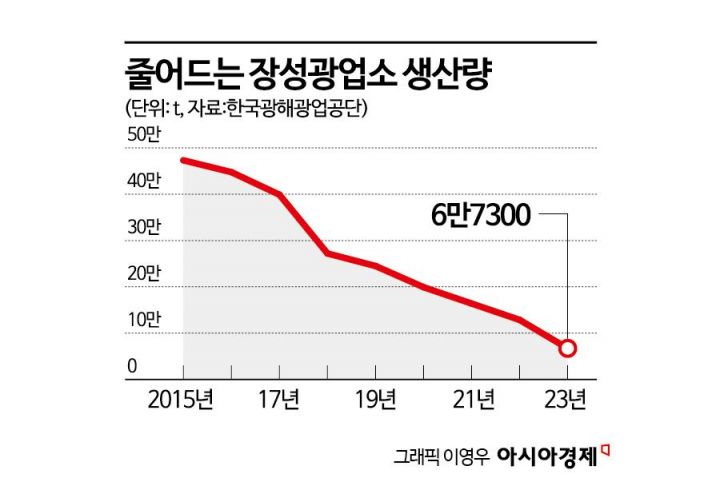
Jangseong Mining Site began its decline in 1989 with the coal industry rationalization policy and mine restructuring. At that time, the government took measures to reduce coal production as oil prices stabilized and demand for eco-friendly fuels began to rise. Subsequently, coal consumption sharply decreased, reserves were depleted, and the Korea Coal Corporation's debt ballooned, making it impossible to continue operations.
Gangwon Province estimates that the closure of Jangseong Mining Site will cause damages amounting to 3.3 trillion won to the local community and a 13.6% decrease in the Gross Regional Domestic Product (GRDP). Population outflow is also expected to be severe. Taebaek once had a population exceeding 120,000 in the 1980s, but with the decline of the coal industry, the population has dropped to around 30,000. This is the smallest among city-level regions nationwide and even lags behind some county areas. A total of 876 people, including 416 employees, are expected to lose their jobs, and residents are likely to move to other regions.
Taebaek City plans to foster alternative industries to replace the coal mine. The city is conducting preliminary feasibility studies worth 521.9 billion won for projects including the Jangseong Mining Site clean methanol production base, Cheoram Station methanol and mineral logistics facilities, and a core mineral industrial complex in the Gotoseel Industrial Complex. A Taebaek city official explained, "If the preliminary feasibility study passes this year, we will secure national funding next year. If site preparation begins next year, full-scale industrial complex development and related business operations can start from 2027."
However, since it will take time to foster alternative industries, the city has also decided to request designation as an employment crisis area. An employment crisis area refers to a local government requiring support due to a rapid deterioration in employment conditions. If designated, the area can receive priority budgets for employer support, region-specific job creation, employment stabilization, and vocational skill development. Taebaek City plans to conduct a research project for employment crisis area designation and submit an application to the Ministry of Employment and Labor within this month.
© The Asia Business Daily(www.asiae.co.kr). All rights reserved.
![From Hostess to Organ Seller to High Society... The Grotesque Scam of a "Human Counterfeit" Shaking the Korean Psyche [Slate]](https://cwcontent.asiae.co.kr/asiaresize/183/2026021902243444107_1771435474.jpg)


















