IT exports centered on semiconductors increase, sustaining current account surplus
Current account surplus expected to be larger than anticipated this year
Current account surplus projected to decrease due to foreign dividend payments in April
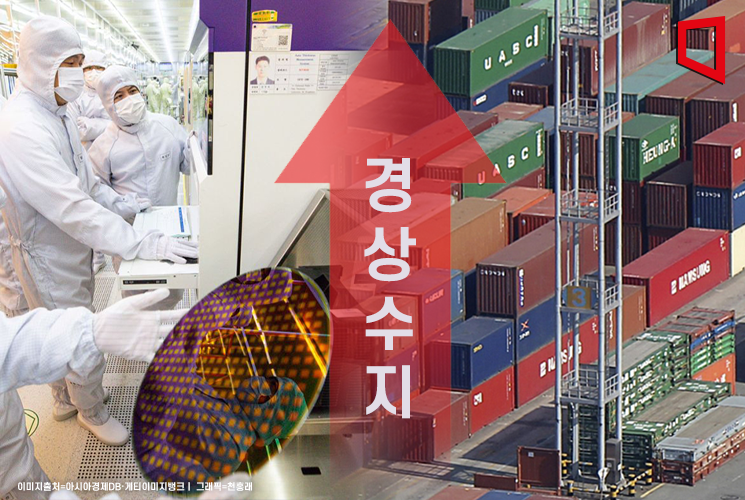
South Korea's current account balance recorded a surplus for 11 consecutive months. On a quarterly basis, it also posted a surplus for four consecutive quarters, successfully turning to a surplus compared to the previous year. With continued export growth centered on semiconductors, the annual current account surplus is expected to exceed previous forecasts.
Annual Current Account Surplus Forecast Likely to Be Revised Upward Due to Strong Export Performance
According to the 'Balance of Payments (provisional)' released by the Bank of Korea on the 9th, the current account surplus in March was $6.93 billion. This marks the 11th consecutive month of surplus since May last year, and the surplus amount increased from $6.86 billion in the previous month.
The cumulative surplus for the entire first quarter was $16.84 billion, successfully turning to a surplus compared to a deficit of $5.96 billion in the first quarter of last year. This is the fourth consecutive quarter of surplus since the second quarter of last year.
The surplus amount also exceeded expectations. In its economic outlook released in February, the Bank of Korea forecasted an annual current account surplus of $52 billion and a first-half surplus of $19.8 billion for this year, but the first quarter alone accounted for about 85% of the first-half forecast.
Accordingly, the Bank of Korea expects this year's current account surplus to exceed the forecasted $52 billion. In its economic assessment released last month, the Bank of Korea stated, "The current account surplus is expected to widen as exports show a favorable trend supported by the recovery of the IT sector and strong growth in the U.S., while imports continue to decline." The Bank of Korea is expected to raise the current account surplus forecast in the revised economic outlook to be announced this month.
Shin Seung-chul, Director of the Economic Statistics Bureau at the Bank of Korea, said, "The first quarter current account surplus alone has mostly met the first-half forecast, and the annual current account surplus forecast is expected to be revised upward from the previous $52 billion."
Goods Balance Surplus for 12 Consecutive Months... Improvement in Key Items such as Semiconductors and Automobiles
Looking at the March current account by item, the goods balance recorded a surplus of $8.09 billion, marking a surplus for 12 consecutive months since April last year. The goods balance surplus for the first quarter was $18.94 billion, turning to a surplus compared to a deficit of $9.78 billion in the same period last year.
The goods balance surplus was driven by semiconductor exports. March exports amounted to $58.27 billion, a 3.0% increase compared to the same period last year. Based on customs clearance, semiconductors increased by 34.5%, information and communication devices by 7.9%, and petroleum products by 3.3%. Semiconductor exports have been on an upward trend for five consecutive months from November last year to March this year, and the increase is expected to continue in April. On the other hand, March exports of passenger cars decreased by 5.7%, machinery and precision instruments by 6.6%, steel products by 9.4%, and chemical products by 11.4%, showing unfavorable conditions.
Director Shin said, "Since the second half of last year, export improvements have continued mainly in semiconductors and automobiles, and recently, exports of other IT items such as displays and wireless communication devices have also improved," adding, "Customs clearance exports in April also appear favorable, so the improvement in the goods balance is expected to continue for the time being."
Examining exports by region, compared to the same month last year, exports to Southeast Asia (12.7%), the U.S. (11.6%), and China (0.4%) increased, while those to the EU (-6.7%) and Japan (-12%) decreased.
Imports amounted to $50.18 billion, down 13.1% compared to the same month last year. This decline continued mainly due to falling energy prices and raw materials. Based on customs clearance, raw materials such as coal decreased by 18.4% compared to the same month last year, and capital goods such as semiconductor manufacturing equipment and information and communication devices decreased by 3.5%. Consumer goods such as passenger cars and grains decreased by 9.5%.
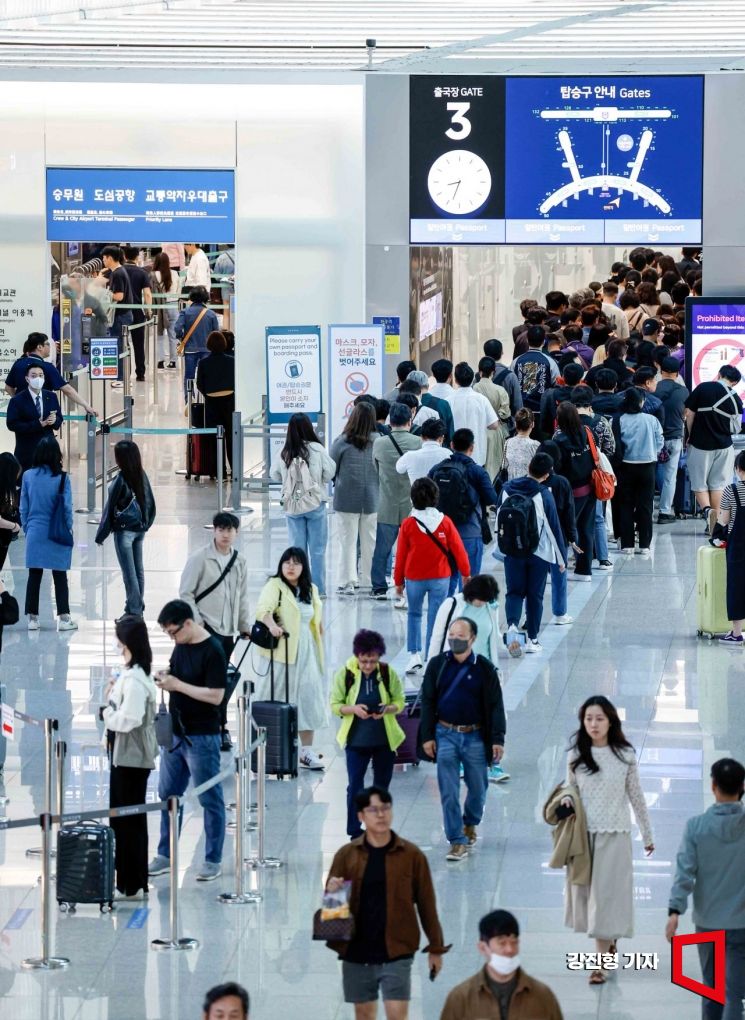 On the 3rd, ahead of the Children's Day holiday, travelers visiting Incheon International Airport Terminal 1 are lining up to move to the boarding concourse. Photo by Jinhyung Kang aymsdream@
Service Account Deficit Continues as Overseas Travelers Increase
Unlike the goods balance, the service account recorded a deficit of $2.43 billion in March. The deficit size increased compared to one year ago (-$1.97 billion) and one month ago (-$1.77 billion).
Within the service account, the travel account deficit reached $1.07 billion. However, due to an increase in foreign tourists and a decrease in domestic outbound travelers, the deficit narrowed compared to February (-$1.36 billion).
Director Shin emphasized, "Given South Korea's economic structure where more domestic residents travel abroad than foreigners enter the country, it is difficult for the service account to turn to a surplus," adding, "To reduce the travel account deficit, it is necessary to expand infrastructure for overseas tourists."
The intellectual property rights account recorded a deficit of $800 million in March, with the deficit increasing compared to February (-$40 million) due to a decrease in income from patent and trademark royalties. The transportation account also turned from a $180 million surplus to a $120 million deficit within a month, explained by the Bank of Korea as due to increased payments for maritime transport.
The primary income account recorded a surplus of $1.83 billion, mostly due to dividend income from overseas subsidiaries of domestic companies, with the dividend income account surplus at $1.78 billion. The secondary income account recorded a deficit of $560 million.
The net financial account, calculated as assets minus liabilities, was $11.06 billion, significantly increasing from $6.85 billion in the previous month. Direct investment increased by $2.83 billion, mainly due to domestic investors' overseas investments, while foreign investment in Korea increased by $1.61 billion. Securities investment saw domestic investors' overseas stock investments increase by $8.88 billion, mainly in bonds, while foreign investment in domestic bonds decreased by $840 million.
© The Asia Business Daily(www.asiae.co.kr). All rights reserved.


















