2023 Survey Results on Out-of-School Youth
62.2% Dropped Out During High School
Elementary and Middle Schools Prefer 'Homeschooling', High Schools Cite 'Psychological Issues'
About 6% of out-of-school youth have experienced social withdrawal for more than six months. Based on the fact that one in five cited 'support services' as the reason for overcoming withdrawal, authorities have decided to establish a dedicated support system for isolated and withdrawn youth.
The Ministry of Gender Equality and Family announced the results of the "2023 Survey on Out-of-School Youth" on the 9th. The survey was conducted from April to December last year, targeting 2,890 out-of-school youth nationwide aged 9 to 24. Initiated in 2015, this survey is based on the "Act on Support for Out-of-School Youth," and the survey cycle has been changed from every three years to every two years.
The survey results showed that the most common time for youth to leave school was during high school at 62.2%, followed by middle school (20.8%) and elementary school (17.0%). The most frequently cited reason for leaving school was psychological and mental health issues (31.4%). The main reasons for leaving school varied by period: during elementary and middle school, the most common reason was parental encouragement to pursue alternative education or homeschooling, at 61.3% and 35.2% respectively, while during high school, psychological and mental health issues were the most common at 37.9%.
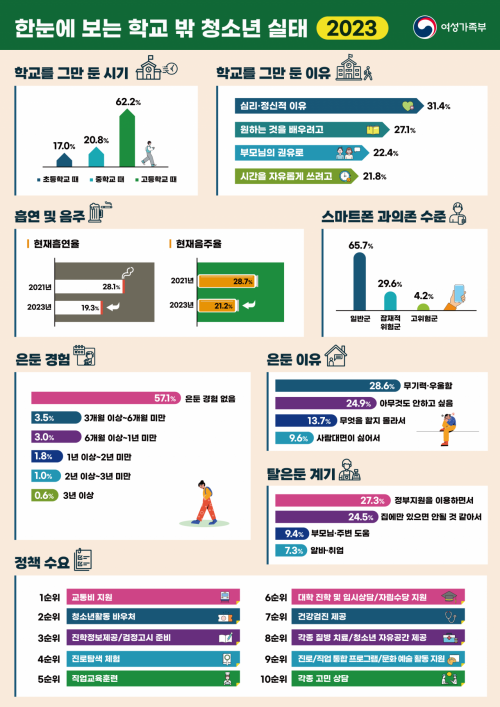
Among out-of-school youth, 6.4% were socially withdrawn for six months or longer. Those in the potential withdrawal group, with withdrawal periods between three and six months, accounted for 3.5%. Withdrawal experience refers to the past period after leaving school when the youth stayed at home without going outside or engaging in external activities. The main reasons for withdrawal were "feeling lethargic or depressed" at 28.6%, followed by "not wanting to do anything" (24.9%), "not knowing what to do" (13.7%), and "disliking encounters with people" (9.6%).
The most common reason for socially withdrawn out-of-school youth to come out was the use of support services (27.3%). Additionally, 24.5% said they left withdrawal because they felt they could no longer just stay at home.
The rate of out-of-school youth engaging in physical activity for 60 minutes a day, five or more days a week, decreased compared to the previous survey, dropping from 13.2% in 2021 to 10.8% last year. The obesity rate among male youth was 20.7%, and the overweight rate was 10.4%, both higher than those of female youth, while the underweight rate among female youth was 9.4%, higher than that of males.
However, smoking and drinking indicators improved compared to the previous survey. The current smoking rate among out-of-school youth was 19.3%, and the current drinking rate was 21.2%. The current smoking rate decreased by 8.8 percentage points, and the current drinking rate decreased by 7.5 percentage points compared to 2021.
Among out-of-school youth, 69.5% planned to prepare for the qualification exam (GED) at the time they left school. Compared to the previous survey, preparation for the GED and university entrance increased by 11.2 percentage points and 6.9 percentage points respectively, while the proportion of those without specific plans decreased by 7.5 percentage points.
The most desired policy demand, following the 2021 survey, was "transportation cost support," scoring 3.33 out of 4 points. This was followed by youth activity vouchers (3.19 points), provision of admission information and GED preparation support (3.18 points), and career exploration experiences (3.12 points).
Based on these survey results, the Ministry of Gender Equality and Family plans to strengthen the support system to help out-of-school youth grow into healthy members of society. First, as information linkage for youth who drop out expands up to high school, efforts will be made to expand discovery and tailored service support, and to identify youth in blind spots such as isolated and withdrawn youth early.
Additionally, a dedicated support system considering the characteristics of isolated and withdrawn youth will be established to pilot projects, and inter-agency cooperation with ministries such as the Ministry of Health and Welfare will be strengthened for social awareness and promotion. Tailored support such as professional vocational training, work experience (internships), workplace experience, and employment linkage will also be provided to out-of-school youth facing difficulties in career exploration.
Shin Young-sook, Vice Minister of the Ministry of Gender Equality and Family, stated, "We will work closely with related ministries such as the Ministry of Education and local education offices to identify out-of-school youth in emotional crisis early and strengthen tailored psychological support, while also enhancing responses to new policy demands."
© The Asia Business Daily(www.asiae.co.kr). All rights reserved.
![Clutching a Stolen Dior Bag, Saying "I Hate Being Poor but Real"... The Grotesque Con of a "Human Knockoff" [Slate]](https://cwcontent.asiae.co.kr/asiaresize/183/2026021902243444107_1771435474.jpg)











