Customer Ordered Sushi After Seeing Delivery App Menu Photo
Only White Fish Arrived, Inquired with Vendor
Vendor Explains "Photos Are Just Randomly Attached"
Violation of Advertising Act, Difficult to Assign Responsibility
Can a dish ordered through a delivery application (app) be considered 'fraud' if it looks completely different from the example photo? Attention is focused on a complaint raised by a netizen. Recently, a story titled "I ordered delivery sushi, but this is what I got" was posted on an online community. The author, Mr. A, said he ordered a product after seeing a photo of assorted sushi posted by a sushi delivery company, but the actual food he received looked nothing like the photo.
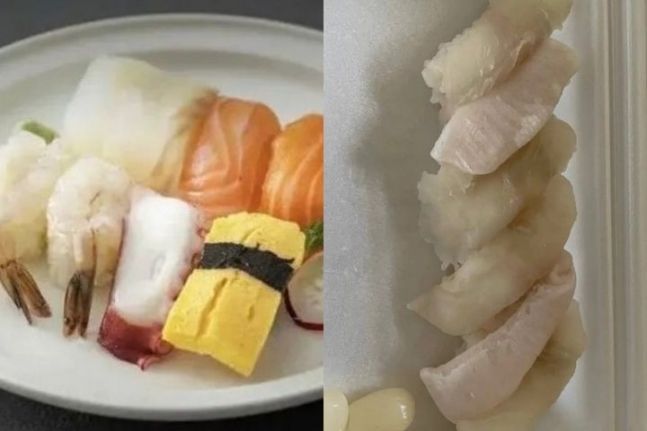 Example photo of a sushi delivery company (left) and the actual food. [Image source=Online community capture]
Looking at the photo he posted, the example photo of assorted sushi uploaded by the company shows various types of sushi arranged on a plate. However, the food Mr. A actually received was made up only of white fish.
After receiving the food, Mr. A said, "I called the company and talked to them," adding, "They said, 'We just started the business and put up any photo that can be used on Baedal Minjok (a Korean delivery app).' They only apologized and told me to just eat it. Isn't this fraud?" He added, "I obviously ordered expecting salmon, shrimp, etc., but there was only one type of white fish."
However, opinions among netizens were divided. The actual sushi in the photo Mr. A posted was made from various parts of flatfish (gwang-eo), and some pointed out that it was actually a more expensive product than the example photo, which included relatively cheaper ingredients like shrimp and egg. On the other hand, some responded, "The issue is not about the price but that the photo and the actual product are completely different."
So, can one be punished simply because the actual food differs from the photo? Article 8 of the current Food Labeling and Advertising Act prohibits "false or exaggerated labeling or advertising" and "labeling or advertising that deceives consumers." If the false content or exaggerated expressions in the advertisement are problematic, the relevant administrative agency can issue a correction order to the business owner. In some cases, this can lead to business suspension or cancellation, or even imprisonment of up to five years and fines of up to 50 million won.
However, it is difficult to hold someone responsible for violating the labeling and advertising law solely because there is some difference between the photo and the actual food. Especially recently, if the restaurant’s menu includes phrases such as "reference image" or "staged photo" in advance, there is room to avoid liability.
© The Asia Business Daily(www.asiae.co.kr). All rights reserved.
![A Woman Who Jumps Holding a Stolen Dior Bag... The Mind-Shaking, Bizarre Con of a "Human Knockoff" [Slate]](https://cwcontent.asiae.co.kr/asiaresize/183/2026021902243444107_1771435474.jpg)
















