Jeju Air and Jin Air Rally to Record 1Q Quarterly Earnings
Korean Air Also Sees 20% Revenue and 5% Operating Profit Increase in 1Q
Travel Demand Growth and Fare Hikes Drive Gains
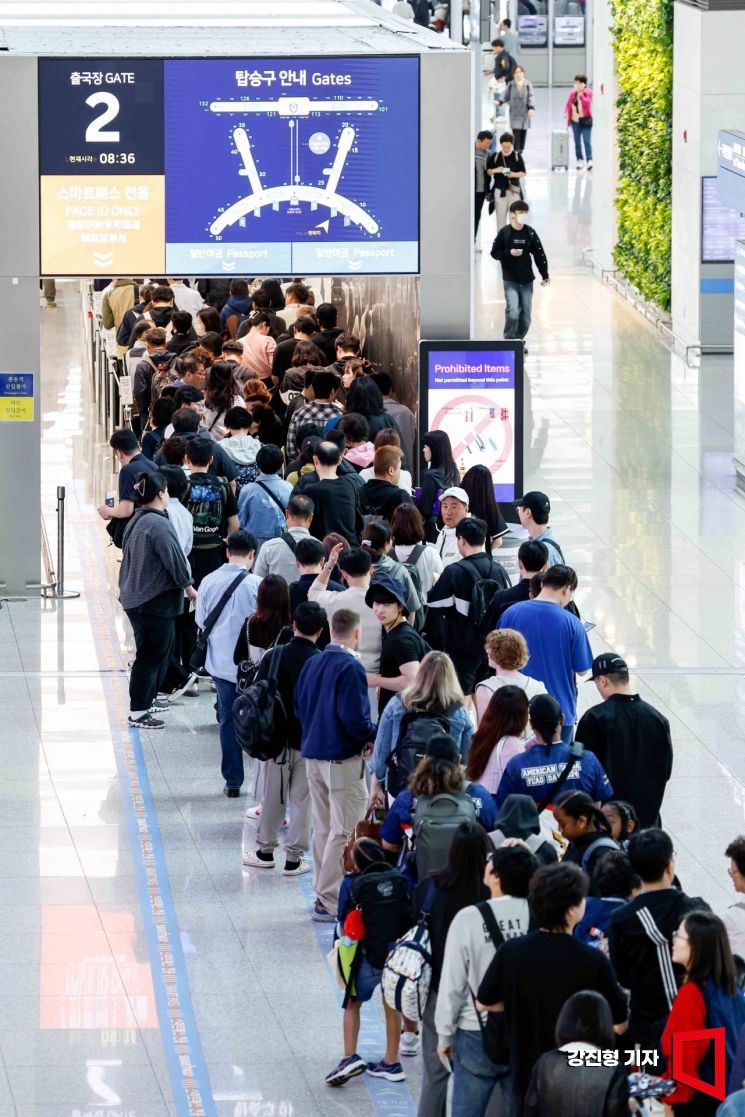 On the 3rd, travelers visiting Incheon International Airport Terminal 1 ahead of the Children's Day holiday lined up to move to the boarding concourse. Photo by Jinhyung Kang aymsdream@
Domestic airlines achieved 'record-breaking' performance across the board in the first quarter of this year. This was due to a surge in passenger demand despite higher airfares. As overseas travel has become more of a 'routine,' analysts say that the overall scale of airlines' earnings has increased.

According to the industry on the 9th, Korean Air announced yesterday that it posted provisional results for the first quarter of this year with separate sales of 3.8225 trillion KRW and operating profit of 436.1 billion KRW. This represents increases of 19.6% and 5.1%, respectively, compared to the same period last year. The sales figure is the highest ever recorded for a first quarter.
Jeju Air, the leading low-cost carrier (LCC), also posted strong results. It achieved separate sales of 539.2 billion KRW and operating profit of 75.1 billion KRW in the first quarter, growing 27.7% and 6.2%, respectively, compared to the same period last year. This is the highest quarterly performance ever, marking six consecutive quarters of profit since the fourth quarter of 2022. Jin Air recorded a 'big hit' by ranking first among LCCs in terms of operating profit, with 98.5 billion KRW in the first quarter, a 16.0% increase from the same period last year.
The background to these strong results is the increase in travel demand. According to the Ministry of Land, Infrastructure and Transport’s Aviation Statistics System, the number of international passengers in the first quarter of this year was 21,607,700, up 55.6% compared to the same period last year. This nearly recovers the 23,012,848 passengers recorded in the first quarter of 2019, before COVID-19.
In particular, the sustained low won-yen exchange rate kept Japan routes consistently popular, and demand for Southeast Asia routes increased due to the winter peak season. The number of passengers on Japan routes in the first quarter was 6,205,279, which is actually 6.0% higher than before COVID-19.
Along with passenger demand, airfares also rose. The International Airfare Consumer Price Index increased from 96.38 in the first quarter of 2020 to 121.37 in the first quarter of this year. This is about a 25.9% increase compared to just after the COVID-19 outbreak.
Strong performance is expected to continue for the time being. Demand remains steady, and despite rising oil prices due to geopolitical conflicts in the Middle East, the increase is not being passed on to jet fuel costs. Furthermore, as overseas travel becomes routine, the airline industry is no longer following the traditional 'cycle logic,' analysts say.
Choi Go-woon, a researcher at Korea Investment & Securities, explained, "The utility of travel has become as important as essential goods, and even economically, travel to Japan and Southeast Asia has become a reasonable choice compared to domestic price increases. International supply is expected to lag behind potential overseas travel demand until 2025, and as a result, airfares that are 30% higher than in 2019 have now become the 'new normal.'"
© The Asia Business Daily(www.asiae.co.kr). All rights reserved.


















