President Ueda Speaks at Tokyo Lecture
Identifies Exchange Rate Fluctuations and Oil Prices as Risks
Kazuo Ueda, Governor of the Bank of Japan (BOJ), stated on the 8th that if inflation rises or the risk of inflation increases, "it would be appropriate to adjust interest rates more quickly."
According to the Nihon Keizai Shimbun, Governor Ueda made these remarks at a lecture held in Tokyo on the same day. Regarding future monetary policy operations, he said, "If the economic or inflation outlook and the surrounding risks change, there will be a reason to move interest rates," citing exchange rate fluctuations and oil prices as risk factors.
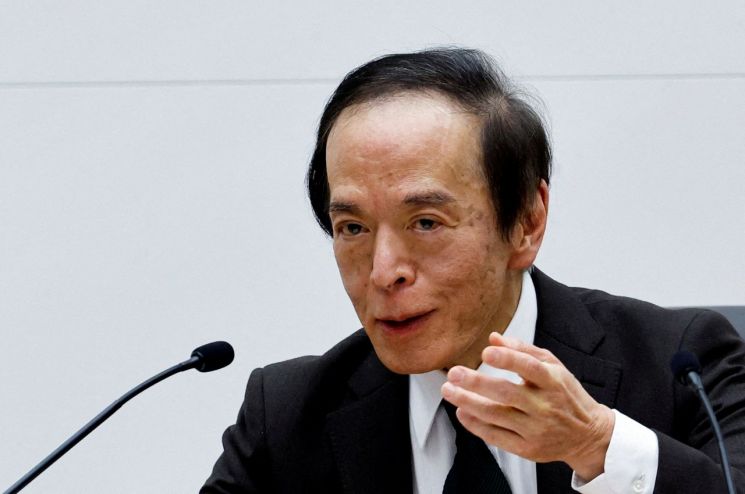
Regarding the weak yen, Governor Ueda stated, "There is a possibility of weakening the premise of the outlook that cost-push pressures starting from rising import prices will stabilize." He also assessed, "Compared to the past, companies are acting more proactively regarding wages and price setting, making exchange rate fluctuations more likely to affect inflation than before."
Governor Ueda said, "It goes without saying that the exchange rate is an important factor affecting the economy and inflation," adding, "There is a possibility that a monetary policy response will be necessary. We are closely monitoring the recent impact of the weak yen." He also expressed concern, saying, "A rapid and one-sided depreciation of the yen increases uncertainty by making it difficult for companies to plan their business operations, which negatively affects the economy."
Earlier, after the BOJ's Monetary Policy Meeting on the 26th of last month, Governor Ueda said at a press conference following the decision to keep policy rates unchanged, "Currently, the weak yen is not having a significant impact on the underlying inflation rate." The market has evaluated this statement as further stimulating the yen's weakness.
Following his remarks, the yen sharply weakened, and on the 29th of the same month, the yen-dollar exchange rate exceeded 160 yen per dollar for the first time in 34 years since April 1990. Due to the yen's extreme volatility, there were also observations that Japanese foreign exchange authorities directly intervened in the market to counter the yen's weakness.
However, the yen-dollar exchange rate fell to the 153 yen per dollar range on the 3rd, then gradually rose and is currently trading in the 155 yen range.
© The Asia Business Daily(www.asiae.co.kr). All rights reserved.
![Clutching a Stolen Dior Bag, Saying "I Hate Being Poor but Real"... The Grotesque Con of a "Human Knockoff" [Slate]](https://cwcontent.asiae.co.kr/asiaresize/183/2026021902243444107_1771435474.jpg)











