WSJ Reports 'Apple Developing AI Semiconductor'
Will Nvidia's AI Market Share Decline?
Focus on Samsung Electronics and SK Hynix Benefits
Taiwan TSMC Also Likely to Increase Market Share
Following big tech companies such as Google and Microsoft (MS), Apple has also entered AI chip development, intensifying the semiconductor war among big tech firms. This move is interpreted as part of an anti-NVIDIA alliance and is seen as positive news for Taiwan's TSMC, Samsung Electronics, and SK Hynix.
The AI semiconductor independence of big tech companies has gained more attention as Apple unveiled the M4 chip with AI capabilities on the 7th (local time). Earlier, the Wall Street Journal (WSJ) reported the day before that Apple has been developing AI semiconductors for data centers under the internal codename ‘ACDC (Apple Chip for DataCenter)’ for several years. According to the report, Apple released a system-on-chip (SoC) with enhanced AI functions while developing AI semiconductors.
It is unusual for Apple to attract attention for AI two days in a row. While NVIDIA, MS, Meta, Amazon, Alphabet, and Tesla?collectively known as the ‘Magnificent Seven’ representing major U.S. tech stocks?have been actively developing and showcasing AI semiconductors, Apple had remained quiet until now.
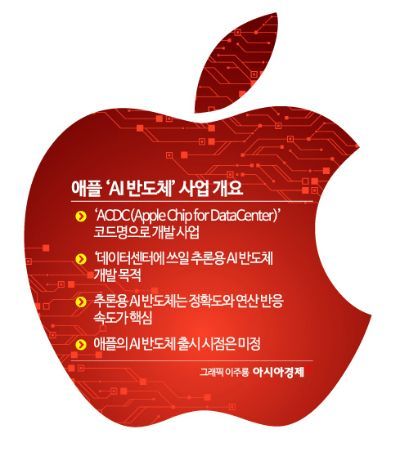
Attention is also focused on the strengthened anti-NVIDIA front as Apple introduces AI semiconductors. NVIDIA holds over 80% market share in the AI semiconductor market. Due to high dependence on NVIDIA products, shortages have occurred, leading to situations where orders are placed but not fulfilled. The product prices are also substantial; for example, the H100 exceeds 50 million KRW per unit. This is the background for many companies to introduce their own AI semiconductors.
The semiconductor industry expects mixed outcomes for companies if this trend continues. If major customers continue to leave, NVIDIA may face reduced earnings and a slight decline in influence in the AI semiconductor market. On the other hand, as AI semiconductors increase, companies like Samsung Electronics and SK Hynix, which offer high-value-added memory products such as high-bandwidth memory (HBM) used alongside AI semiconductors, are expected to have more business opportunities.
TSMC, a foundry company serving big tech clients including Apple, can also increase its earnings and market share by expanding AI semiconductor orders. However, since NVIDIA is also a major customer, the degree of earnings growth may vary depending on future market conditions. If TSMC’s market share rises, Samsung Electronics, which also operates a foundry business, may face difficulties in securing market share.
A semiconductor industry insider said, "While TSMC’s market share may increase through this opportunity, the AI semiconductor market is still growing and the pie is large, so it will be difficult for a single company (TSMC) to handle it alone," adding, "Samsung Electronics has also achieved results by having AI semiconductor company Groq as a customer, so it is necessary to observe future competition among companies."
© The Asia Business Daily(www.asiae.co.kr). All rights reserved.
![Clutching a Stolen Dior Bag, Saying "I Hate Being Poor but Real"... The Grotesque Con of a "Human Knockoff" [Slate]](https://cwcontent.asiae.co.kr/asiaresize/183/2026021902243444107_1771435474.jpg)
















