90% of US Treasury Bonds Issued by Treasury Department Have Interest Rates Above 4%
High Interest Rates Expected to Persist...Increase in Investors Seeking Fixed Income
As the timing of the U.S. Federal Reserve's (Fed) benchmark interest rate cuts is delayed, a large influx of funds is flowing into U.S. Treasury investments. This is due to the low possibility of further rate hikes limiting the decline in bond prices, and the expectation that if the current high interest rates persist long-term, investors can reliably earn an annual interest yield of around 5%. There is also a forecast that even if the Fed lowers rates in the future, the decline in interest rates will be limited due to a strong U.S. economy.
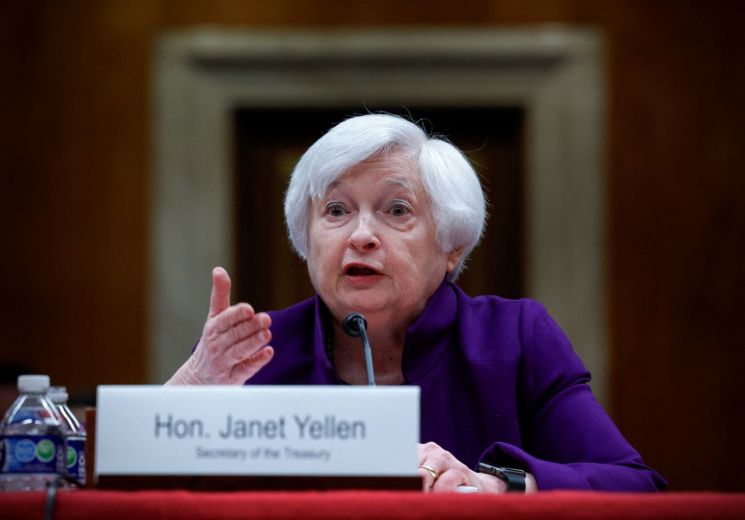
On the 6th (local time), Bloomberg News reported, citing market research firm Emerging Portfolio Fund Research (EPFR), that money market funds (MMFs), which invest in safe assets such as short-term government bonds with standby funds, attracted a record high of $6.1 trillion (approximately 8,290 trillion won) in April this year. Short-term bonds have the advantage of maturing quickly, allowing investors to fully enjoy the returns from high interest rates. Additionally, U.S. bond funds attracted $300 billion (approximately 408 trillion won) in 2023, and as of now this year, inflows have already reached $191 billion (approximately 260 trillion won).
Investors' bond interest income is also increasing. The total amount paid by the U.S. Treasury in interest on government bonds last year reached $900 billion (approximately 1,223 trillion won), double the average of the past decade. In March this year, the U.S. Treasury paid $89 billion (approximately 121 trillion won) in interest to U.S. Treasury investors, which equates to $2 million (approximately 270 million won) in interest every minute. The share received by individual investors has also grown significantly. According to the Congressional Budget Office (CBO), the interest and other income expected to be earned by individuals investing in U.S. Treasuries this year is $327 billion (approximately 444 trillion won), more than double that of the mid-2010s. This is expected to increase annually over the next decade.
The surge in interest payments by the U.S. Treasury is due to the Fed's benchmark rate hikes and increased Treasury issuance, which have pushed bond yields higher. According to Bloomberg, the 10-year U.S. Treasury yield was 4% as of the 10th of last month, rising more than 2 percentage points from 1.9% in March 2022, just before the Fed began its current tightening cycle. Currently, over 90% of U.S. Treasury bonds issued by the Treasury have yields exceeding 4%.
Generally, the optimal time to invest in bonds is during periods of interest rate cuts, as bond prices, which determine yields, move inversely to interest rates. For this reason, investors tend to increase bond purchases when rate cuts are anticipated, aiming for bond price appreciation. Those currently focusing on bond investments note the low likelihood of further rate hikes and the prospect of prolonged high interest rates, allowing them to secure stable high interest income for the time being. Earlier, Fed Chair Jerome Powell dismissed the possibility of rate hikes immediately after the Federal Open Market Committee (FOMC) meeting on the 1st, but stated, "It will take longer than expected to gain confidence that inflation is on a sustainable path toward 2%."
Despite signs of cooling in the labor market, the slowdown in U.S. inflation toward the Fed's 2% target has stalled, making it unlikely that rate cuts will occur soon. The strong U.S. economy also leads some investors to expect limited future rate cuts by the Fed, increasing the appeal of generating fixed income through bond purchases. The risk of losses from bond price declines is also low. According to Bloomberg estimates, for losses to occur from Treasury investments, the benchmark rate would need to rise by 0.75 percentage points next year.
Furthermore, the restructuring of global supply chains excluding China may sustain inflation, and the chronic U.S. fiscal deficit along with the expected surge in Treasury issuance could also limit future declines in U.S. Treasury yields, analysts say.
Dan Ivascyn, Chief Investment Officer (CIO) of PIMCO, the world's largest bond manager, said, "Looking back over the past 15 years, inquiries about bond investments are at their highest," adding, "Investors believe they can earn 6-8% returns from bond investments. A completely new buyer base is emerging."
© The Asia Business Daily(www.asiae.co.kr). All rights reserved.
![Clutching a Stolen Dior Bag, Saying "I Hate Being Poor but Real"... The Grotesque Con of a "Human Knockoff" [Slate]](https://cwcontent.asiae.co.kr/asiaresize/183/2026021902243444107_1771435474.jpg)
















