A study has found that harmful substances are released into the air from cigarettes displayed in packaging alone. Nicotine was detected in the air around cigarette display racks in convenience stores, raising concerns about harmful substance exposure for vulnerable groups such as adolescents, children, and employees who frequently use convenience stores.
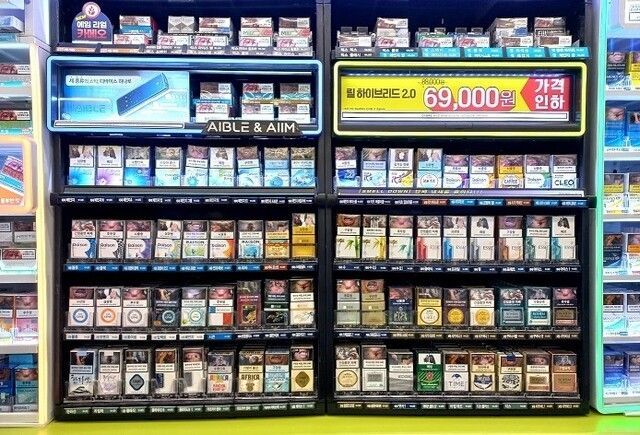
On the 3rd, a joint research team from the Department of Health Administration at Yonsei University Mirae Campus, the University of Southern California, and Daegu Catholic University announced that they identified this fact after measuring nicotine concentrations in the air around cigarette display racks installed in 95 convenience stores nationwide.
According to the research team, nicotine was detected in all 95 convenience stores surveyed. The median nicotine concentration in the air near the cigarette display racks was 0.0908㎍/㎥, and even at the point farthest from the cigarette display racks within the surveyed stores, nicotine was measured at a concentration of 0.0345㎍/㎥.
Nicotine is normally not detected unless it is a smoking area. According to a paper published by the American research team in the international journal Tobacco Control (2004), the nicotine concentration in the air collected around smoking rooms inside airports ranged from 0.15 to 0.72, but no nicotine was detected in the air in non-smoking areas outside the airport.
In Korea, an analysis of nicotine concentration in the air reported in the Journal of the Korean Society of Living Environmental System (2018) showed levels in the following order: billiard halls (4.95㎍/㎥), screen golf centers (2.89㎍/㎥), karaoke rooms (2.01㎍/㎥), and coffee shops (0.05㎍/㎥). The nicotine concentration measured inside convenience stores this time was lower than in places where smoking occurred at that time but higher than in coffee shops where smoking was prohibited.
Regarding these results, the research team analyzed that there is a possibility that vulnerable groups such as employees working in tobacco retail environments including convenience stores, and adolescents and children who frequently use convenience stores, could be exposed to nicotine over a long period. Notably, in this survey, 99% of convenience stores reported having ventilation systems, and 70% said they ventilate frequently. Nevertheless, nicotine was detected in all stores, indicating that simple ventilation alone is insufficient to completely prevent secondhand smoke inside convenience stores. The research team pointed out the need for measures such as strengthening exhaust facilities centered around areas where cigarette display racks are installed.
Professor Myungbae Park of Yonsei University, the lead researcher, explained, "This study proved that nicotine can be released into the air even from packaged cigarettes, and that exposure to nicotine can occur even without direct or indirect smoking." He added, "While emphasizing the need for smoking cessation is important, there is also a need to newly review policy aspects that can minimize nicotine exposure in public places," and stated, "Improving cigarette packaging to be completely sealed to effectively block nicotine release could be one alternative."
Meanwhile, the paper was published in the latest issue of the international journal Drug and Alcohol Dependence.
© The Asia Business Daily(www.asiae.co.kr). All rights reserved.
![Clutching a Stolen Dior Bag, Saying "I Hate Being Poor but Real"... The Grotesque Con of a "Human Knockoff" [Slate]](https://cwcontent.asiae.co.kr/asiaresize/183/2026021902243444107_1771435474.jpg)
















