The 24th Korea-Japan-China Finance Ministers and Central Bank Governors Meeting
The economies of ASEAN+3 (Korea, Japan, China) are expected to show higher growth than last year, supported by investment, exports, and robust consumer spending.
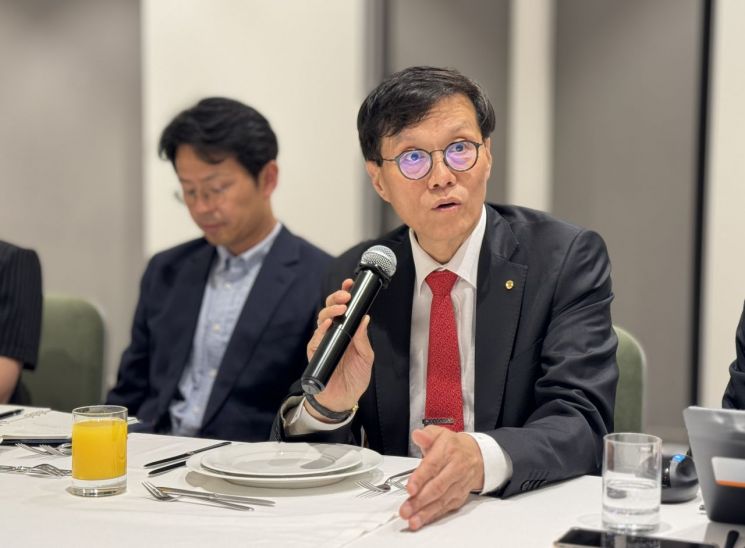
According to the Bank of Korea on the 3rd, Lee Chang-yong, Governor of the Bank of Korea, attended the "24th Korea-Japan-China Finance Ministers and Central Bank Governors Meeting" held in Tbilisi, Georgia. At the meeting, the three countries forecasted that the ASEAN+3 regional economy would experience higher growth than the previous year, driven by investment, exports, and strong consumer spending.
However, they pointed out short-term risk factors such as geopolitical conflicts, rising commodity prices, slowing growth in major trading partners, and increased volatility in foreign exchange markets due to external factors. They also agreed that medium- to long-term risks include climate change and population aging.
Member countries agreed on the need to recover policy capacity and strengthen fiscal sustainability after the pandemic, while maintaining tight monetary policies and enhancing growth potential.
At the meeting, the three countries also reached an agreement on the advantages of the new funding structure of the multilateral currency swap, CMIM, called the "paid-in capital method." The CMIM (Chiang Mai Initiative Multilateralisation) is a multilateral currency swap arrangement within ASEAN+3 with a total size of $240 billion.
Governor Lee emphasized the necessity of transitioning to the paid-in capital method to enhance the effectiveness of CMIM. By switching to the paid-in capital method, the balance sheets of member countries and CMIM are separated. This reduces political and credit risk burdens for funding countries and lowers uncertainty of benefits for borrowing countries, significantly improving CMIM’s effectiveness.
He also supported the establishment of a Rapid Financing Facility (RFF) within the current CMIM. The RFF is a program that provides small-scale, short-term financial support without pre- or post-conditions to resolve crises caused by temporary external shocks such as natural disasters.
Meanwhile, the 25th Korea-Japan-China Finance Ministers and Central Bank Governors Meeting is scheduled to be held next year in Milan, Italy, hosted by China. This meeting is held annually ahead of the ASEAN+3 Finance Ministers and Central Bank Governors Meeting to review key agendas in advance and discuss economic and financial cooperation among Korea, Japan, and China.
© The Asia Business Daily(www.asiae.co.kr). All rights reserved.

















