The Winner Is Like a Flower: Emphasizing Responsibility to the Party and People
"Oppose During Decision-Making, But Follow Once Party Policy Is Set"
"Unprecedented Landslide Victory... Worried It May Lead to Disappointment"
"I usually don't speak at length..., but today I have a few things to say."
Lee Jae-myung, leader of the Democratic Party of Korea, typically did not speak for long during party meetings. This was partly because the floor leader usually leads these meetings, and also because if speeches got too long, they were often seen as either 'lectures' or 'nagging.' Although he has experience as a mayor of basic and metropolitan local governments, he entered the National Assembly through a by-election, so his parliamentary experience is shorter than that of other first-term lawmakers. He has even described himself as a "half-term" lawmaker, showing a cautious attitude. Considering this, Lee's speech at the Democratic Party floor leader electee meeting on the 3rd was unusual. It was long.
Opening with congratulatory remarks, Lee explained why he did not smile when the exit polls of the 22nd general election, which showed a landslide victory, were announced. He said, "The exit poll results were announced, but I could not smile. There are many reasons, but one of them is that while everyone else was smiling, our comrades who lost were shedding tears." In fact, Lee drew attention by showing a blank expression instead of cheering or smiling despite the overwhelming victory in the general election.
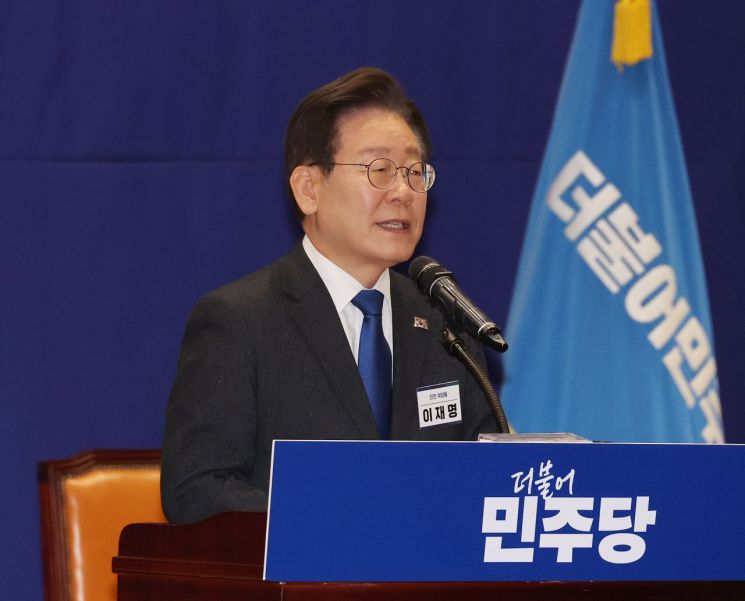 Lee Jae-myung, leader of the Democratic Party of Korea, is giving a greeting at the 1st floor leader election winners' general meeting of the 22nd National Assembly Democratic Party held at the National Assembly Members' Office Building on the morning of the 3rd.
 [Photo by Yonhap News]
Regarding this, he urged that the glory of being elected as a member of the National Assembly should be recognized as an achievement made by party members and the people, not by individual candidates. Comparing the electees to splendid flowers, Lee mentioned those who tasted defeat in regions like Yeongnam, saying, "We are not individuals but members of the political organization called the Democratic Party. We occupy the place of splendid flowers as a result of the roles played by many people who make up the party?the roots, stems, leaves, and branches." He added, "Candidates in overwhelmingly favorable or unfavorable regions are not born to be candidates of those regions. I felt more sorrowful tears than laughter thinking about those who dedicate themselves for the party's overall victory and for democracy in the Republic of Korea."
Sharing these reflections, he urged, "The positions and roles you hold are never personal. Please do not forget that your achievements are not individual accomplishments made by your own ability when you engage in legislative or political activities in the future."
At this meeting, Lee also spoke about the relationship between members of the National Assembly as constitutional institutions and members of political parties. Regarding party positions, he said, "It is good to express opposing opinions during discussions, but there should be no blocking of party-backed legislation without opposition during the discussion."
He said, "We are party members, but at the same time, we are independent constitutional institutions. We need to balance these two aspects well." Lee emphasized the importance of conviction. He said, "I hope you never give up on your claims based on your political beliefs or values." Especially addressing first-term lawmakers elected this time, he said, "Each individual should strongly assert claims based on public interest goals rather than private desires. Reformist remarks for the party's development should be made strongly. I think the stronger, the better."
At the same time, he said, "What we need to guard against is creating unnecessary internal conflicts and confrontations. Since we have taken on these roles by the power of the Democratic Party members and the people who support us, it is desirable to follow the party line on goals that everyone has agreed upon and consented to, unless it seriously contradicts your conscience and values." Lee said, "What was regrettable in the 21st National Assembly was that I saw several cases where bills, which were difficult to decide as party positions, were opposed for personal reasons and stalled. I did not point this out because of internal conflicts, but I hope the newly elected members avoid such situations as much as possible." He added, "It is good to strongly oppose during decision-making processes, but I hope there will be no cases where party-backed legislation is effectively nullified without opposition."
In fact, within the Democratic Party, there have been frequent situations where members remained silent during party line discussions but cast rebel votes during voting. Regarding this issue, there was a counterargument that some members could not openly express dissent due to concerns about the views of the staunch supporters called 'Gaeddal.' However, there were voices of self-reflection within the party about lawmakers, as constitutional institutions, remaining silent during party line discussions but 'coming out' during plenary votes. Lee expressed his own conviction about balancing lawmakers as constitutional institutions and as party members, saying that members should not hesitate to debate strongly during internal discussions but should follow the party line once a conclusion is reached, unless it seriously contradicts their conscience.
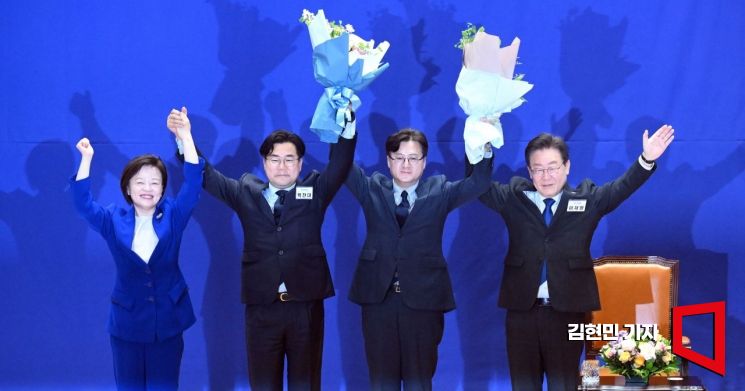 Park Chan-dae, a member of the Democratic Party of Korea newly elected as the floor leader (second from the left), is taking a commemorative photo with Lee Jae-myung, the party leader, Hong Ik-pyo, the former floor leader, and Jin Sun-mi, the party election commission chairperson, at the 22nd National Assembly Democratic Party of Korea elected members' general meeting held at the National Assembly Members' Office Building on the 3rd. Photo by Kim Hyun-min kimhyun81@
He also urged members to strengthen constituency management. He said, "There is no solution for overwhelmingly favorable or unfavorable regions, but there are several places where the results actually reflected whether members had made personal efforts over a considerable period. Your roots and starting points are the people of your constituencies, especially party members, supporters, and voters. It is important to communicate a lot, have many conversations, and listen to many demands, and do your best within what is possible."
He also gave advice about the period 'after' an overwhelming victory. Since the responsibility entrusted by the people can turn into disappointment, members must fulfill their responsibilities and missions. He said, "For the first time in Korean history, we achieved an overwhelming majority as the ruling party, and now, as the opposition, we have an unprecedented overwhelming majority. If we do not fulfill the responsibilities expected or imposed by the people well, I have a great concern that the same amount of disappointment will return to us." He reminded members not to forget that despite the great victory in the last general election, the party lost in the presidential and local elections.
© The Asia Business Daily(www.asiae.co.kr). All rights reserved.


















