April Foreign Exchange Reserves at $413.26 Billion
Impact of Strong Dollar Leading to Exchange Rate Defense
Bank of Korea: "Sufficient Capacity to Respond to External Shocks"
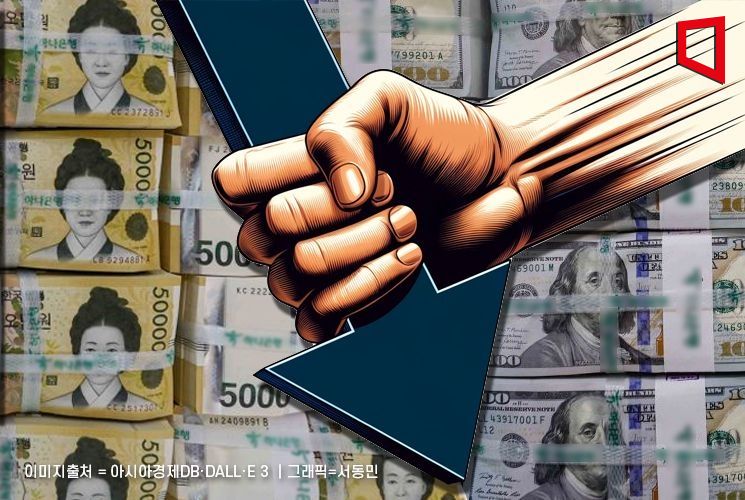
As the foreign exchange authorities stepped in to defend against the sharp rise in the won-dollar exchange rate caused by the strong dollar, South Korea's foreign exchange reserves slightly decreased compared to the previous month. However, the Bank of Korea explained that the size of the country's foreign exchange reserves and the short-term external debt ratio are sufficient to respond to external shocks.
According to the Bank of Korea on the 7th, as of the end of April, South Korea's foreign exchange reserves stood at $413.26 billion, down $5.99 billion from the end of the previous month.
The Bank of Korea stated that the decrease in foreign exchange reserves last month was due to market stabilization efforts such as foreign exchange swaps with the National Pension Service and a reduction in foreign currency deposits by financial institutions.
Last month, the won-dollar exchange rate hit 1,400 won, and the strong dollar phenomenon continued, prompting intervention by the foreign exchange authorities. The foreign exchange authorities and the National Pension Service have signed a foreign exchange swap agreement with a limit of $35 billion and take market stabilization measures when necessary.
At the end of each quarter, foreign currency deposits temporarily increase to comply with the Bank for International Settlements (BIS) capital adequacy ratio requirements for financial institutions, but in April, this effect disappeared, resulting in a decrease in foreign exchange reserves.
Additionally, the Bank of Korea added that the decrease in foreign exchange reserves was due to temporary factors combined with the strengthening of the US dollar last month, which reduced the dollar-converted value of foreign currency assets denominated in other currencies.
Foreign Exchange Reserves at 25% of GDP Provide Sufficient Crisis Response Capability
The Bank of Korea emphasized that the current foreign exchange reserves amount to 25% of the gross domestic product (GDP), exceeding the OECD's 2020 average of 17.5%, ranking ninth globally, and are at a level sufficient to respond to external shocks.
The short-term external debt ratio was also at a favorable level of 31.3% as of the end of February, compared to 74% at the end of 2008 during the global financial crisis.
The International Monetary Fund (IMF) and international credit rating agencies also evaluate that South Korea's foreign exchange reserves are sufficient to respond to external shocks when considering the short-term external debt ratio and current account payment ratio.
A Bank of Korea official said, "Compared to September 2022, when the exchange rate surged, the fundamentals of the domestic economy are stable, and both external debt and foreign exchange reserves remain at stable levels. The current foreign exchange reserves exclude funds from the currency swap with the National Pension Service, but since these funds are fully returned upon maturity, they will act as a factor for increasing foreign exchange reserves in the future."
He added, "Bilateral currency swap agreements have been signed with eight countries including Canada and Switzerland, and multilateral agreements have been concluded with ASEAN+3 countries, further strengthening the foreign exchange safety net."
Meanwhile, by asset type, securities such as government bonds and corporate bonds accounted for the largest portion of foreign exchange reserves at $370.61 billion (89.7%). Other components included deposits at $18.85 billion (4.6%), Special Drawing Rights (SDR) at the IMF at $14.64 billion (3.5%), gold at $4.79 billion (1.2%), and IMF positions at $4.37 billion (1.1%).
As of the end of March, South Korea maintained its ninth place globally in terms of foreign exchange reserves. China ranked first with $3.2457 trillion, followed by Japan with $1.2906 trillion, Switzerland with $881.6 billion, and India with $646.4 billion in fourth place.
© The Asia Business Daily(www.asiae.co.kr). All rights reserved.
!["The Woman Who Threw Herself into the Water Clutching a Stolen Dior Bag"...A Grotesque Success Story That Shakes the Korean Psyche [Slate]](https://cwcontent.asiae.co.kr/asiaresize/183/2026021902243444107_1771435474.jpg)
















