When a wound appeared on the face, juice was squeezed from herbs and applied
After a month, the wound healed and was completely cured
An orangutan with a large wound on its face was captured treating the injury using medicinal herbs commonly used in traditional medicine for various diseases. On the 3rd (local time), Dr. Isabel Roemer's team at the Max Planck Institute for Animal Behavior (MPIAB) in Germany reported that a wild Sumatran orangutan named 'Rakus' in Indonesia had sustained a large facial wound. Subsequently, Rakus was observed chewing and crushing medicinal herbs found in the nearby forest and applying the crushed herbs to the wound for treatment.
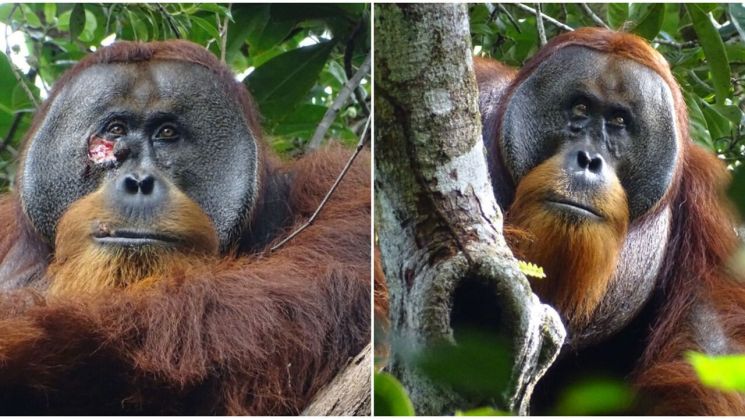 Sumatran orangutan 'Lakus' before (left) and after treatment of facial wounds with medicinal herbs [Photo by Scientific Reports/Isabelle Laumer et al]
Rakus, who had a deep wound on the cheek below the right eye, began chewing the stems and leaves of a medicinal herb called Akar Kuning (scientific name Fibraurea tinctoria) three days later, applying the extracted juice repeatedly to the wound for seven minutes. Then, the chewed plant material was used as a temporary bandage to cover the wound area. Observations showed no signs of infection in the wound area for several days. From the fifth day of treatment, the wound began to heal and was confirmed to be completely cured within a month.
Akar Kuning, a vine plant found in Southeast Asian tropical rainforests, is known to contain antibacterial, anti-inflammatory, antifungal, and antioxidant components. It has analgesic, antipyretic, and diuretic effects and is used in traditional medicine to treat dysentery, diabetes, malaria, and other conditions. The research team noted that since Rakus applied Akar Kuning repeatedly only to the wound over about 30 minutes and did not apply it to other body parts, it is highly likely that the orangutan intentionally used the herb to treat the facial wound.
It is not yet confirmed whether this is the first time Rakus has treated a wound or if this behavior was learned from other orangutans. However, the research team added that such healing behavior may suggest origins from a common ancestor of humans and great apes. The study by Dr. Isabel Roemer's team at the Max Planck Institute for Animal Behavior (MPIAB) was published in the scientific journal Scientific Reports.
Meanwhile, orangutans, which share 97% of their DNA with humans, are representative animals capable of imitating human behavior beyond just using tools. Like chimpanzees, they show excellent tool-using abilities and can communicate by learning sign language. Additionally, orangutans possess the ability to infer outcomes based on their actions. For example, when confined in wildlife centers, they can use learned tool-use methods to improvise shelters to avoid rain in the wild. Notably, orangutans boast some of the highest levels of tool-use ability compared to other species.
© The Asia Business Daily(www.asiae.co.kr). All rights reserved.

















