Charge Tourists an Additional 1000 to 2000 Yen
Approximately 25 Million Tourists Visited Japan Last Year
A recently opened restaurant in Tokyo, Japan, has introduced a service that charges foreigners full price while offering discounts to Japanese customers. There have been calls in Japan to implement a 'dual pricing system' that charges more to foreigners enjoying relatively cheap tourism due to the weak yen. Some restaurants have actually adopted a similar approach.
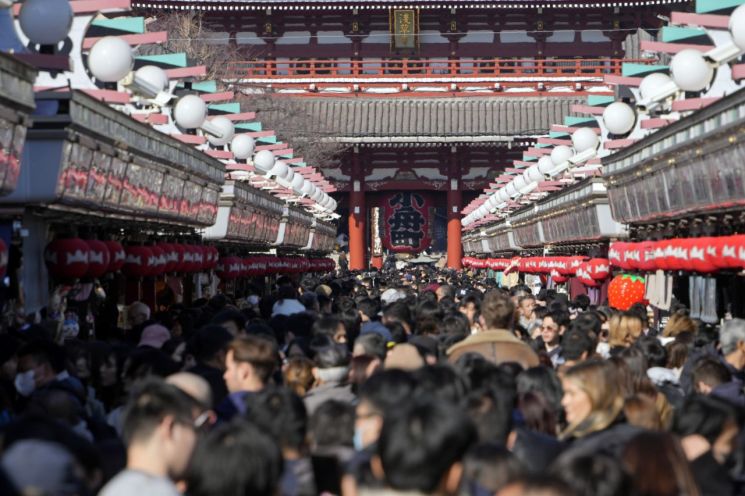 The Nakamise Shopping Street leading to Sensoji Temple in the Asakusa district of Tokyo, Japan, around February. JNTO (Japan National Tourism Organization) announced that approximately 25 million people visited Japan in 2023, which is about 80% of the total number of visitors to Japan in 2019 before the COVID-19 pandemic.
 [Photo by EPA·Yonhap News]
On the 2nd, a seafood and BBQ buffet restaurant in Japan announced via social media (SNS) that "foreign residents in Japan, including Japanese people, receive a 1,000 yen discount," promoting that "weekday lunch is 5,980 yen (excluding tax), but Japanese or domestic residents can enjoy it from 4,980 yen with a discount." Located in Shibuya, Tokyo, this restaurant opened newly on the 12th. Customers can eat unlimited amounts of 60 types of seafood, BBQ, alcohol, and beverages for 90 minutes.
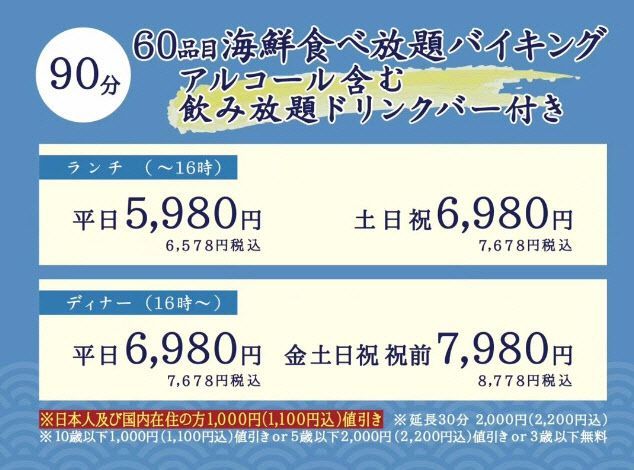 Price notice at a restaurant in Tokyo. A "dual pricing system" has been introduced, charging foreigners the full price.
 [Photo by X (formerly Twitter)]
According to the price list of the restaurant, weekday lunch costs 5,980 yen (about 53,000 KRW) excluding tax, and dinner costs 6,980 yen (about 62,000 KRW). Japanese customers receive a 1,000 yen (about 10,000 KRW) discount on these prices. This means they can have dinner at the lunch price. Including tax, lunch costs 6,578 yen (about 58,000 KRW), and dinner costs 7,678 yen (about 68,000 KRW). However, Japanese or domestic residents receive a 1,100 yen discount on these prices. The restaurant owner said in an interview with Fuji News Network (FNN) that "the weak yen phenomenon has lasted a long time, and I hope more people can enjoy the seafood buffet even a little."
Earlier, the Japan National Tourism Organization (JNTO) announced that about 25 million people visited Japan in 2023, which is about 80% of the total number of visitors to Japan in 2019 before the COVID-19 pandemic.
Concerns Mixed with Voices Calling Japan 'Cheap Japan' Amid Weak Yen Phenomenon
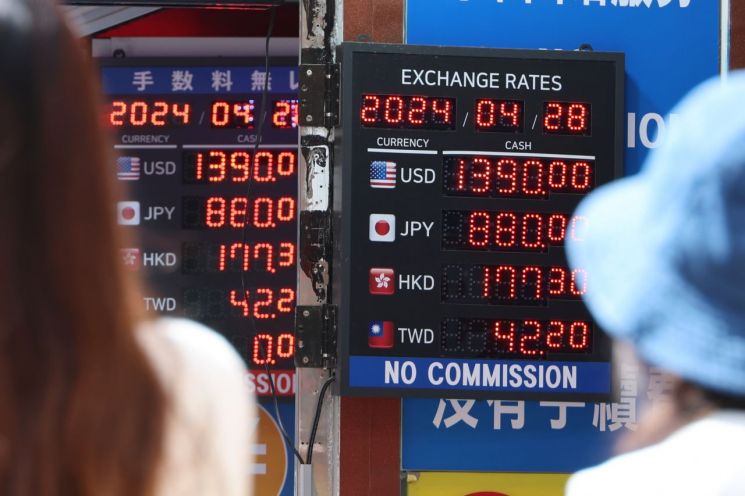 As the yen continues to weaken, on the morning of the 28th of last month, exchange rates for various currencies including the dollar and yen were displayed at a currency exchange booth in Myeongdong, Jung-gu, Seoul.
 [Photo by Yonhap News]
Recently, Japan has experienced an unprecedented weak yen phenomenon, with the yen-dollar exchange rate surpassing 160 yen per dollar for the first time in 34 years. Although the Bank of Japan ended its negative interest rate policy on the 19th, the timing of the U.S. Federal Reserve's rate cuts has been delayed, and the large interest rate gap is expected to continue for some time. In particular, as foreign tourists increase due to the weak yen, there are concerns that Japan might become "Cheap Japan (Yasui Nippon)."
One Japanese netizen posted on SNS, "The most unfair thing is that Japanese people risk their lives to provide services desperately, while foreign travelers think it's 'cheap' and enjoy themselves freely," adding, "I want to slap those guys who look down on Japanese people with outrageous overcharging." This post, uploaded on the 29th of last month, has been viewed by 3.74 million people and received over 12,000 likes.
Because of this, discussions about introducing a 'dual pricing system' that sets lower prices for Japanese and higher prices for foreigners are ongoing in Japan. In February, Hisanori Nagayami, Vice President of the Japan Ryokan Association, said, "In Singapore, dual pricing is operated by offering discounts to residents at theme parks, supermarkets, restaurants, and so on," adding, "Foreign tourists pay more but enjoy 'good unfair' benefits such as fast track access and courteous support."
© The Asia Business Daily(www.asiae.co.kr). All rights reserved.



















