Already Intervened Twice, Likely Injected at Least 8 Trillion Yen
"Intervention as Long as Necessary" Expected
165 Yen per Dollar Forecast... "Additional Rate Hike in Autumn"
As the unprecedented prolonged weak yen continues, Japanese authorities have begun efforts to boost the yen, with forecasts suggesting they could intervene again at any time if the yen's weakness persists. The amount previously injected by the Japanese government and the Bank of Japan (BOJ) to defend the exchange rate is estimated to be at least 8 trillion yen (approximately 71 trillion won).
According to major foreign media on the 2nd (local time), Atsushi Takeuchi, senior researcher at the Riko Institute for Sustainability and Business and a former BOJ official, stated that Japanese authorities are highly likely to continue intervening in the market until the risk of yen depreciation due to speculation is eliminated.
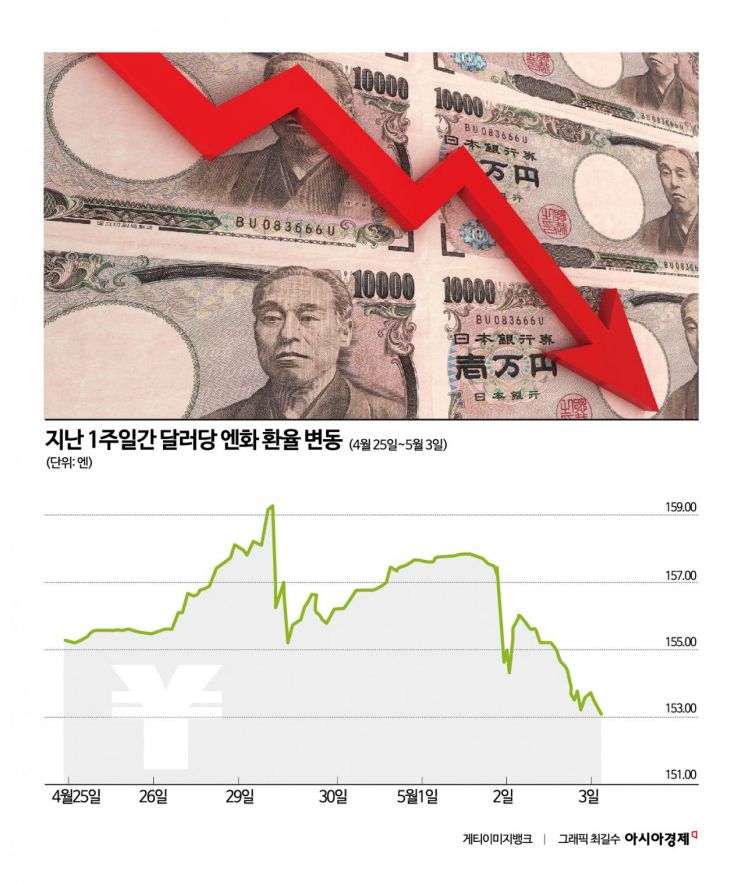
The yen's value surged three times over the past week. On this day in the New York foreign exchange market, the yen-dollar exchange rate gradually declined from the 156 yen range per dollar to the 153 yen range by evening. A decline in the yen-dollar exchange rate means an appreciation of the yen, and a 3-yen fluctuation in one day is quite significant. Japanese media such as NHK analyzed that the yen rose due to increased caution as expectations grew that authorities would repeatedly intervene in the market.
It is estimated that Japanese authorities have already intervened in the market twice. Before 2 p.m. on the previous day, when the Federal Open Market Committee (FOMC) results determining U.S. monetary policy were announced, the yen-dollar exchange rate was moving in the high 157 yen range per dollar, but then sharply dropped to 153 yen. Also, on the 29th of last month in the Asian foreign exchange market, the yen-dollar exchange rate surpassed 160 yen but then plunged more than 4 yen again, raising speculation about Japanese authorities' market intervention..
The Nihon Keizai Shimbun and others analyzed BOJ statistics and estimated that the Japanese government injected more than 5 trillion yen in the first round and over 3 trillion yen in the second round to defend the exchange rate. However, Masato Kanda, Japan’s Vice Minister of Finance, responded "no comment" when asked about market intervention the previous day.
Researcher Takeuchi said, "By intervening when the yen's depreciation accelerates, psychological impact can be maximized," and added, "Authorities will intervene as long as necessary to prevent a sharp yen drop caused by speculative trading." He served as the BOJ’s foreign exchange department head during Japan’s foreign exchange market interventions from 2010 to 2012.
Some express concerns that although Japan holds foreign exchange reserves worth $1.29 trillion (approximately 1764 trillion won), intervention might be limited because some assets, such as U.S. Treasury bonds, are difficult to sell. However, Takeuchi dismissed this, saying, "The reason for holding massive foreign exchange reserves is to prepare for intervention when necessary."
Other experts also believe that authorities are highly likely to intervene again. Hirofumi Suzuki, senior FX strategist at Sumitomo Mitsui Banking Corporation, said, "During Japan’s Golden Week holiday (April 27 to May 6), they are waiting for the U.S. employment report, and depending on the results, additional intervention may occur," and explained, "(In the previous day’s case) by acting immediately after the U.S. FOMC decision outside Japanese business hours, they sent a warning that they can intervene 24 hours a day."
Daisaku Ueno, currency strategist at Mitsubishi UFJ Morgan Stanley Securities, said, "There is no doubt about intervention. They will continue to intervene," and added, "Authorities have set 160 yen per dollar as the final defensive line."
However, despite Japanese authorities’ interventions, the yen’s weakness is expected to continue. This is because the outlook for U.S. Federal Reserve (Fed) interest rate cuts has receded, making it inevitable that the interest rate differential between the two countries will persist. RBC Capital Markets forecasted that the yen-dollar exchange rate will reach 165 yen per dollar, dropping the yen’s value to its lowest level since 1986. Along with short-term interventions, there are also predictions that the BOJ will raise interest rates a second and third time within the year to narrow the U.S.-Japan interest rate gap.
Takatashi Ito, a Columbia University professor and former vice minister of Japan’s Ministry of Finance, evaluated, "Appropriate intervention is effective." He predicted, "If the yen’s weakness continues and inflation rises significantly, the BOJ may raise interest rates twice to 0.5% by the end of this year," and added, "The BOJ could raise rates again as early as this fall."
© The Asia Business Daily(www.asiae.co.kr). All rights reserved.
![User Who Sold Erroneously Deposited Bitcoins to Repay Debt and Fund Entertainment... What Did the Supreme Court Decide in 2021? [Legal Issue Check]](https://cwcontent.asiae.co.kr/asiaresize/183/2026020910431234020_1770601391.png)
















