Release of Government Stockpiles of Cabbage and Radish
Additional 2,000 Tons of Distant-Water Squid Stockpiled
Rapid Implementation of New Tariff Quotas for Cabbage and Dried Gim
Although the consumer price inflation rate re-entered the 2% range after three months, the high prices of fruits and vegetables continue, widening the gap with the perceived inflation. The government announced that it will focus on releasing government stockpiles to ease household price burdens and establish structural price stabilization measures through the newly formed 'Livelihood Price Task Force (TF)'.
On the 3rd, the Ministry of Economy and Finance announced that at the 'Price-Related Ministries Meeting' held at the Government Seoul Office Building, chaired by Kim Beom-seok, Economic and Financial Secretary to the President, they intensively reviewed price trends by item such as agricultural, livestock, and fishery products, and petroleum products. The meeting was attended by directors and bureau chiefs from the Ministry of Economy and Finance, Ministry of Agriculture, Food and Rural Affairs, Ministry of Trade, Industry and Energy, Ministry of Oceans and Fisheries, and the Fair Trade Commission.
Last month, the consumer price inflation rate slowed to 2.9% year-on-year, re-entering the 2% range after three months. Contrary to the trend of core price indices, which show underlying inflation, slowing to the low 2% range, prices of agricultural products and petroleum products continued to soar. Pear prices (102.9%) doubled, recording the largest increase ever, and apple prices also rose by more than 80% compared to a year ago, showing a growing gap between the indicators and perceived inflation.
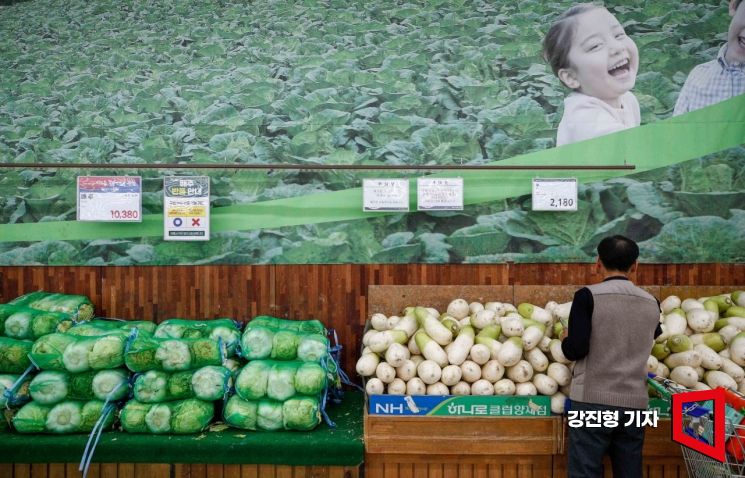 Following last year's poor harvest that caused apple and pear prices to surge, the prices of napa cabbage and radish, essential ingredients on Korean tables, are also rising, increasing the burden of food prices. On the 17th, a customer visiting Hanaro Mart Yangjae branch in Seocho-gu, Seoul, is purchasing radish. Photo by Jinhyung Kang aymsdream@
Participants in the meeting evaluated that although petroleum prices rose, agricultural product prices fell compared to the previous month and service prices remained stable, indicating a resumption of the inflation slowdown trend. However, they agreed that uncertainties such as international oil price volatility and abnormal weather remain significant, and decided to strengthen efforts to manage prices and supply for each item until inflation stabilizes at the policy target of 2%.
First, the government will release 100 to 110 tons daily from stockpiles for napa cabbage and radish, which have recently seen soaring prices, and will expedite procedures to introduce newly applied tariff quotas for napa cabbage (entirely imported), cabbage (6,000 tons), carrots (40,000 tons), and grapes (entirely imported) within this month.
For seafood, the government will additionally stockpile up to 2,000 tons of deep-sea squid, which began domestic supply at the end of last month, from today to proactively prepare for potential supply instability. Additionally, dry seaweed (700 tons) and seasoned seaweed (125 tons) will be subject to tariff quotas to expand supply.
For petroleum products, processed foods, dining-out services, textiles, and others, the government is creating conditions for price stabilization by extending fuel tax cuts and reducing raw material tariff quotas. The industry is urged to participate in alleviating the public burden, and market monitoring will continue to prevent opportunistic price hikes. The Fair Trade Commission will operate a separate reporting center to monitor unfair practices such as price collusion in essential sectors like food, clothing, and housing, and will form a 'Market Monitoring Task Force' within this month to investigate any detected suspicions.
The Livelihood Price TF, with the Presidential Office acting as the control tower, will also prepare key price stabilization and structural price stabilization measures. As the rise in prices of agricultural, livestock, and fishery products and fresh foods directly related to table prices shows little sign of abating, the Presidential Office announced the establishment of the Livelihood Price TF the day before. This is the first time in 13 years since the Lee Myung-bak administration in 2011 that the Presidential Office directly plays the role of a price control tower. The Ministry of Economy and Finance stated, "Through the price TF encompassing economic and social ministries, we will closely cooperate to analyze the distribution and supply structures of items with high sensitivity or large price fluctuations and find structural price stabilization measures."
© The Asia Business Daily(www.asiae.co.kr). All rights reserved.

















