China Demands US Stop Megaphone Diplomacy
US Urged to Prevent AI from Controlling Nuclear Weapons
China has rejected the United States' proposal for nuclear weapons control talks, reported the US online media Semaphore on the 2nd (local time).
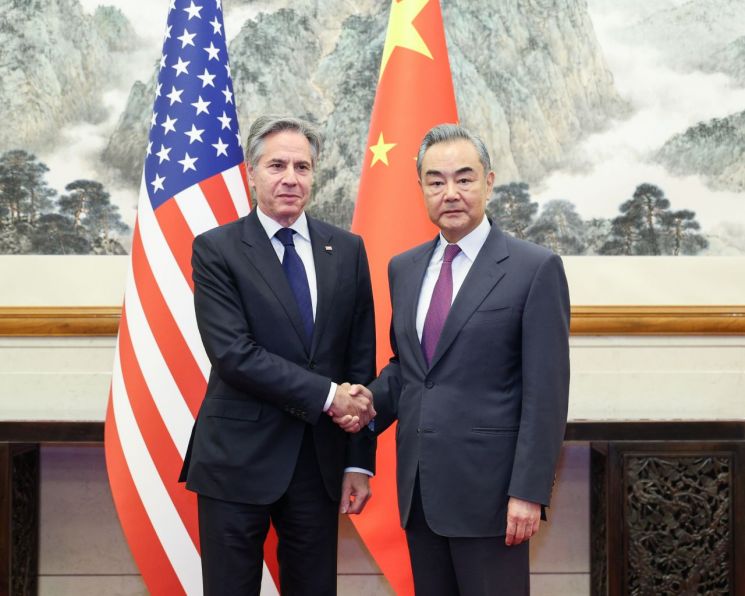 On the 26th of last month in Beijing, China, U.S. Secretary of State Tony Blinken (left) and Chinese Foreign Minister Wang Yi met and took a commemorative photo.
 [Photo by Yonhap News]
A US State Department spokesperson said regarding the US hope to resume talks after nuclear arms reduction talks between the US and China in November last year, "Unfortunately, China has refused follow-up talks and has not provided substantive responses to the options we proposed."
The spokesperson stated that the US government proposed "common-sense measures addressing the fundamental risks of conflict and uncontrolled crisis escalation in the nuclear and space domains." The proposed measures include improving crisis communication with China, institutionalizing prior notification of strategic ballistic missile test launches, and efforts to reduce space tensions.
In response, Liu Fengyu, spokesperson for the Chinese Embassy in the US, urged the US to stop its megaphone diplomacy. He added, "The country with the largest nuclear arsenal must significantly and substantially reduce its nuclear weapons for arms control negotiations."
Meanwhile, the US State Department also urged China and Russia to join an international commitment to prevent artificial intelligence (AI) from controlling nuclear weapons. Paul Dean, Deputy Assistant Secretary for Arms Control Verification and Implementation at the State Department, emphasized in an online briefing, "The United States has made a clear and strong commitment that humans will have full control over nuclear weapons."
He said, "France and the United Kingdom have made the same commitment," and added, "We would welcome similar statements from China and Russia."
He mentioned that the United Nations has five permanent members (Permanent 5, P5) including the US, China, Russia, the UK, and France, explaining, "We believe this is a very important norm for responsible behavior and is very welcome in the context of the P5."
Dean's remarks came as the US administration seeks to deepen separate discussions with China regarding nuclear weapons policy and AI development. On the 26th of last month, Secretary of State Antony Blinken met with Wang Yi, China's Foreign Minister, in China to discuss the spread of AI technology. Secretary Blinken said both sides agreed to hold the first bilateral talks on AI within the coming weeks and to share views on AI risk management measures.
© The Asia Business Daily(www.asiae.co.kr). All rights reserved.

















