Jung Jin-seok Chief Secretary Briefing
"Bad Politics Trying to Politically Exploit"
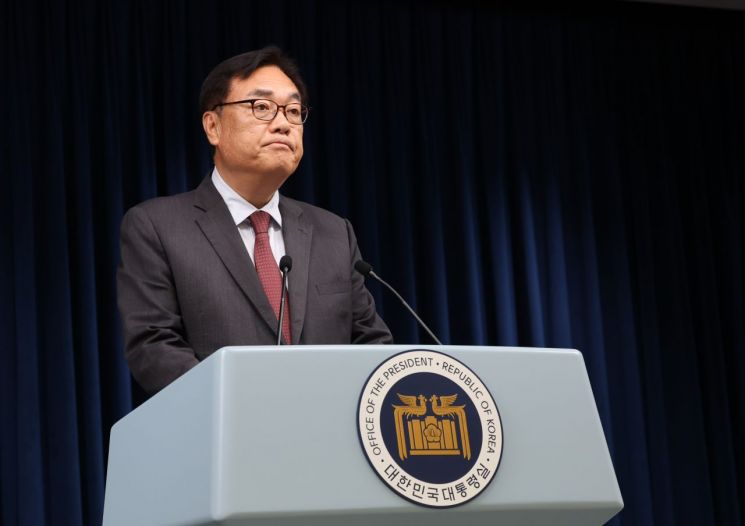 Jung Jin-seok, Chief of Staff to the President, wears a stern expression as he announces the presidential office's position on the 'Chae Sang-byeong Special Prosecutor Act,' which was passed solely by the opposition party in the National Assembly, at the Yongsan Presidential Office building in Seoul on the 2nd.
 [Image source=Yonhap News]
On the 2nd, the Presidential Office expressed "deep regret" over the ruling Democratic Party's unilateral and forceful passage of the special prosecutor law for Cha Sang-byeong during today's plenary session of the National Assembly, even changing the legislative schedule.
It added, "Despite the High-ranking Officials' Crime Investigation Office (PCC) and the police already conducting a full-scale investigation, the opposition's unilateral push for a special prosecutor suggests political motives beyond fact-finding," indicating a stern response. This effectively foreshadows President Yoon Seok-yeol's exercise of the right to request reconsideration (veto) of the special prosecutor law.
"Rushing Legislation Before the Ink Dries on the First Page of Cooperation"
On the afternoon of the same day, Chief Secretary Jeong Jin-seok stated at a briefing at the Yongsan Presidential Office, "The Presidential Office views the Democratic Party's unilateral legislative rush very seriously," criticizing, "The Democratic Party's forceful passage of the special prosecutor law is a bad political act that exploits the tragic death of Cha Sang-byeong for political purposes."
In particular, the Presidential Office expressed deep regret that the Democratic Party pushed ahead with a legislative rush before the ink was even dry on the first page of cooperation, at a time when public expectations for bipartisan cooperation were high following the summit meeting and the agreed passage of the Itaewon Special Act. This is seen as a direct defiance of the general election mandate and the solemn command of the people to unite and focus on people's livelihoods.
Chief Secretary Jeong said, "It is natural to investigate the cause and process of the accident and punish those responsible," adding, "Since the PCC and police are currently conducting thorough investigations, it is only proper to wait for the investigation results before introducing a special prosecutor." He explained that this aligns with the purpose of introducing a special prosecutor as stipulated by law.
Jeong added, "As guaranteed by law, the PCC and police should conduct the initial investigation, and based on the results, procedures such as the introduction of a special prosecutor should be discussed and followed."
He also said, "The PCC is an organization established by the Democratic Party using fast-track procedures. Naturally, it is common sense and proper to wait for the investigation results," emphasizing, "So far, there have been 13 instances of special prosecutors being appointed, but none were introduced without bipartisan agreement."
Yoon Signals Veto... Exercise Within 15 Days of Government Transmission
Jeong stated, "Given concerns that the unilaterally passed special prosecutor law today will plunge South Korea into chaos, the Presidential Office will respond sternly going forward."
The Presidential Office’s strong criticism of the opposition’s "legislative rush" during the Chief Secretary’s briefing 90 minutes after the special prosecutor law was passed is interpreted as a firm expression of intent to exercise the veto. Especially considering that the first meeting between President Yoon and Democratic Party leader Lee Jae-myung on the 29th of last month opened the door to cooperation, the opposition’s forceful passage of the special prosecutor law is seen as undermining the significance of the rare successful summit.
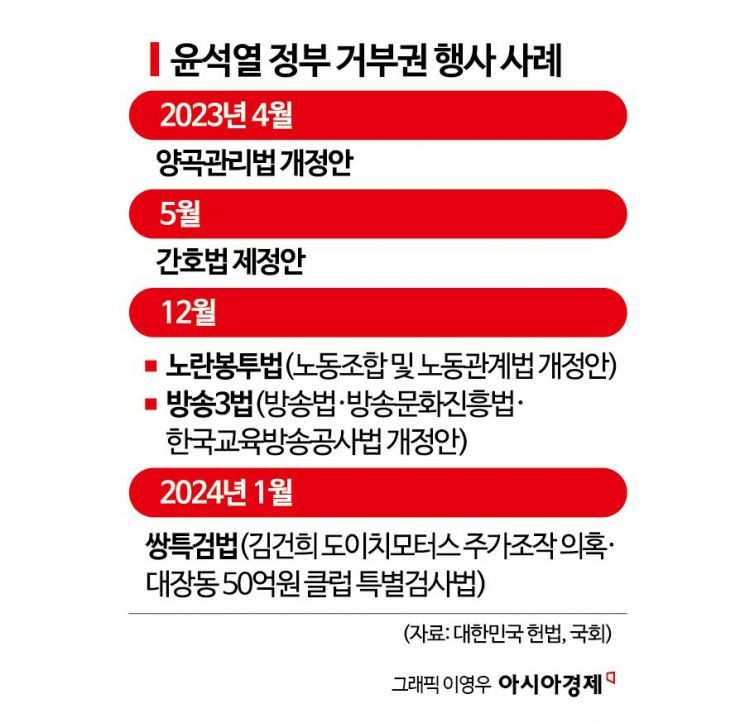
President Yoon can exercise the veto within 15 days after a bill passed by the National Assembly is transmitted to the government. Over the past two years, President Yoon has exercised veto power five times on nine bills. If he exercises the veto on the Cha Sang-byeong special prosecutor law soon, it will be recorded as the tenth bill to be vetoed.
© The Asia Business Daily(www.asiae.co.kr). All rights reserved.


















