Deployment of 2-Story Electric Buses and Demand-Based Chartered Buses
Increasing Transport Capacity and Alleviating Congestion of Metropolitan Buses in Seoul City Center
The government will significantly expand public transportation in the southern Gyeonggi region to improve transportation convenience. The plan aims to reduce commuting time to Seoul by up to 30 minutes. To achieve this, the government will increase the number of double-decker electric buses and metropolitan buses, and introduce charter buses for commuting, express buses, and metropolitan demand-responsive transit (DRT) buses. Additionally, in consultation with Gyeonggi Province, time-based bus-only lanes will be installed to increase bus operating speeds.
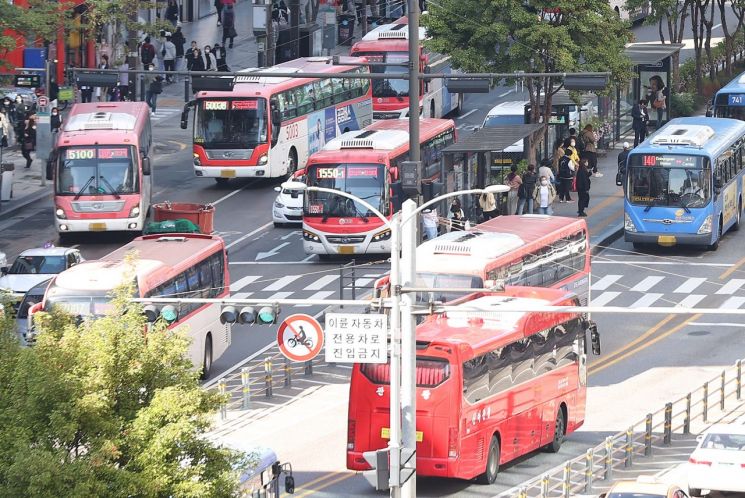
The Ministry of Land, Infrastructure and Transport's Metropolitan Area Wide-area Transportation Committee (MAWTC) held a press briefing at the Government Complex Sejong on the 2nd to announce the "Measures to Improve Transportation Convenience in the Southern Metropolitan Area."
About 7.61 million people, approximately 55.8% of Gyeonggi Province's total population, are concentrated in the southern region. Although there is railway infrastructure, many people use metropolitan buses. As of last year, the number of metropolitan bus users in southern Gyeonggi was about 329,000 per day, exceeding the combined total of northern, western, and eastern Gyeonggi (about 257,000). However, bus supply is insufficient, with a full capacity rate reaching 29.7%.
To address this issue, the Ministry of Land plans to gradually deploy 40 out of 50 available 71-seat double-decker electric buses this year to Yongin (14 buses), Suwon and Hwaseong (10 buses each), Ansan (3 buses), Siheung (2 buses), and Osan (1 bus). The additional metropolitan buses are expected to carry a total of 18,401 more passengers. The government will also promote the establishment of up to five new metropolitan bus routes in the southern region. These will be finalized after the route committee meeting next month.
Customized charter buses for commuting will also be added based on an analysis of public transportation users' destinations. A total of 211 trips will be deployed on 32 southern routes with high full-capacity rates during commuting hours. This accounts for about 82% of the 257 charter bus trips dispatched across the entire metropolitan area.
Among the metropolitan wide-area express trains (GTX) A line, which opened in March, connecting transportation will be expanded around Dongtan Station, where demand is high. Seven bus routes from the outskirts of Dongtan New Town to Dongtan Station (operating three trips each during commuting hours) will be added to improve accessibility to GTX-A. The Ministry of Land predicts that daily demand for GTX-A will increase by approximately 600 to 1,000 passengers as a result.
In addition, the Ministry of Land plans to introduce time-based bus-only lanes to ensure smooth bus operation. From the second half of next year, these lanes will operate during commuting hours on a 6.3 km, 8-lane round-trip section of Local Road No. 309, from Cheonggye IC to Gwacheon IC, a main arterial road between southern Gyeonggi and Sadang/Yangjae. This is expected to reduce commuting times by up to 24 minutes for 27 bus routes traveling to Sadang and Yangjae stations in the southern metropolitan area. Separately, Gyeonggi Province plans to gradually increase bus-only lanes in preparation for new town settlements in the southern metropolitan area after 2030. Additional new roads connecting the southern region and Seoul are also reportedly under consideration.
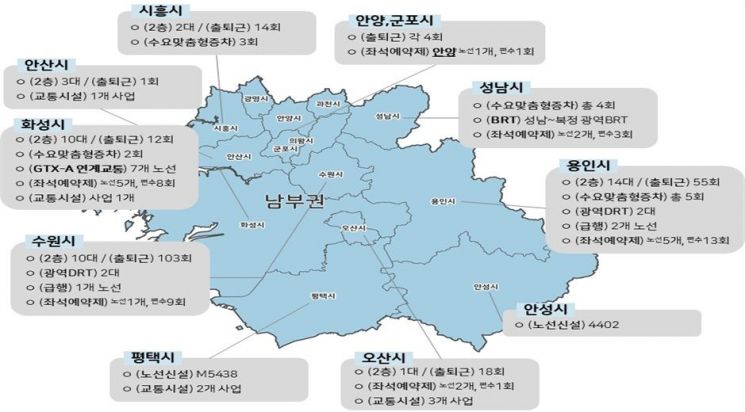 Measures to Improve Transportation Convenience in the Southern Gyeonggi Area / Image provided by the Ministry of Land, Infrastructure and Transport
The Ministry of Land will also introduce a Bus Rapid Transit (BRT) on the trunk route between the old city area of Seongnam (Namhansanseong) and Seoul's Bokjeong Station (10.2 km). This is expected to reduce travel times on a total of 67 bus routes by up to 14 minutes. The Ministry anticipates starting construction on the Seongnam BRT project within this year, with phased openings possible from next year.
Express buses, which stop only at major stops, will be introduced for the first time on one general metropolitan bus route in Suwon and two in Yongin. Travel times on these routes will be reduced by up to 30 minutes compared to existing routes. The number of metropolitan bus routes applying seat reservation systems will increase from 37 to 53, and the number of trips will rise from 81 to 118.
Bus routes will be dispersed and adjusted to alleviate congestion on metropolitan buses in major downtown areas of Seoul. Metropolitan bus routes passing through Myeongdong will have their turnaround routes and stops adjusted to reduce the number of buses passing through the congested Namdaemun Tax Office section from 143 to 106 per hour. Travel times between Seoul Station and Soonchunhyang University Hospital will be reduced by up to 8 minutes. For metropolitan bus routes passing through Gangnam, reverse-direction operation and curbside changes will reduce the number of buses passing through the central lane near Gangnam Station from 198 to 145 per hour. This will shorten travel time between Sinsa and Bangbang Intersection by 12 minutes.
Furthermore, the Ministry of Land will accelerate the concentrated investment projects in the southern metropolitan area announced at the transportation sector public discussion hosted by President Yoon Seok-yeol in January. The "Pyeongtaek Godeok District Concentrated Investment Project" (total project cost 292.3 billion KRW), delayed for years due to route conflicts and resident complaints, will begin construction in the second half of this year. Additionally, five key metropolitan transportation facility projects in Hwaseong Taean 3, Ansan Jangsang, and Osan Segyo 2 will be ordered and started within the year.
Kang Hee-eop, chairman of the Metropolitan Area Wide-area Transportation Committee, said, "Through these measures to improve transportation convenience, we hope residents of the southern metropolitan area commuting to Seoul can enjoy a convenient and comfortable commuting environment. We will also promptly prepare transportation measures for the northern and eastern regions to realize the promised '30-minute commuting era across the entire metropolitan area' made at the recent public discussion."
© The Asia Business Daily(www.asiae.co.kr). All rights reserved.

![Clutching a Stolen Dior Bag, Saying "I Hate Being Poor but Real"... The Grotesque Con of a "Human Knockoff" [Slate]](https://cwcontent.asiae.co.kr/asiaresize/183/2026021902243444107_1771435474.jpg)
















